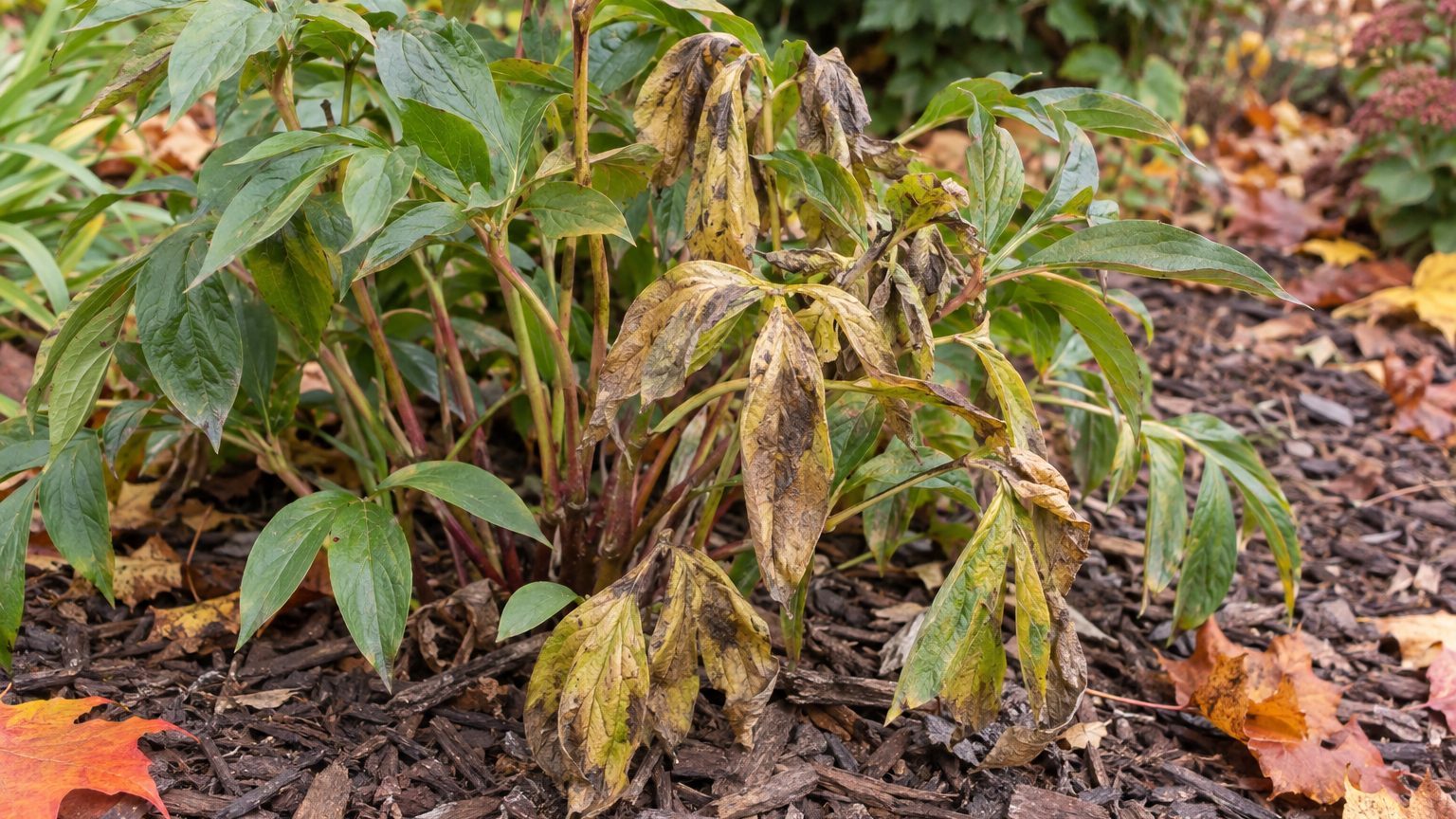
Some shoots on a peony wilt and droop while the rest of the clump looks fine. That lopsided collapse often comes from a fungus living in the soil, not from thirst. Once it is in the plant there is no fixing it, so the work is spotting it early, removing the plant and keeping the bed from reinfecting a replacement.
Verticillium Wilt: What You See

The clearest clue is a plant that looks sick above and sound below.
- Some shoots wilt while the base of the plant still looks perfectly sound.
- Cut a wilted shoot near the base and look at the cross section, where the water-conducting tissue inside the stem has turned brown.
- The wilting tissue soon yellows, then browns and dies.
- In California, shoots and branches are reported to die back, often starting on one side of the plant, and whole plants may die.
- A plant can carry the infection for a while before any symptom shows, as noted in Illinois.
When a clump droops unevenly, check the inside of a wilted stem near the base.
From the almanac
Peonies in your state
The dates on this page depend on where you live. Your state's page carries its frost dates, its USDA zones and the year laid out month by month.
Northeast
Southeast
- Alabama
- Arkansas
- Delaware
- Florida
- Georgia
- Kentucky
- Louisiana
- Maryland
- Mississippi
- North Carolina
- South Carolina
- Tennessee
- Virginia
- West Virginia
Midwest
Southwest
West
Pacific Northwest
Canada
Verticillium Wilt or Something Else?
Several ordinary problems make a peony wilt, and in Illinois they are known to be mistaken for this disease. A single droopy stem proves nothing, so pair what the foliage does with what the stem and soil tell you.
| Looks like | How to tell them apart |
|---|---|
| Seasonal die-back of foliage | Seasonal die-back affects foliage as the season ends; check a wilted stem for internal browning before deciding. |
| Drought | Check whether the soil is dry, then inspect a wilted stem for internal browning before deciding. |
| Too much soil moisture | Check whether the soil is waterlogged, then inspect a wilted stem for internal browning before deciding. |
Fusarium wilt, bacterial wilt and root rots can also look like this disease. A brown inner stem on a shoot that wilted while the base stayed sound points toward verticillium.
What Causes Verticillium Wilt, and Where It Is Worst
Two soil fungi cause it, Verticillium albo-atrum and V. dahliae. They enter through the roots, then grow inside the xylem, the tissue that carries water and nutrients up the plant. The plant’s own response plugs the xylem, which cuts off water and food and leads to wilt and poor growth.
The fungus does not leave when the plant does. V. dahliae forms tiny black resting structures that survive in soil for many years without a host. When a susceptible plant goes into that soil, they germinate and infect it.
Treat any bed with a history of the disease as infested.
How to Treat Verticillium Wilt
Verticillium is a destructive fungus that is nearly impossible to kill because it lives in the soil, so treatment mostly means confirming the problem and removing the plant.
- Cut a wilted shoot near the base and check the inside, so that you can see whether the water-conducting tissue has browned.
- Rule out dry soil and waterlogged soil, so that you do not dig up a plant that only needs better watering.
- Remove the infected plant and destroy it, but assume the fungus remains in the soil.
- Skip the idea of waiting out the fungus with a long rotation of other plants, since long rotations with nonsusceptible plants are not effective against it.
- Keep susceptible plants out of that spot, so that the resting structures in the soil have nothing to infect.
Confirm the diagnosis before removing the plant.
How to Prevent Verticillium Wilt Coming Back
Prevention is mostly about where you plant and how closely you watch, and it follows the growing season.
- As the shoots come up, look over each clump for a shoot that wilts while its neighbors stay firm.
- Before planting a new peony, avoid any bed with a history of verticillium wilt, since the fungus survives in soil for many years.
- Water evenly so that drought stress does not blur the picture when you diagnose a wilting stem.
- After removing a sick plant, wash your tools, so that you do not carry soil to the next clump.
After a peony dies from verticillium wilt, do not put another susceptible plant in that bed.
Where This Comes From
Common Questions
How Fast Does Verticillium Wilt Kill a Peony?
It depends on the plant. In California, small plants may die in a single season, while larger plants usually decline more slowly.
Can Irrigation Water Spread Verticillium Wilt?
The fungus produces spores called conidia that can travel in irrigation water, though they are not long-lived. The longer-lasting risk is the resting structures in the soil.
Which Other Garden Plants Get Verticillium Wilt?
Many flowers are susceptible, including dahlia, chrysanthemum, snapdragon, impatiens, phlox, poppy, delphinium, aster and bleeding heart. Some garden vegetables are also susceptible.