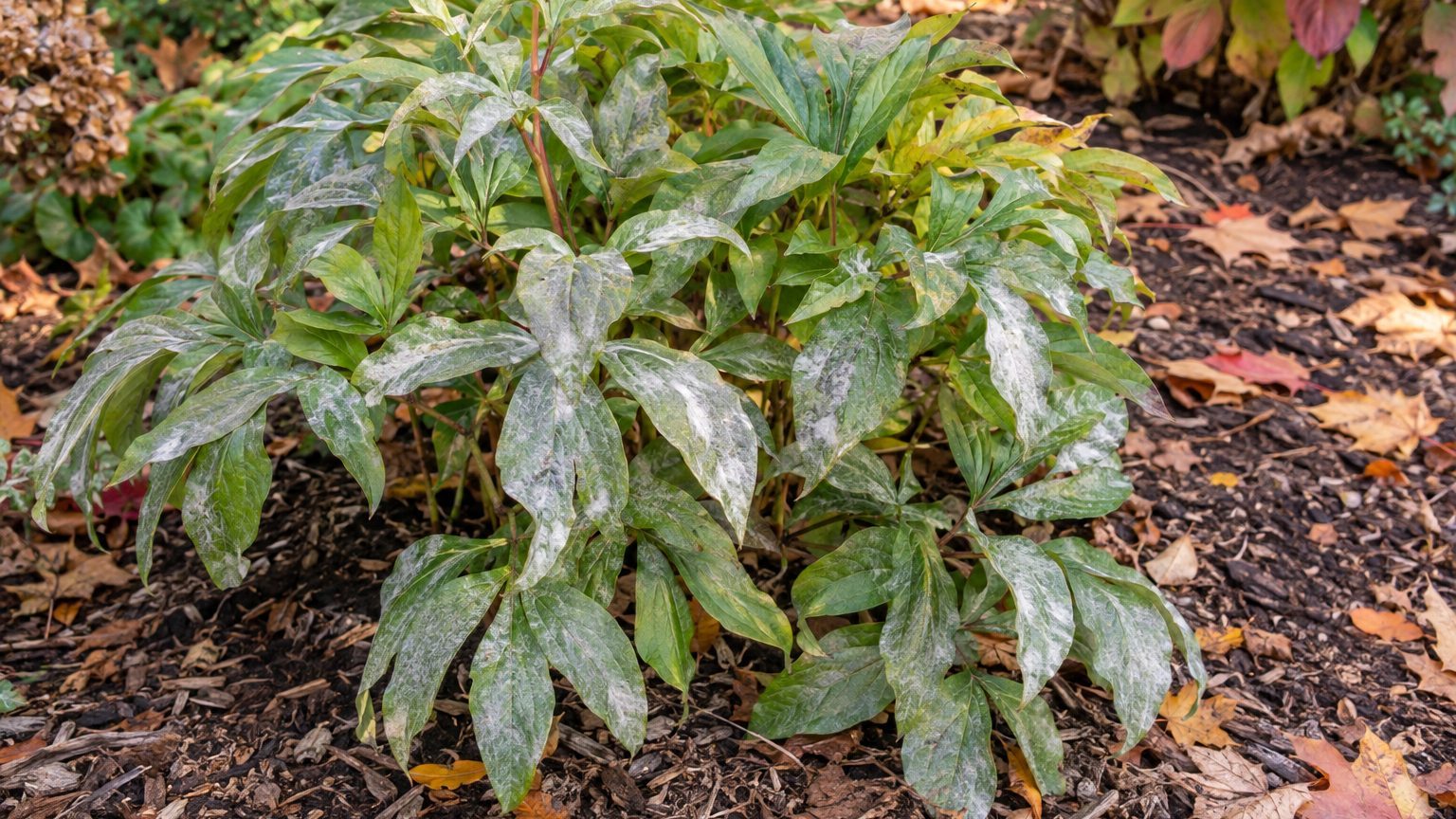
White patches on peony leaves, as if someone dusted the plant with flour, are a sign of a fungal disease that gardeners now meet more often than they used to. Powdery mildew on your peonies is easy to spot once you know the signs, but once it appears on the leaves there is little that a gardener can do.
Powdery Mildew: What You See

The disease announces itself on the leaves, and it changes fast once it starts.
- Small white spots appear on the leaves first, often looking like scattered snowflakes.
- The spots merge quickly until the whole leaf surface wears a white-to-gray powdery coating.
- The coating sits on the foliage and is easy to see, so a heavily affected plant looks dusted.
- It tends to show up later in the growing season, well after the plant has leafed out.
- Peonies in partial shade or in crowded spots with little air movement are more likely to show it.
Spotting those first white flecks early gives you a chance to act before the whole plant is coated.
From the almanac
Peonies in your state
The dates on this page depend on where you live. Your state's page carries its frost dates, its USDA zones and the year laid out month by month.
Northeast
Southeast
- Alabama
- Arkansas
- Delaware
- Florida
- Georgia
- Kentucky
- Louisiana
- Maryland
- Mississippi
- North Carolina
- South Carolina
- Tennessee
- Virginia
- West Virginia
Midwest
Southwest
West
Pacific Northwest
Canada
Powdery Mildew or Something Else?
Other things can leave pale or fuzzy marks on peony foliage, so check before you act. Pairing what you see with where it sits, or with a quick touch test, settles most doubts.
| Looks like | How to tell them apart |
|---|---|
| Dust or dried spray residue | Pale film that wipes off cleanly with a damp finger and often sits only on the leaves nearest a path, a hose spray or a treated area. Mildew leaves a growing coating that spreads from small spots. |
| Gray mold on buds and stems | Fuzzy gray growth with soft, collapsing tissue, mostly on buds and stem bases in damp spells. Mildew stays powdery and dry on the leaf surface. |
Brown or purplish blotches on the leaves are a different matter from mildew. They are spots in the leaf tissue, not a white powder lying on top of it. If a wipe test leaves the coating in place and the white growth is spreading across the leaf, you are dealing with mildew.
What Causes Powdery Mildew, and Where It Is Worst
A fungus in the Erysiphe group causes it. The spores are light and easily dislodged, so wind or splashing water carries them from leaf to leaf and from plant to plant. The fungus also overwinters on diseased plant material, which is how it returns to the same bed.
Conditions matter more than region here. Poor air movement and shade make the disease more likely, and peonies growing in partial shade get it more often than those in open sun. It is a common problem later in the growing season, especially on plants in too much shade with poor air circulation.
The disease is not tied to a single part of the country. Wherever a peony sits in a shady, closed-in corner, the risk goes up. Powdery mildew is also common on lilac and bee balm.
How to Treat Powdery Mildew
Once the coating is on the leaves, there is little a gardener can do to clear it, so the work is about limiting what comes next.
- Check the leaves closely and confirm the white coating is mildew, so that you are not treating dust or another problem.
- Scout the other peonies, since the spores travel easily from leaf to leaf by wind and water.
- Call or visit your state’s extension service to ask which fungicides are registered where you live, so that you use only what is legal and suited to your garden.
- Apply a fungicide before infection takes hold, at the first sign of mildew or ahead of it on plants that had it before, because it works as protection and not as a rescue.
- Move shaded peonies to a sunnier spot when they can be transplanted, since this often reduces mildew over time.
Always follow the label on whatever product your extension office points you to. A coating that has already covered the leaves will not turn green again, but you can keep it from reaching the next plant.
How to Prevent Powdery Mildew Coming Back
Prevention follows the calendar of the peony itself, from the first shoots to the final cleanup.
- In early spring, note which peonies sit in shade or in a crowded corner, since full sun with good air movement helps minimize the disease and those are the plants to move.
- As the shoots grow, keep neighboring plants from crowding the clumps so air can move through the foliage.
- Through the growing season, scout the leaves regularly, with extra attention in the later months when mildew tends to arrive.
- If mildew showed up the year before, ask your extension service about timing a preventive fungicide before infection, since that is when it can be effective.
- At the end of the growing season, cut the plants down to the ground, rake out all diseased material and keep it out of the compost pile.
Sanitation matters because the fungus overwinters on leftover leaves, so a clean bed starts next spring with far fewer spores.
Where This Comes From
The advice here draws on university extension guidance, including advice written for Illinois and Iowa. Your own state’s extension service can confirm the timing and the products allowed where you garden.
Common Questions
Does Powdery Mildew Mean the Peony Is Dying?
No. This foliar disease does not typically kill peony plants, though it makes them look rough.
Is Powdery Mildew New on Peonies?
It has become increasingly common in landscapes over the years. It was relatively rare on peonies until the last few years, which is why it is worth scouting for.
Can Powdery Mildew Spread from Other Plants to Peonies?
The spores move easily by wind and water, and the disease is common on plants like lilac and bee balm. Keeping an eye on your peonies helps you catch it early.