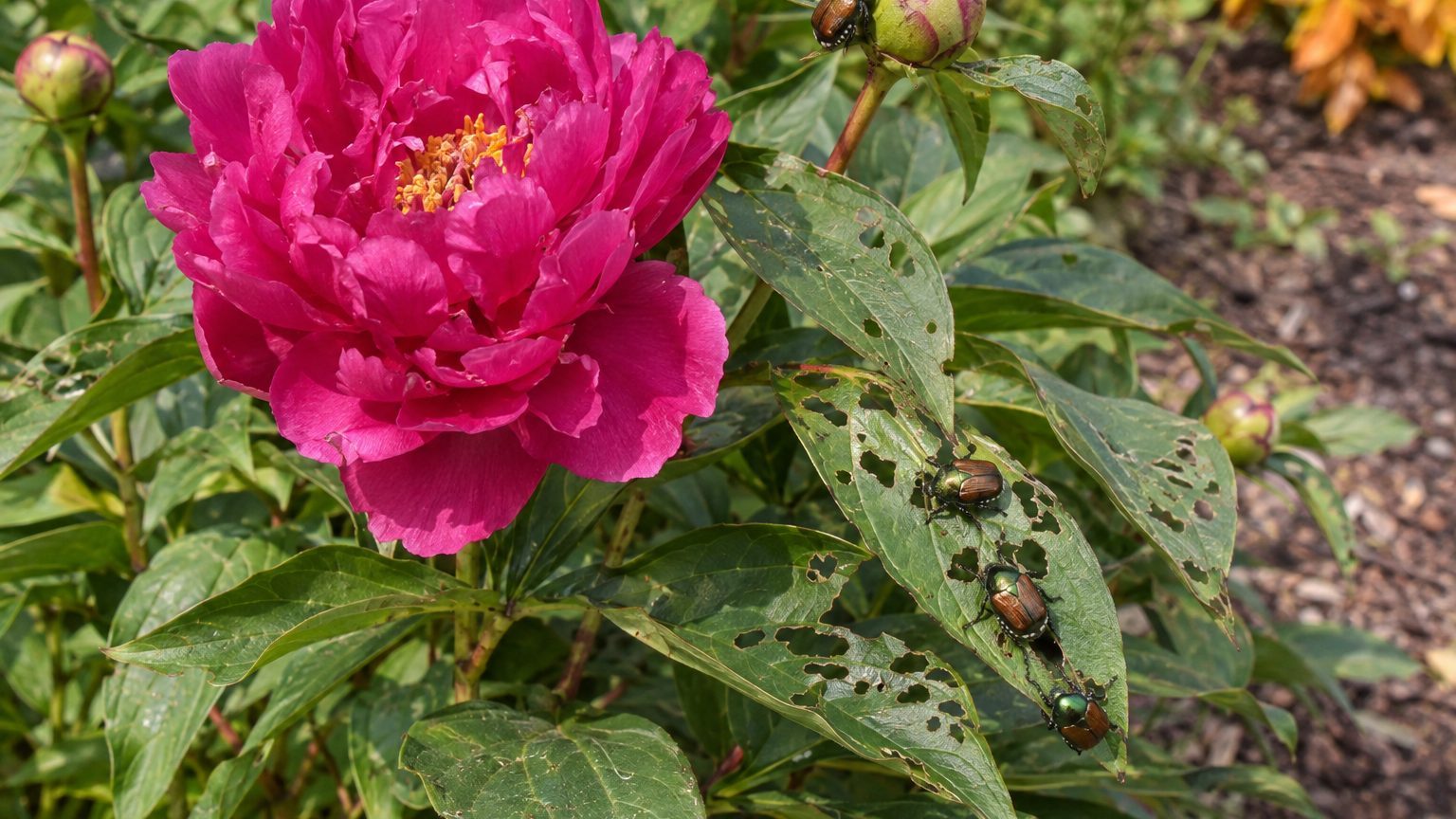
Metallic green beetles clustered on an open peony bloom, and leaves that look like lace by midsummer, point to Japanese beetles. They arrive after the main peony show is nearly over, but they find the last blooms and the foliage anyway. Handling them well comes down to knowing what they look like, what they are not, and when they feed.
Japanese Beetles: What You See

The damage is usually easier to spot than the beetle, so start with the leaves and blooms.
- Leaves turn lacelike, because the adults eat the tissue between the leaf veins and leave the veins standing.
- Beetles sit on open blossoms, since rose and peony blooms are especially susceptible.
- Flower buds get chewed too, and the adults also go after fruits, including overripe and decaying ones.
- Beetles gather on low plants early in the day, where they crawl up to warm their bodies before taking flight.
- In New Hampshire, adults emerge from the soil between the last week of June and early July, and feeding peaks from mid-July through August.
In New Hampshire, beetles may stay around until the first frosts of early fall.
From the almanac
Peonies in your state
The dates on this page depend on where you live. Your state's page carries its frost dates, its USDA zones and the year laid out month by month.
Northeast
Southeast
- Alabama
- Arkansas
- Delaware
- Florida
- Georgia
- Kentucky
- Louisiana
- Maryland
- Mississippi
- North Carolina
- South Carolina
- Tennessee
- Virginia
- West Virginia
Midwest
Southwest
West
Pacific Northwest
Canada
Japanese Beetles or Something Else?
Chewed peony foliage is not always the work of this beetle. Judge by the pattern of the damage and by the place and time you find the culprit, not by a single hole or a single insect.
The leaf pattern matters most. Lace with the veins left intact on leaves, along with beetles on open flowers, fits the beetle.
| Looks like | How to tell them apart |
|---|---|
| Disease spotting on leaves | Spots and blotches leave the leaf tissue whole and show no insects on the plant. Beetle damage removes tissue between the veins and the beetles are in plain sight on the leaves and blooms. |
| Bud damage from other chewing pests | Look at the buds and the foliage together. Beetles feed on both and leave lacy leaves, while a bud problem alone with clean foliage points elsewhere. |
Disease is a separate matter from beetles, and cultivar choice affects it. Among the cultivars tested, Festiva Maxima and Bowl of Beauty are less susceptible to disease, but that says nothing about beetle feeding.
What Causes Japanese Beetles, and Where It Is Worst
The adults come up out of the soil each summer, feed on the plants around them, and the cycle repeats. Those that emerge near your peonies find blossoms, buds and foliage within easy crawling distance.
Timing varies by place. In New Hampshire, adults emerge from the soil between the last week of June and early July and are most active from mid-July through August. Confirm local timing before planning control.
Peonies are also a favorite of the Tiphia wasp, which preys on beetle grubs. In that research, peonies were the most attractive ornamental tested as a nectar source and were not susceptible to Japanese beetle feeding; peony blossoms can still be susceptible. They help as one part of the solution, not the whole answer.
How to Treat Japanese Beetles
Work in this order, starting as soon as you see the first beetles on the plants.
- Check the plants early in the day, when beetles are sluggish and still warming up on low growth, so you can find them and reach them easily.
- Knock or pick the beetles into a container of soapy water, which removes them before they draw more beetles to the same blooms.
- Remove or cut off badly chewed blooms and buds, so the plant does not keep attracting more feeders.
- Clear overripe or decaying fruit from beneath and near the bed, since adults feed on it too.
- Check which products are approved where you live, because registrations differ from state to state.
Keep checking regularly through the peak weeks, because new adults keep arriving while the season runs.
How to Prevent Japanese Beetles Coming Back
Prevention follows the beetle’s year, and most of it happens before the adults show up.
- In early summer, before adults emerge, plan to watch the beds, since the first emergence falls between the last week of June and early July in New Hampshire.
- In New Hampshire, check peony foliage and any remaining blooms regularly from mid-July through August, when feeding is heaviest.
- In New Hampshire, keep an eye out for stragglers in early fall, since beetles can linger until the first frosts.
- Through the growing season, keep peonies in the garden to feed Tiphia wasps, which prey on the grubs, though this is only part of the answer.
Pick up fallen fruit and spent blooms as you go, so the beds stay less attractive to feeding adults.
Where This Comes From
Timing and treatment rules differ by state, so check local rules before you act.
Common Questions
Do Japanese Beetles Kill Peonies?
They damage leaves, buds and blooms, but those signs alone do not show that the plant is dying. That harms the plant’s look and its flowering. Peonies are susceptible to blossom feeding, so protect the blooms you want to keep.
Are Peonies Good for Beneficial Wasps?
Yes. Peonies provide nectar for the Tiphia wasp, which preys on Japanese beetle grubs. Planting them is one part of the solution, not a cure for every beetle problem.
When Do Japanese Beetles Show Up?
In New Hampshire, adults emerge between the last week of June and early July. Activity peaks from mid-July through August, and some may remain until the first frosts of early fall. Timing in your state may differ.