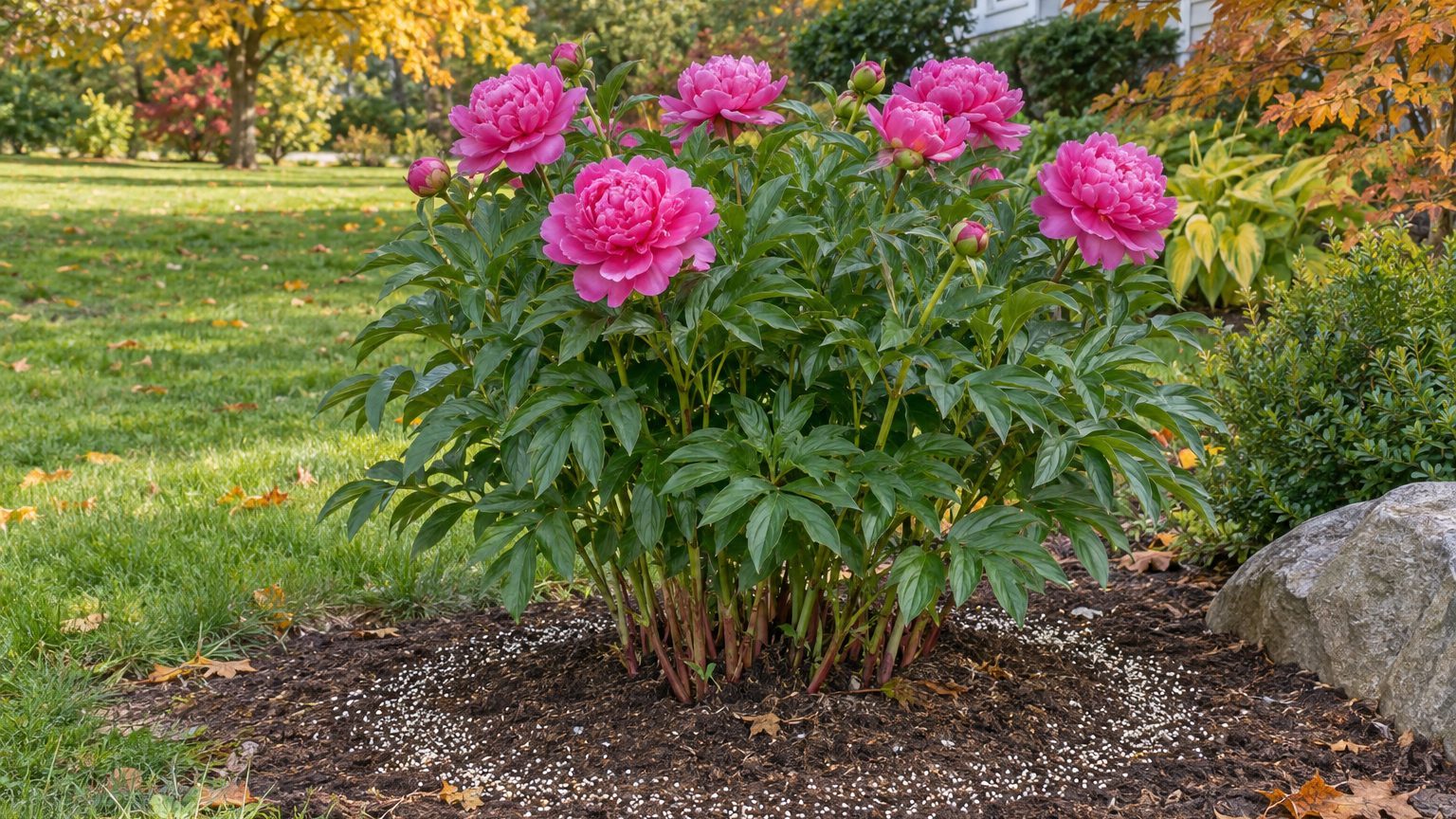
Red shoots pushing through cold spring soil are the signal that a peony is awake and ready for a modest meal. Fertilizer choice and placement vary by location and growing setup. Amounts and timing shift a little from state to state.
Do Peonies Need Fertilizer?
Established peonies need only a light feeding, and many bloom well on very little. How much you give depends on where you live and on whether the plant grows in a bed, a pot or a high tunnel.
In Indiana, a complete fertilizer can be applied annually. In Kansas the advice is to feed twice a year, in spring and fall. Local soil and climate make the difference, so a neighbor’s schedule in another state may not fit your yard.
Nitrogen is the nutrient to go easy on, because too much pushes leafy growth at the expense of flowers. The state selector just below this section takes you to the page for your state.
From the almanac
Peonies in your state
The dates on this page depend on where you live. Your state's page carries its frost dates, its USDA zones and the year laid out month by month.
Northeast
Southeast
- Alabama
- Arkansas
- Delaware
- Florida
- Georgia
- Kentucky
- Louisiana
- Maryland
- Mississippi
- North Carolina
- South Carolina
- Tennessee
- Virginia
- West Virginia
Midwest
Southwest
West
Pacific Northwest
Canada
How to Fertilize Peonies

Feeding goes in a set order, and each gesture either protects the crown or steers the plant toward flowers instead of foliage.
- Wait for the shoots to rise, so that the feed meets roots that are actively growing. In Utah, feed when stems stand 2 to 3 inches high; South Carolina uses the same stage, while North Dakota calls for early spring.
- Choose a low-nitrogen or balanced fertilizer, so that the plant builds buds rather than a thicket of leaves. A low-nitrogen analysis such as 5-10-10 is the pick in Utah. Kansas uses an even ratio, such as 10-10-10.
- Measure the dose for each plant, so that a generous scoop does not tip it into leaf growth. A quarter cup of complete fertilizer per plant is the amount in Iowa and Indiana. For Utah high-tunnel peonies and South Carolina garden peonies, use 2 to 3 pounds per 100 square feet.
- Scatter the fertilizer in a band out from the crown, so that the feeding roots reach it and the crown stays clear. Kansas advice puts the band 8 to 18 inches from the center of the plant. In Iowa, the rule is to keep fertilizer 6 inches from the crown.
- Scratch it in lightly and water, so that the granules dissolve and move down to the roots instead of sitting on the surface.
Kansas gardeners who feed twice a year use 1.5 to 2 ounces per plant at each feeding. Whatever the schedule, the aim is the same: enough phosphorus and potassium to support buds, and only a little nitrogen so the plant does not trade flowers for foliage.
Fertilizing Needs by Peony Type
The feeding itself stays light, but the way it is delivered shifts with how the peony is grown.
Garden beds, containers and high tunnels use different feeding methods.
| Peony Type | What changes | Why it matters |
|---|---|---|
| In-ground garden peony | A quarter cup of complete fertilizer per plant, scratched into the surface, in Indiana | Established roots search wide, so a small dose is enough |
| Container peony | Controlled-release feed mixed into the potting mix at low rates, with 9 lbs/yd³ giving a good balance in Virginia trials | A pot holds a small volume of mix, so the dose is set at planting |
| High tunnel cut-flower peony | A low-nitrogen feed over the soil surface at 2 to 3 pounds per 100 square feet in Utah | Closely planted rows are fed by area, not plant by plant |
For an in-ground peony, use the recommendation for your state rather than the container or high-tunnel rates. For container production in Virginia, incorporate controlled-release feed into the potting mix at a low recommended rate before potting. The high tunnel row matters mainly if you grow peonies for cutting.
Peony Fertilizing Mistakes to Avoid
Fertilizer Piled at the Crown

Fertilizer dumped against the stems can injure the crown, the knot of buds where next year’s shoots start. Spread it in a band out from the plant instead, and water it in so it does not sit in a concentrated pile.
Too Much Nitrogen

A high-nitrogen lawn product or an extra scoop gives you a big, lush clump with few flowers. Choose a low-nitrogen or balanced analysis and stick to the measured dose, even when the plant looks like it could use more.
Ignoring Slow Growth
A peony whose top growth slows and whose vigor fades may be short of phosphorus and potassium. In Missouri, slowing top growth and fading vigor can call for a complete fertilizer high in phosphorus and potassium, placed 6 to 18 inches from the crown. Skipping that step lets the decline continue.
When to Fertilize Peonies in Your State
The sign and timing to watch for depend on where the peony grows. Follow the feeding timing given for your location. The months for that moment differ from state to state, and each state’s page lays them out.
- Open the page for your state to find the local feeding months.
- Mark that month on the calendar and set the measuring cup beside the bag before the shoots break the soil.
Common Questions
Can You Use Manure on Peonies?
Yes, as a soil improver rather than a feed. In South Carolina, well-rotted manure is spread on the soil surface in a 1- to 2-inch layer, and North Dakota advice is the same for composted manure. Keep the layer back from the stems.
What Do the Three Numbers on a Fertilizer Bag Mean?
They give the percentages of nitrogen, phosphorus and potassium, in that order. A bag marked 5-10-10 has less nitrogen than phosphorus or potassium, which suits a plant grown for flowers. A bag marked 10-10-10 has all three in even amounts.
Is a Soil Test Worth Doing Before Feeding Peonies?
It is useful if the plant has been in the same spot for years. A test shows whether phosphorus and potassium are already high, in which case a lighter feeding will do. Follow the sampling and submission instructions provided by the soil-testing laboratory you choose.
Sources : hiddenspringspeonyfarm.com | americanpeonysociety.org