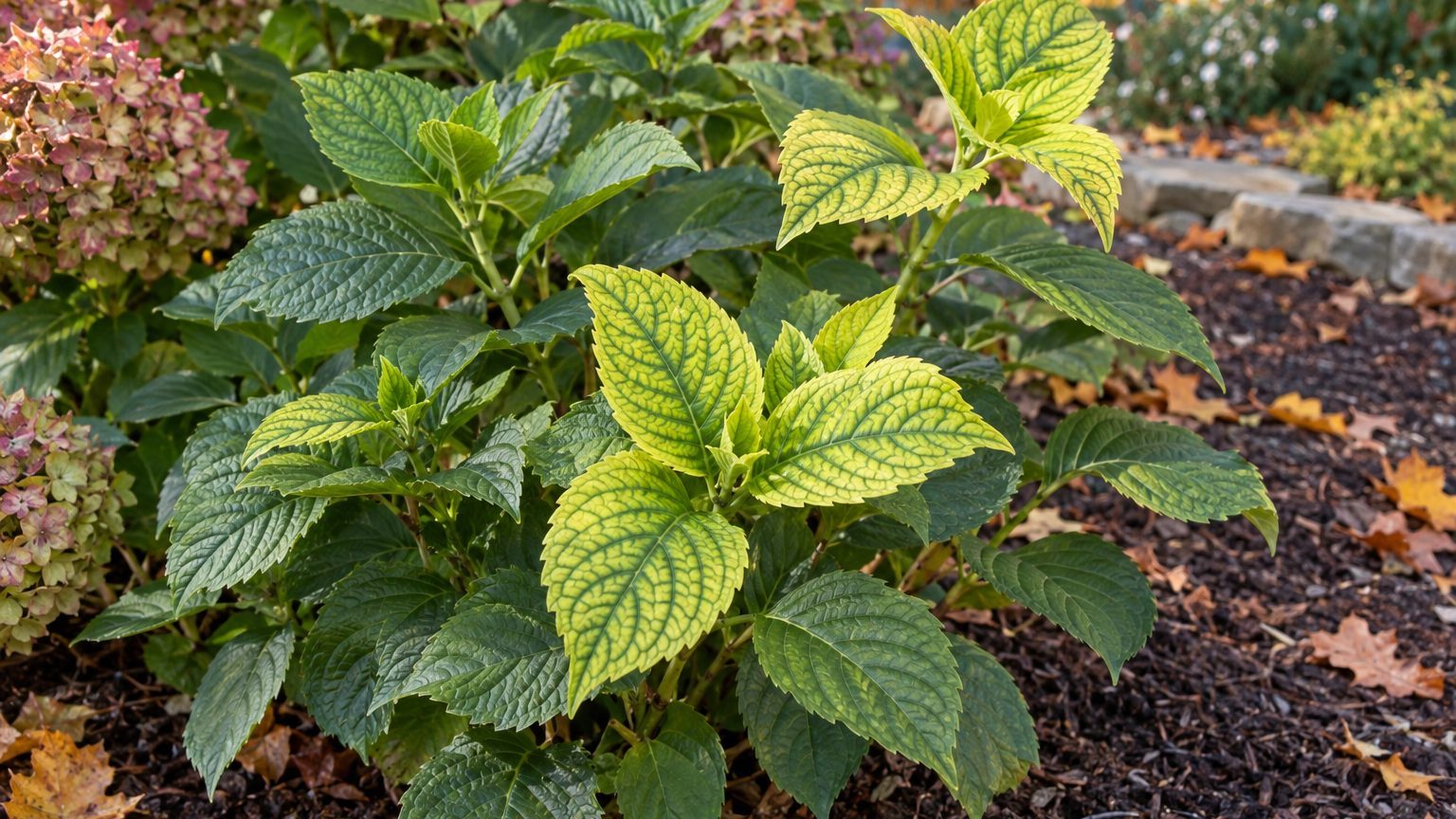
Yellow leaves with dark green veins point most often to a plant that cannot pull a mineral out of the soil, not to a lack of water or a disease. Soil pH is the usual suspect. Check what has been added to the bed and get a soil test before you buy any treatment.
Hydrangea Yellow Leaves With Green Veins: What You See

The NC State Extension Gardener Plant Toolbox rates growth as rapid for bigleaf and panicle types, and that pace is when the pattern shows most clearly. These are the signs to look for:
- Leaf blades turn pale yellow or lime while the veins stay dark green, like a green net on yellow cloth.
- The youngest leaves at the shoot tips often go first, and older leaves lower down stay greener.
- It appears in the growing season, when the shrub is making new leaves fast.
- Severe cases bring brown edges and small, sparse blooms.
- One shrub may be affected, or every plant sharing the same soil.
A plant with this pattern is usually still alive and growing. The trouble is that it cannot use what the soil holds.
From the almanac
Hydrangeas in your state
The dates on this page depend on where you live. Your state's page carries its frost dates, its USDA zones and the year laid out month by month.
Northeast
Southeast
- Alabama
- Arkansas
- Delaware
- Florida
- Georgia
- Kentucky
- Louisiana
- Maryland
- Mississippi
- North Carolina
- South Carolina
- Tennessee
- Virginia
- West Virginia
Midwest
Southwest
West
Pacific Northwest
Canada
Hydrangea Yellow Leaves With Green Veins or Something Else?
Yellow leaves have a long list of causes, and the green veins narrow it fast. The NC State Extension Gardener Plant Toolbox names leaf spot, bacterial wilt and powdery mildew as hydrangea diseases. It calls aphids, scales, nematodes and mites rarely a problem.
Look closely at one leaf before reaching for anything. Whether the green stays inside the veins or breaks into spots, powder or webbing is the sign that decides.
| Looks like | The sign that tells them apart |
|---|---|
| Leaf spot: yellow patches on the blade | Spots with their own edges, scattered across the leaf, instead of a clean green net along the veins |
| Powdery mildew: dull, pale leaves | A white-gray powder on the surface that rubs off on a finger |
| Mites: faded, yellowing leaves | Fine stippling on top and tiny specks or webbing on the underside |
Crisp brown margins are a separate problem, covered in Hydrangea Leaves Turning Brown: Causes and How to Fix It. Blooms lost after a cold snap belong to Hydrangea Frost Damage: Causes and How to Fix It. The rest of the family sits in Hydrangea Problems.
What Causes Hydrangea Yellow Leaves With Green Veins, and Where It Is Worst
The NC State Extension Gardener Plant Toolbox lists hydrangea soil pH from acid, below 6.0, to alkaline, above 8.0. The higher the pH climbs, the harder it is for roots to reach certain minerals. That is why the pattern tracks soil more than weather:
- Great Lakes and the North (Michigan, Minnesota, Wisconsin): panicle and smooth types dominate, and trouble usually follows lime added to lawns or beds.
- The South (Georgia, Texas, the Carolinas): bigleaf is the common type, and yellowing shows up where the soil sits on the alkaline side.
- Plains and Mountain West (Kansas, Nebraska, Colorado): soils there often run alkaline, and panicle, the only type that takes full sun well, is the usual choice.
- Anywhere a bed borders lawn care (any state): lime makes soil more alkaline, and high-phosphorus fertilizer locks aluminium up in the soil.
Your zone and hydrangea type change the details, so your state’s page in this series gives the local picture.
How to Treat Hydrangea Yellow Leaves With Green Veins
Start this week with looking, not buying. The NC State Extension Gardener Plant Toolbox puts acid soil below 6.0 and alkaline soil above 8.0, so the number on a soil test matters more than any guess.
- Name your type: write down whether it is bigleaf, mountain, panicle, smooth, oakleaf or climbing, since only bigleaf and mountain change flower color with pH.
- Compare new leaves with old ones: a green net on yellow tissue at the shoot tips confirms you are chasing a soil problem.
- Stop lime and high-phosphorus feed: lime raises pH, and high-phosphorus fertilizer locks aluminium up in the soil.
- Send a soil sample to your state extension service: read the pH against the 6.0 and 8.0 lines, then ask what is approved in your state to correct it.
- Mulch and keep water steady: bigleaf and panicle are shallow-rooted and benefit from mulch.
Skip kitchen remedies. The source says coffee grounds or citrus peel can acidify soil enough to turn flowers blue, but the pH shift is very small. What the plant needs is available aluminium, which acidity releases. Judge progress by new growth, since leaves already yellow rarely recover.
How to Prevent Hydrangea Yellow Leaves With Green Veins Coming Back
The NC State Extension Gardener Plant Toolbox rates hydrangea maintenance as low, which means prevention is mostly restraint, timed to the year.
- Late winter to early spring: send a soil sample before you feed anything, so you know the pH you are working with.
- Spring: lay mulch over the roots, since bigleaf and panicle are both shallow-rooted.
- Summer: water steadily in dry spells, because rapid growth in bigleaf and panicle needs a constant supply.
- Late summer: check that your lawn program is not sending lime or high-phosphorus fertilizer into the hydrangea bed.
- Fall and winter: cut hollow stems back to 12 to 24 inches and leave them standing for native bees, which nest in them.
Type and zone move these dates, so your state’s page sets the calendar for your yard.
Where this comes from
Hardiness ranges, soil pH limits, growth rates and the disease and pest lists come from the NC State Extension Gardener Plant Toolbox entry for Hydrangea. The diagnostic signs in the comparison table are general field cues, not extension figures.
Soil, lime rules and approved treatments differ from state to state. Confirm your test results and options with your state’s extension service before you change anything.
Common questions
Will the yellow leaves turn green again?

Rarely. Leaves that have yellowed usually stay that way, so watch the new growth. Fresh leaves coming in greener are the sign your fix is working.
Does this mean my hydrangea will change color?
Only if it is bigleaf or mountain. Those types go blue below about pH 5.5, pink above about pH 6.5 and purple in between. Panicle, smooth, oakleaf and climbing types do not shift color with soil.
Should I add fertilizer to green up the leaves?
Choose carefully. High-phosphorus fertilizer locks aluminium up in the soil, which pushes blue flowers toward pink. Get a soil test first and ask your extension service what suits your soil.