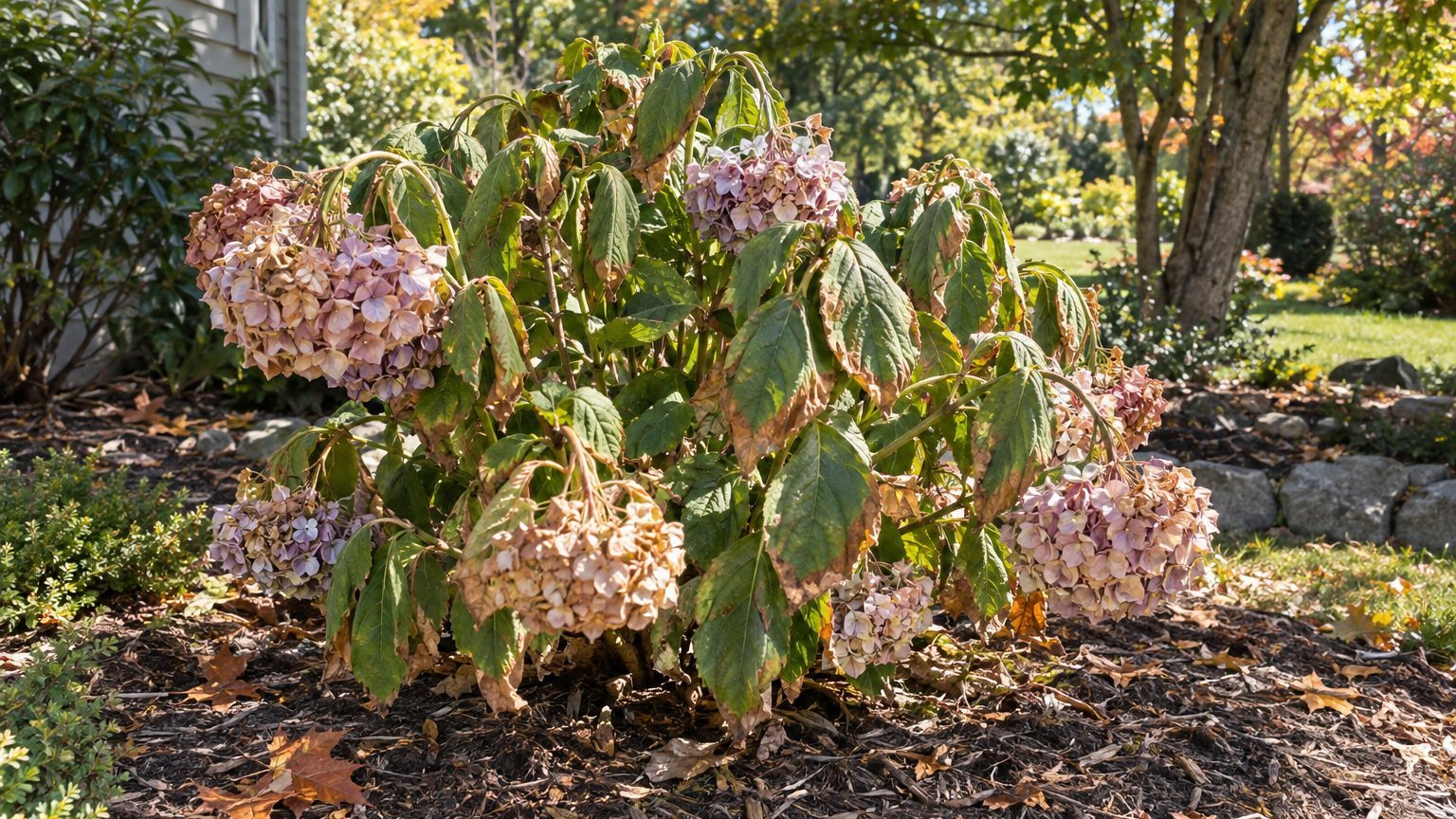
Hydrangea wilting in the heat usually means the plant is losing water faster than its shallow roots can supply it. Deep watering at the base, mulch and shade from afternoon sun fix most cases.
Which type you grow changes the answer. Bigleaf wants shade by afternoon, while panicle is the one hydrangea that takes full sun well.
Hydrangea Wilting in the Heat: What You See

The NC State Extension Gardener Plant Toolbox puts bigleaf hydrangea at 3-6 feet tall and wide, and a plant that size shows heat stress in a few clear ways:
- Leaves hang limp from the stems, most often from midday through late afternoon.
- Flower heads sag or nod, and the round mop-head or flat lacecap blooms look too heavy for their stems.
- Leaf edges turn crisp and brown, with tan patches on the side facing the afternoon sun.
- The plant looks fine at first light, then slumps again as the sun climbs.
- It shows up in a hot spell from early summer into early fall, and the soil under the plant is dry.
Panicle can droop the same way because it is shallow-rooted too, though it is the type built for full sun.
From the almanac
Hydrangeas in your state
The dates on this page depend on where you live. Your state's page carries its frost dates, its USDA zones and the year laid out month by month.
Northeast
Southeast
- Alabama
- Arkansas
- Delaware
- Florida
- Georgia
- Kentucky
- Louisiana
- Maryland
- Mississippi
- North Carolina
- South Carolina
- Tennessee
- Virginia
- West Virginia
Midwest
Southwest
West
Pacific Northwest
Canada
Hydrangea Wilting in the Heat or Something Else?
A limp hydrangea is not always a thirsty one. A few other problems droop leaves in summer, and each leaves its own trail.
The NC State Extension Gardener Plant Toolbox names bacterial wilt among the diseases of hydrangea and calls aphids, scales, nematodes and mites rarely a problem. Check the plant at dawn, because the morning tells the story better than the afternoon.
| Looks like | The sign that tells them apart |
|---|---|
| Bacterial wilt | Leaves stay limp at dawn even after a deep soaking the day before. |
| Soggy roots | The soil stays wet and heavy around the roots while the leaves droop. |
| Sun scorch | Crisp tan patches on sun-facing leaves that remain after the plant perks up at night. |
Spring cold that blackens new growth is a different problem, covered in Hydrangea Frost Damage: Causes and How to Fix It. The other kinds of trouble are on their own pages, starting from Hydrangea Problems.
What Causes Hydrangea Wilting in the Heat, and Where It Is Worst
Bigleaf and panicle are both shallow-rooted, says the NC State Extension Gardener Plant Toolbox, and a 3-6 foot bigleaf in afternoon sun loses water through its leaves faster than roots near the surface can replace it.
- Great Lakes and the North (Michigan, Minnesota, Wisconsin): panicle at 3a to 8b is the only hydrangea that takes full sun well, and smooth is the hardiest of the genus, so bigleaf is the type that needs afternoon shade.
- The South (Georgia, Texas, the Carolinas): bigleaf is listed at 6a to 11b, so it grows here, but it wants dappled sun or shade, and thin mulch over shallow roots shows quickly in a hot spell.
- Plains and Mountain West (Kansas, Colorado, Utah): sand is one of the three soils the source lists with clay and loam, and a shallow-rooted plant in fast-draining sand is the first to run dry.
Zone and type settle the rest, so the page for your state gives the answer that fits your yard.
How to Treat Hydrangea Wilting in the Heat
The NC State Extension Gardener Plant Toolbox asks that bigleaf be protected from afternoon sun, so the first week is about water at the roots and shade on the leaves.
- Water deeply at the base: soak the soil in the early morning until the ground under the mulch is moist, not just the surface, and keep the water off the leaves.
- Shade the afternoon side: hang shade cloth or set up a patio umbrella on the west side of a bigleaf, while a panicle in full sun needs water and mulch instead.
- Mulch the root zone: both bigleaf and panicle are shallow-rooted and benefit from mulch, so spread it wide and keep it off the stems.
- Check again at dawn: upright leaves mean the plant only outran the sun, and limp ones mean drainage needs a look before any more water goes on.
- Hold the pruners: bigleaf forms its buds the previous summer, so hard cuts in a heat spell risk next year’s flowers.
- Call the county extension office: if the plant stays limp at dawn with good drainage, they can confirm bacterial wilt and tell you what is approved in your state.
Skip fertilizer until the plant stands up on its own. A stressed hydrangea needs water, not a push.
How to Prevent Hydrangea Wilting in the Heat Coming Back
Prevention follows the calendar, and most of it happens before the first hot week arrives.
- At planting: give bigleaf dappled sun or shade away from the afternoon sun, and save full-sun spots for panicle.
- Early spring: spread mulch over the roots, since the NC State Extension Gardener Plant Toolbox lists both bigleaf and panicle as shallow-rooted plants that benefit from it.
- Late spring: start deep, slow watering at the base before the heat builds, so roots reach down instead of staying near the surface.
- Midsummer: check the soil during every hot spell and go easy on feeding, because heavy feeding pushes leaf over bloom, the pattern in Hydrangea Big Leaves No Flowers: Causes and How to Fix It.
- Late summer: leave bigleaf alone once your state’s pruning cutoff passes, because next year’s buds are forming now.
- Fall: top up the mulch so the shallow roots go into winter covered.
Your state page gives the exact dates for pruning and mulching in your zone.
Where this comes from
The types, zone ranges, root habit and disease list here come from the NC State Extension Gardener Plant Toolbox entry for Hydrangea.
Check timing, watering rules and any treatment with your state’s cooperative extension service. They know what applies in your soil and climate.
Common questions
Will a wilted hydrangea recover on its own overnight?
Often, yes. Heat-wilted leaves usually stand back up by dawn once the sun is off and the soil is moist. Leaves still limp at dawn after a deep watering point to drainage or one of the look-alikes above.
Should I cut off wilted leaves or stems?
No. The leaves shade the crown and roots. Bigleaf also forms its buds the previous summer, so cutting during a heat spell can cost you next year’s flowers.
Which hydrangea handles full sun best?
Panicle, the only hydrangea the NC State Extension Gardener Plant Toolbox says takes full sun well. Bigleaf wants dappled sun, partial shade or deep shade, with protection from afternoon sun.