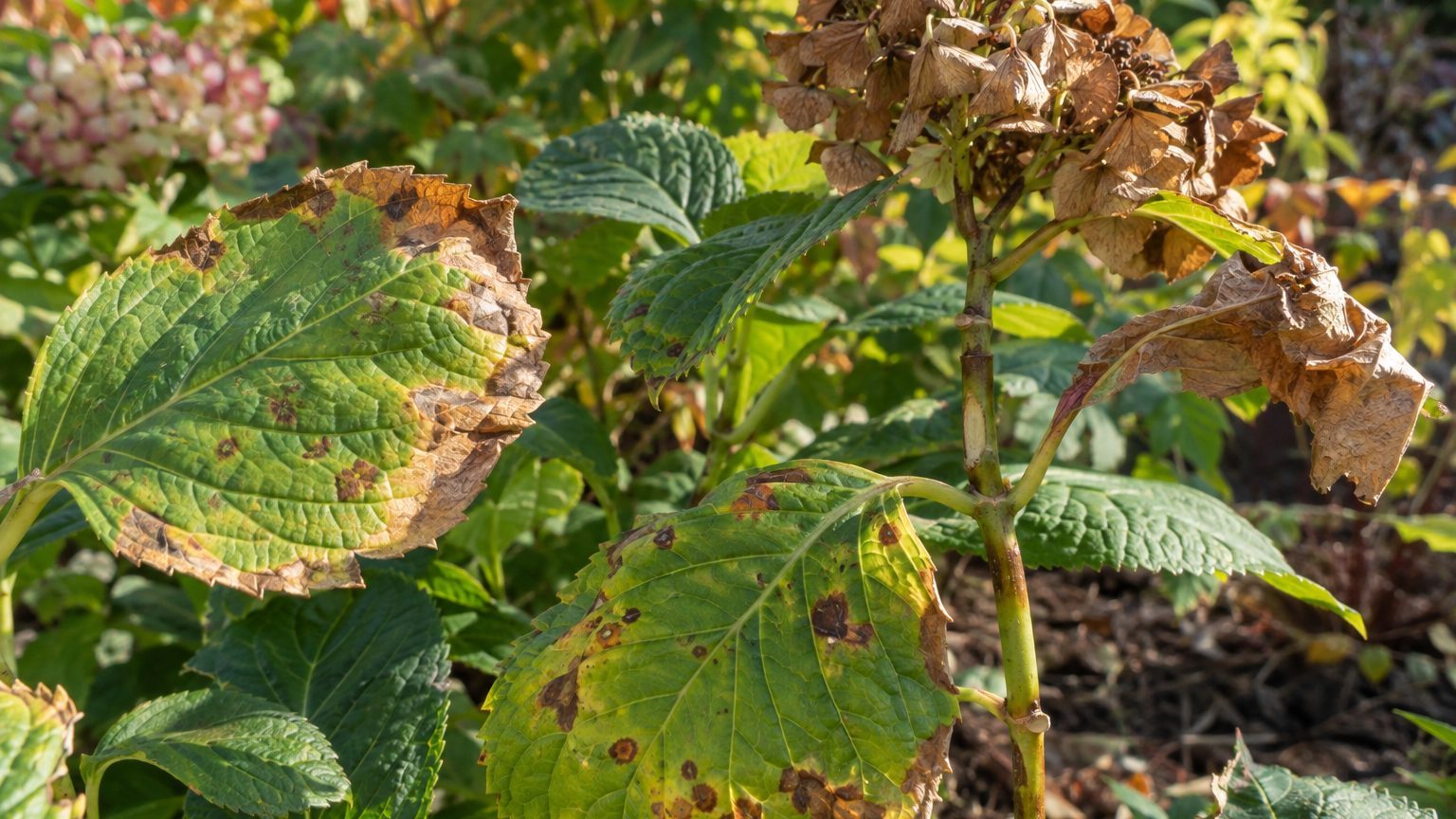
Brown leaf edges, spots or dried-out tops on a hydrangea usually trace back to one of four things: afternoon sun on a plant that wants shade, shallow roots running dry, frost on buds and young growth, or a leaf disease such as leaf spot. Which one you have depends on where the browning sits and on the type, because bigleaf, panicle and oakleaf do not want the same things.
Hydrangea Leaves Turning Brown: What You See

Browning shows up in a handful of distinct patterns, and the NC State Extension Gardener Plant Toolbox names leaf spot among the diseases that mark hydrangea foliage.
- Crisp, tan-brown edges on the leaves that face the afternoon sun.
- Brown spots scattered across the leaf blade, sometimes merging into patches.
- Papery, dried-out leaves at the top of the plant after a stretch of midsummer heat.
- Blackened buds and new shoots in spring, right after a late cold snap.
- Ragged, dried edges with torn bites, usually at deer height.
Timing matters as much as color. Wine-red autumn foliage on an oakleaf hydrangea is normal, so judge the pattern against the calendar before you worry.
From the almanac
Hydrangeas in your state
The dates on this page depend on where you live. Your state's page carries its frost dates, its USDA zones and the year laid out month by month.
Northeast
Southeast
- Alabama
- Arkansas
- Delaware
- Florida
- Georgia
- Kentucky
- Louisiana
- Maryland
- Mississippi
- North Carolina
- South Carolina
- Tennessee
- Virginia
- West Virginia
Midwest
Southwest
West
Pacific Northwest
Canada
Hydrangea Leaves Turning Brown or Something Else?
Brown is where several problems end up, and not all of them start with the plant. The NC State Extension Gardener Plant Toolbox lists deer as a damage agent, and hydrangeas do get browsed, so a chewed look deserves a close inspection.
Check the shape of the damage before you reach for a hose or a sprayer. The pattern on the leaf usually settles the question faster than guessing at the cause.
| Looks like | The sign that tells them apart |
|---|---|
| Scorched, limp leaves in a heat spell | Leaves droop by afternoon and stand back up by evening or after a deep watering. True browning does not reverse. |
| Fading, tan-yellow leaves | Veins stay green while the tissue between them turns yellow, then tan. |
| Dried, ragged leaf edges | Bites are torn and uneven, with tissue missing rather than dried in place. |
Limp leaves that perk up by evening are covered in Hydrangea Wilting in the Heat: Causes and How to Fix It.
Yellow tissue between green veins has its own sheet, Hydrangea Yellow Leaves With Green Veins: Causes and How to Fix It. The other look-alikes sit together under Hydrangea Problems.
What Causes Hydrangea Leaves Turning Brown, and Where It Is Worst
The NC State Extension Gardener Plant Toolbox rates bigleaf at USDA 6a to 11b and panicle at 3a to 8b, and most browning comes from a mismatch between type and place: bigleaf in hot sun, shallow roots drying out, or frost catching buds.
- Great Lakes and the North (Michigan, Minnesota, Wisconsin): bigleaf starts at zone 6a, so across much of this region frost-blackened buds and shoots are the likelier culprit. Panicle and smooth hydrangeas are the sturdier picks.
- Northeast and Mid-Atlantic (New York, Pennsylvania, Virginia): zones straddle the bigleaf line, so a late frost after buds swell can brown old-wood growth. The source calls panicle a good substitute for the mop-head hydrangea where that species is not winter hardy.
- The South (Georgia, Texas, the Carolinas): heat and afternoon sun scorch leaf edges on bigleaf, which needs protection from afternoon sun. Panicle is the only type that takes full sun well, and shallow roots on both dry out fast without mulch.
Your state’s page gives the zone and the calendar for where you garden, and the right answer changes with both type and zone.
How to Treat Hydrangea Leaves Turning Brown
The NC State Extension Gardener Plant Toolbox gives bigleaf 3 to 6 feet in height and width and asks for dappled sun, so this week’s job is matching that picture to what is growing in your yard.
- Name the type: bigleaf, panicle, smooth, oakleaf, mountain and climbing hydrangeas need different care, and every step below shifts with the answer.
- Read where the browning sits: edges on the sun side point to scorch, scattered spots point to leaf spot, and blackened tips after a cold snap point to frost.
- Cut the afternoon sun on bigleaf: shade cloth or a better-placed planting does more than extra water, while panicle is the one type that handles full sun.
- Water at the base and mulch: bigleaf and panicle are shallow-rooted, so mulch holds moisture where the roots sit, and the ground should drain well even if occasional wetness is fine.
- Pick off badly spotted leaves: bag them for the trash instead of the compost pile, and keep water off the foliage.
- Leave the stems alone: bigleaf, oakleaf, mountain and climbing types flower on old wood, so cutting away brown growth to tidy up can take next year’s flowers with it.
For anything that looks like leaf spot, powdery mildew or rust, ask your county extension office what is registered in your state before buying a spray. I am not naming a product here, on purpose.
How to Prevent Hydrangea Leaves Turning Brown Coming Back
The NC State Extension Gardener Plant Toolbox puts the genus at USDA zones 3a through 9b, but it depends entirely on the type, so prevention begins with matching type to zone and then follows the season.
- Late winter: cut panicle back hard, since it flowers on the current season’s growth, and leave old-wood types alone.
- Early spring: lay mulch over the shallow root zone before the first hot stretch arrives.
- Late spring: shade bigleaf from afternoon sun, or move it, once the frost risk in your area has passed.
- Summer: water at the base during dry spells, in the morning, so leaves dry quickly.
- Late summer: rake up fallen spotted leaves so disease has less to overwinter on.
- Autumn and winter: leave hollow stems standing, cut to 12 to 24 inches when you do tidy, so native bees can nest in them.
Pruning dates for old-wood types vary by state, so take those from your state page.
Where this comes from
Type, zone, sun and disease details here come from the NC State Extension Gardener Plant Toolbox entry for Hydrangea.
Local conditions change the answer, so check the timing and any treatment with your state’s cooperative extension service. They know what is registered and what works in your county.
Common questions
Is a hydrangea with brown leaves dying?

Usually not. Scratch a stem with a thumbnail, and green tissue underneath means the wood is alive. Leaves can brown and drop while buds and roots stay sound.
Does soil pH turn hydrangea leaves brown?
Soil pH moves flower color, and only on bigleaf and mountain hydrangeas. Blue shows below about pH 5.5 and pink above about pH 6.5. Panicle, smooth, oakleaf and climbing types do not change with pH at all.
Are the brown leaves a risk to pets?
Only H. macrophylla is documented as toxic, and only when large quantities are eaten, with nausea, stomach pain, vomiting and sweating. The concern extends to cats, dogs and horses. Fallen browned leaves carry the same compounds as green ones, so rake them up if animals roam your yard.