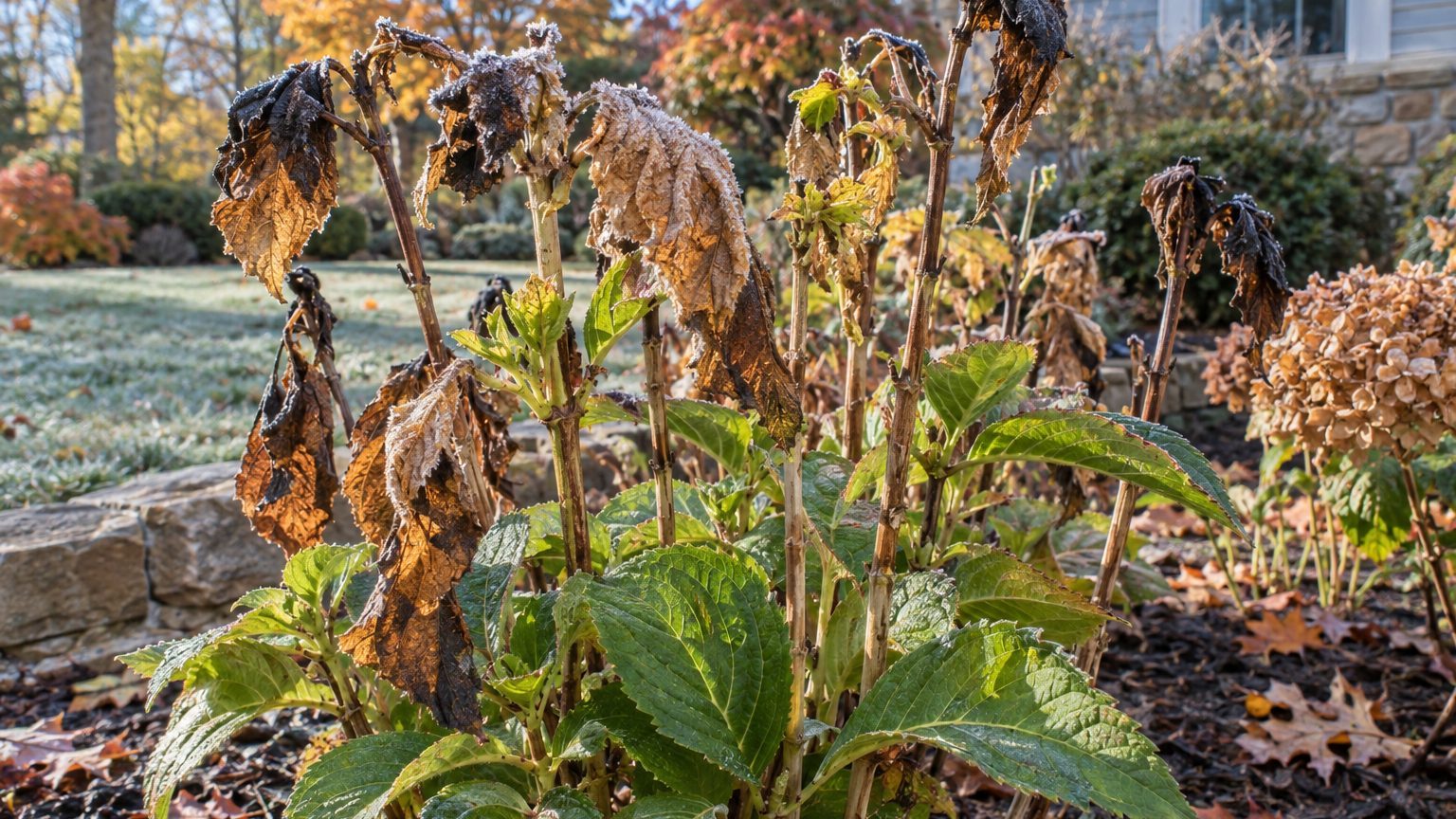
A late frost rarely kills a hydrangea. It burns the new leaves and, on types that flower on last year’s wood, can wipe out the season’s blooms.
Your type decides how much you lose, and your zone decides how often it happens. Bigleaf pays the highest price. Hydrangea Problems covers the other troubles.
Hydrangea Frost Damage: What You See

The NC State Extension Gardener Plant Toolbox puts bigleaf hydrangea at USDA 6a to 11b, and it is the type that shows frost injury most, because its flower buds form the previous summer.
- Shoot tips and soft new leaves turn dark brown or black within a day or two of a cold night in spring.
- Leaves that had just unfurled go limp, then dry to a papery crisp.
- Stems leaf out normally but carry no flower buds at the tips, so the plant stays green and never blooms.
- Canes look dead from the tips downward while fresh shoots push from the base.
- Late-forming flowers open small, twisted or brown at the edges.
Panicle and smooth hydrangeas can lose leaves the same way but still flower, since they bloom on the current season’s growth.
From the almanac
Hydrangeas in your state
The dates on this page depend on where you live. Your state's page carries its frost dates, its USDA zones and the year laid out month by month.
Northeast
Southeast
- Alabama
- Arkansas
- Delaware
- Florida
- Georgia
- Kentucky
- Louisiana
- Maryland
- Mississippi
- North Carolina
- South Carolina
- Tennessee
- Virginia
- West Virginia
Midwest
Southwest
West
Pacific Northwest
Canada
Hydrangea Frost Damage or Something Else?
Frost gets blamed for damage it did not cause. The NC State Extension Gardener Plant Toolbox lists deer, leaf spot and, on panicle, bud blight among the troubles hydrangeas meet. A spring prune also strips flowers from bigleaf as surely as a frost does.
The tell is pattern. Frost hits the newest, most exposed growth all at once after one cold night. The look-alikes follow a cut line, a browsing height or individual leaf spots.
| Look-alike | Looks like | The sign that tells them apart |
|---|---|---|
| Spring pruning | Healthy green stems with no flower buds | Stem tips end in a clean cut, and the leaves are undamaged |
| Deer browsing | Missing shoot tips and buds | Stems look torn or chewed, and the damage stops at one height |
| Leaf spot | Brown patches on leaves | Distinct spots on otherwise healthy leaves, not whole tips blackening together |
A plant that droops on hot afternoons is another matter, covered in Hydrangea Wilting in the Heat: Causes and How to Fix It. The other problems are on their own pages.
What Causes Hydrangea Frost Damage, and Where It Is Worst
A late frost hits after buds have formed on last year’s wood, and the NC State Extension Gardener Plant Toolbox rates the genus at USDA 3a through 9b, though the answer depends entirely on the type.
- Great Lakes and the North (Michigan, Minnesota, Wisconsin): panicle and smooth, which flower on new growth, cope best, and the source calls panicle “a good substitute for the mop-head hydrangea in areas where that species is not winter hardy”.
- Northeast and Mid-Atlantic (New York, Pennsylvania, Maryland): bigleaf grows here, but a hard cold snap after leaf-out costs it flower buds.
- The South (Georgia, Texas, the Carolinas): bigleaf sits well inside its range, so the risk is a warm spell that starts growth before one last cold night.
Your state’s page in this series gives the zone and timing for its reference city.
How to Treat Hydrangea Frost Damage
This week the job is to read the damage, not to cut it away.
- Name your type: bigleaf, mountain, oakleaf and climbing flower on old wood, while panicle and smooth flower on new wood.
- Wait for new growth: leave burned stems alone until leaves show where living wood ends, because pruning an old-wood type in spring removes flowers.
- Cut only what stays dead: trim back to living tissue, and remember panicle takes a hard cut because it flowers on current growth.
- Leave some hollow stems: the NC State Extension Gardener Plant Toolbox says native bees nest in dead hollow stems, so cut them to 12 to 24 inches and leave them standing.
- Water and mulch the roots: bigleaf and panicle are both shallow-rooted and benefit from mulch, so keep the soil evenly moist.
If the plant leafs out but never flowers, see Hydrangea Not Blooming: Causes and How to Fix It. For anything to spray or feed, ask your state extension service what is registered locally.
How to Prevent Hydrangea Frost Damage Coming Back
Prevention follows the calendar, and the NC State Extension Gardener Plant Toolbox lists panicle at USDA 3a to 8b against 6a to 11b for bigleaf.
- Summer, right after bloom: prune old-wood types then, so the next buds form undisturbed.
- Late fall: mulch the shallow roots and leave the canes of old-wood types intact.
- Late winter: cut panicle back hard, since it blooms on new growth, and check your state page for timing.
- Early spring: watch the forecast and cover plants with a sheet or frost cloth on nights that threaten a freeze.
- Planting time: in cold-edge yards, choose panicle or smooth, the hardiest of the genus, or mountain, whose buds take late frost better than bigleaf.
Covering the plant for one night costs almost nothing, and it can save a whole season of flowers.
Where this comes from
The plant types, hardiness ranges and flowering habits here come from the NC State Extension Gardener Plant Toolbox, Hydrangea entry.
Timing and zones vary by state and city. Check with your state’s extension service before you cut, spray or plant.
Common questions
Will my hydrangea bloom after a late frost?

It depends on the type. Bigleaf and lacecap flower on last year’s wood, so a late frost can remove the blooms. Panicle and smooth flower on current growth and usually still bloom.
Is a frost-damaged hydrangea dead?
Usually not. Brown tips and blackened leaves look grim, but buds lower down or at the base often survive. Wait for new leaves before cutting anything.
Which hydrangea handles cold best?
The NC State Extension Gardener Plant Toolbox calls smooth hydrangea the hardiest of the genus, and rates panicle at USDA 3a to 8b. Mountain hydrangea buds also take late frost better than bigleaf.