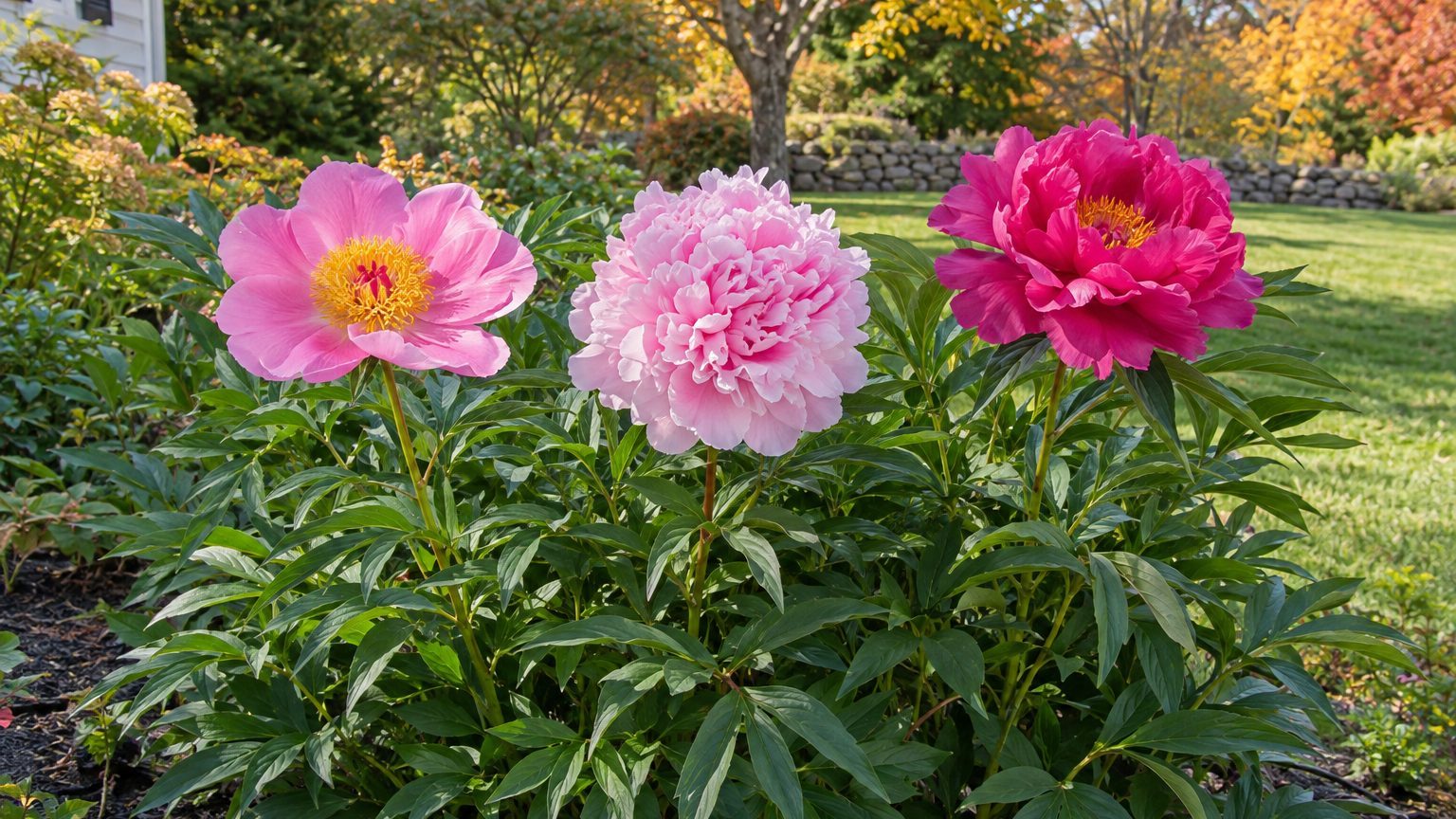
Herbaceous peonies vanish to bare ground each winter and push up fresh stems in spring, while tree peonies keep woody branches through the cold months. Itoh peonies sit between them, with the big flowers of a tree peony on a plant that dies back like a garden peony. Size, bloom timing and staking differ among these types.
What Are the Main Types of Peonies?
Across the country, peonies fall into herbaceous, tree and Itoh (also sold as intersectional) types, with fern-leaf and woodland peonies as smaller specialty groups. The general rule is simple: herbaceous types die back and regrow, tree types stay woody, and Itoh types die back but bloom later. Climate changes how tall each one gets and how long the show lasts.
Herbaceous peonies are the familiar garden peony, with thick, bushy foliage that dies back to the ground each winter. Tree peonies are shrubs in everything but name. Itoh hybrids borrow from both parents, and fern-leaf and woodland types stay small.
The state selector just below this section leads to the page for your state, where timing is written for your climate.
From the almanac
Peonies in your state
The dates on this page depend on where you live. Your state's page carries its frost dates, its USDA zones and the year laid out month by month.
Northeast
Southeast
- Alabama
- Arkansas
- Delaware
- Florida
- Georgia
- Kentucky
- Louisiana
- Maryland
- Mississippi
- North Carolina
- South Carolina
- Tennessee
- Virginia
- West Virginia
Midwest
Southwest
West
Pacific Northwest
Canada
How to Tell Peony Types Apart

Start with the plant itself, then match it to the space and the bloom season you want. These steps go in the order you would actually use them, whether you are shopping or identifying a plant already in the yard.
- Look at the plant in winter, so that you know the type before spring. Bare ground where the plant stood means herbaceous or Itoh, while bare woody branches still standing mean a tree peony.
- Measure the height you have room for, so that the plant does not crowd the window or the walkway. In Pennsylvania, tree peonies run 3 to 7 feet, herbaceous types 2 to 4 feet, and fern-leaf types stay under about 2 feet in Iowa.
- Measure the width too, because peonies are wider than people expect. In Pennsylvania, most have a spread of at least 3 to 5 feet, and in South Carolina a mature herbaceous peony covers about 3 to 4 feet.
- Decide how you feel about staking, so that heavy blooms do not end up in the mud after rain. Mature tree peonies in Indiana usually go without stakes because woody branches carry the flowers, while herbaceous types often need a support ring.
- Choose cultivars that open at different times, so that the show lasts. In Illinois, mixing early, mid-season and late cultivars stretches bloom over a 4- to 6-week period.
Bloom size is the last clue. Tree peony flowers in Washington can be 7 to 10 inches across, a good reason to give them a spot where they can be seen from the house and have room to spread.
Peony Types Compared by Peony Type
The figures below come from Pennsylvania, where height ranges are given for each type side by side. Other states report slightly different numbers, because soil, sun and winter cold all shift how large a plant gets.
Bloom order comes from Connecticut, where Itoh hybrids open after the herbaceous types finish.
| Peony Type | What changes | Why it matters |
|---|---|---|
| Herbaceous | Grows 2 to 4 feet tall and dies back to the ground each winter | Leaves a gap in the bed from late fall until spring shoots appear |
| Tree | Reaches 3 to 7 feet with woody branches that stay through winter | Needs a permanent spot with room overhead and little staking once mature |
| Itoh (intersectional) | Stays 2 to 2.5 feet tall and blooms after herbaceous types in Connecticut | Fits smaller beds and extends the season past the garden peony |
For most yards, the choice comes down to how much winter structure you want. Tree peonies give a shrub shape in a bare bed, while herbaceous and Itoh plants leave open ground. Woodland peonies, about 1 to 1.5 feet tall in Pennsylvania, suit shade edges and small corners, and fern-leaf peonies work in front-of-bed spots where a big mound would block the view.
Peony Selection Mistakes to Avoid
Planting a Tree Peony Too Close to the House
Tree peonies in Washington reach heights of 7 feet and spread 4 or 5 feet, which is far more than a young plant in a nursery pot suggests. Crowded against a wall or walkway, the shrub gets shaded and shoved around. Mark the full mature footprint on the ground before you dig, and leave that space clear.
Treating Every Peony Like a Garden Peony

A tree peony does not die back, so cutting it to the ground in fall, as you would an herbaceous plant, removes the woody framework that carries next year’s flowers. Learn which type you own from the stems in winter. Cut herbaceous stems down after they die back, and leave tree peony wood standing.
Choosing One Bloom Time
Buying several plants of the same cultivar means they all flower at once and then the bed sits green. Instead, pick early, mid-season and late varieties, and add an Itoh if you want bloom after the garden peonies finish. A planting mixed this way keeps color going far longer than a single block of one kind.
Best Peony Types for Your State
The sign that points you to the right type is what the plant does in winter: bare ground or standing woody stems. Match that to the height and bloom season you want, then check the planting and care months for your state.
- Your state’s page gives the months for planting and caring for peonies in your climate, so open it before you buy.
- Go there while the bare stems still show which type you are working with.
Common Questions
Is a Tree Peony Actually a Tree?
No. Tree peonies are shrubs, and in South Carolina they grow about 4 to 5 feet tall under normal conditions. The woody stems are the reason for the name.
Which Peony Types Bloom First?
In Connecticut, the white woodland peony opens first, followed by tree peonies, then herbaceous types, and finally the intersectional hybrids. Planting a few from each group gives you flowers over a long stretch of late spring.
How Tall Do Fern-Leaf Peonies Get?
In Iowa, fern-leaf peonies are often the smallest peony type and rarely reach more than 2 feet. That makes them a good fit near a walkway or at the front of a bed, where a taller peony would block the view.
Sources : rhs.org.uk