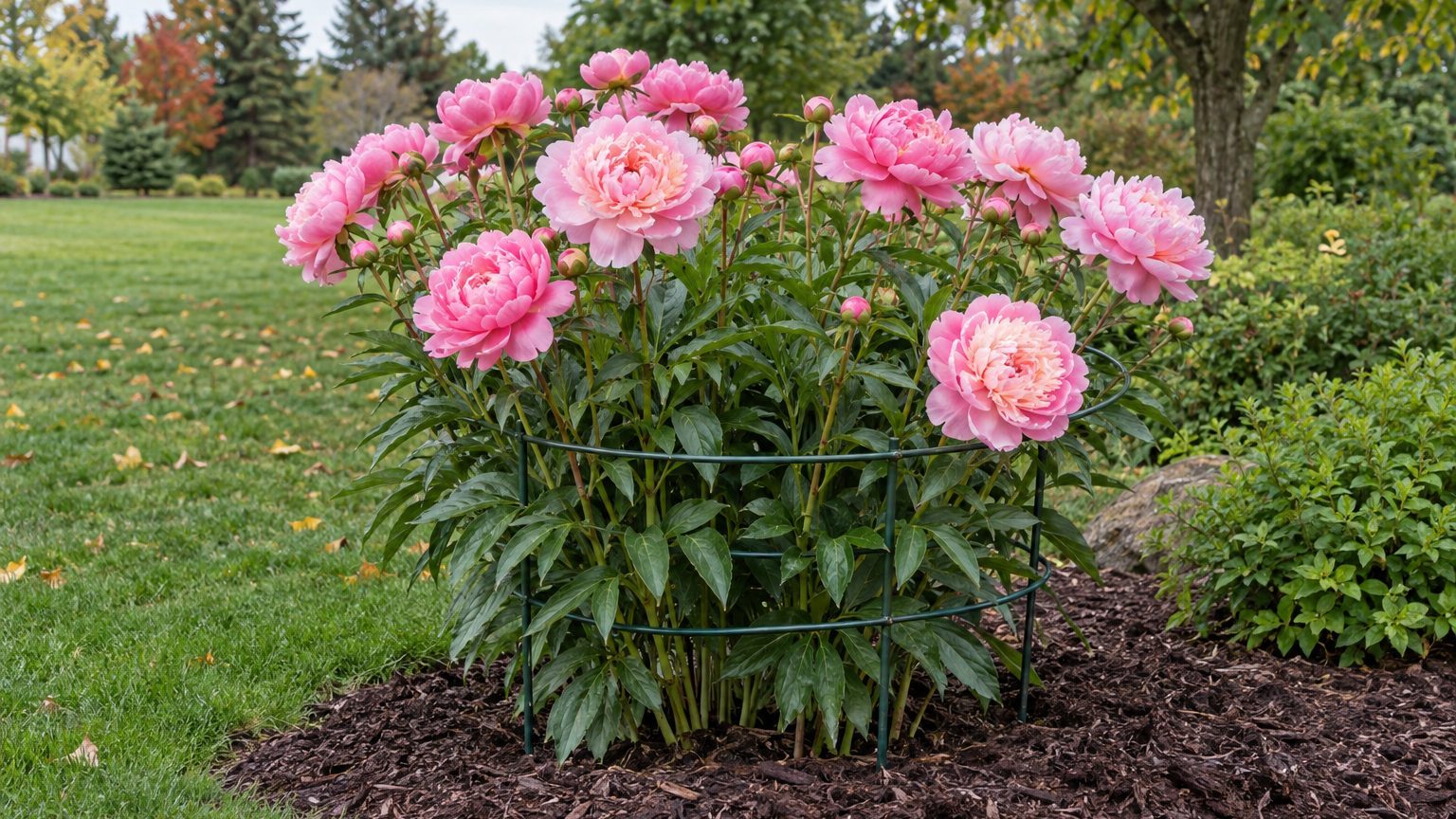
Peony stems can look sturdy early in the growing season, then rain in bloom season can bend them to the mud. The fix goes in before the flowers do. Staking peonies means setting a ring, grid or stake system around the clump while the shoots are still short, so the stems grow up through it and carry the heavy blooms.
Do Peonies Need Staking?
Many garden peonies with big, full flowers do, and heavier blooms are more likely to need support. Climate changes the picture too, because a wet spring or a windy site loads the flower heads with water and pulls stems down.
Type matters as well. In Kentucky, plants with single flowers do not need staking. In Pennsylvania, tree peonies with healthy, mature stems usually go without. Double-flowered herbaceous types are the ones that tend to need help.
The state selector just below this section takes you to the page for your own state.
From the almanac
Peonies in your state
The dates on this page depend on where you live. Your state's page carries its frost dates, its USDA zones and the year laid out month by month.
Northeast
Southeast
- Alabama
- Arkansas
- Delaware
- Florida
- Georgia
- Kentucky
- Louisiana
- Maryland
- Mississippi
- North Carolina
- South Carolina
- Tennessee
- Virginia
- West Virginia
Midwest
Southwest
West
Pacific Northwest
Canada
How to Support Peonies

The order matters more than the hardware, because a support that goes on early lets the plant grow into it and hide it.
- Pick a grow-through support, such as a metal hoop or ring, so that the stems rise inside it and lean on it as they thicken. Iowa gardeners set these over the plants in early spring.
- In South Dakota, watch for new shoots to poke through the soil, then set the support over the clump before the stems grow tall.
- Use stiff wire fencing if you prefer to make your own, since a couple of feet of height is plenty in Iowa and keeps the frame low enough to disappear behind the foliage.
- Push a stake in behind the plant if you tie with twine loops, so that the loops have something solid to pull against. In Kansas, a 2-by 2-inch stake is the suggested size.
- In Iowa, look the frame over as the flower buds form and adjust any loops or ties so the stems stay upright as the buds swell.
Ready-made rings are easy to find. In Kansas, a common size stands 30 inches high. The top ring measures 18 inches across, and the lower ring measures 14 inches, which leaves a cage that narrows toward the base and holds the stems together as they open.
Support Needs by Peony Type
Peonies are not all alike. Flower form is what decides how much help a plant wants, because large, full blooms weigh more and soak up more rain.
Gardeners with a mixed bed can treat each type a little differently instead of caging everything.
| Peony Type | What changes | Why it matters |
|---|---|---|
| Herbaceous and Itoh | Stake early in the growing season (advice from Colorado) | The flowers are very heavy and tend to hold water and flop over |
| Double-flowered | Many must be staked or supported (advice from Iowa) | Full blooms are the ones that flop when open |
| Single-flowered | No staking needed (advice from Kentucky) | Skipping support saves effort and keeps the plant looking natural |
| Tree peonies | Healthy, mature stems usually go unstaked (advice from Pennsylvania) | Woody stems carry the flowers without a frame |
Sort plants by flower form before deciding which ones need support. In Iowa, support double-flowered peonies; in Colorado, support herbaceous and Itoh peonies; Kentucky single-flowered plants need none, and mature Pennsylvania tree peonies usually go without.
Peony Support Mistakes to Avoid
Putting Support in Late

Once stems are tall and the buds are fat, a ring has to be forced down over them, and stems snap or end up pushed to one side. In North Dakota, gardeners install supports in early May, before the plants get too large.
If you missed the window, tie loose loops around the clump on a stake instead of forcing a ring over it.
Relying on Twine Alone

A loop of twine around a clump cuts into stems as the weight of the blooms grows, and the whole bunch tips outward in a storm. A stake hidden behind the plant gives the loops something to pull against, as the Kansas advice describes.
Tie the loops loosely and adjust their height as the stems grow.
Skipping Support After a Dry Spring
A dry spring can lull you into thinking staking is optional. But in Kentucky, large blossoms tend to bend over onto the ground after a spring rain. The blooms can bend onto the ground after rain.
Make support a yearly habit, set up each spring whatever the forecast, as the Kansas advice recommends.
When to Support Peonies in Your State
The sign to watch for is new shoots pushing up through the soil in spring. That is the moment to set the frame, and the exact months shift from state to state.
- The page for your state gives its months for staking, so open it before the shoots appear.
- Use that page again when buds begin to form, to check whether your supports still match the plant’s height.
- Keep the hoops or stakes stored where you can find them, so they are in hand when the shoots show.
Common Questions
Can You Use a Cattle Panel to Support Peonies?
Yes. In South Dakota, woven wire or a piece of cattle panel is recommended, suspended about a foot above the ground by surrounding stakes. The stems grow up through the openings and spread their weight across the grid.
Is It Too Late to Stake Peonies Once the Buds Have Formed?
Not necessarily. In Iowa, staking as the flower buds form can still keep the blooms upright, though earlier is easier. Move gently, since swollen buds on long stems break easily.
Why Do Peony Stems Bend Even When the Plant Is Healthy?
Healthy plants flop too. In Indiana, the large blooms are heavy, and the long stems cannot carry that weight alone. Rain-filled flowers and a gust of wind add to the load, as in Arkansas, where blooms fall over when filled with rain or hit by heavy wind.
Sources : gardensillustrated.com | thepeonyfields.com | longfield-gardens.com