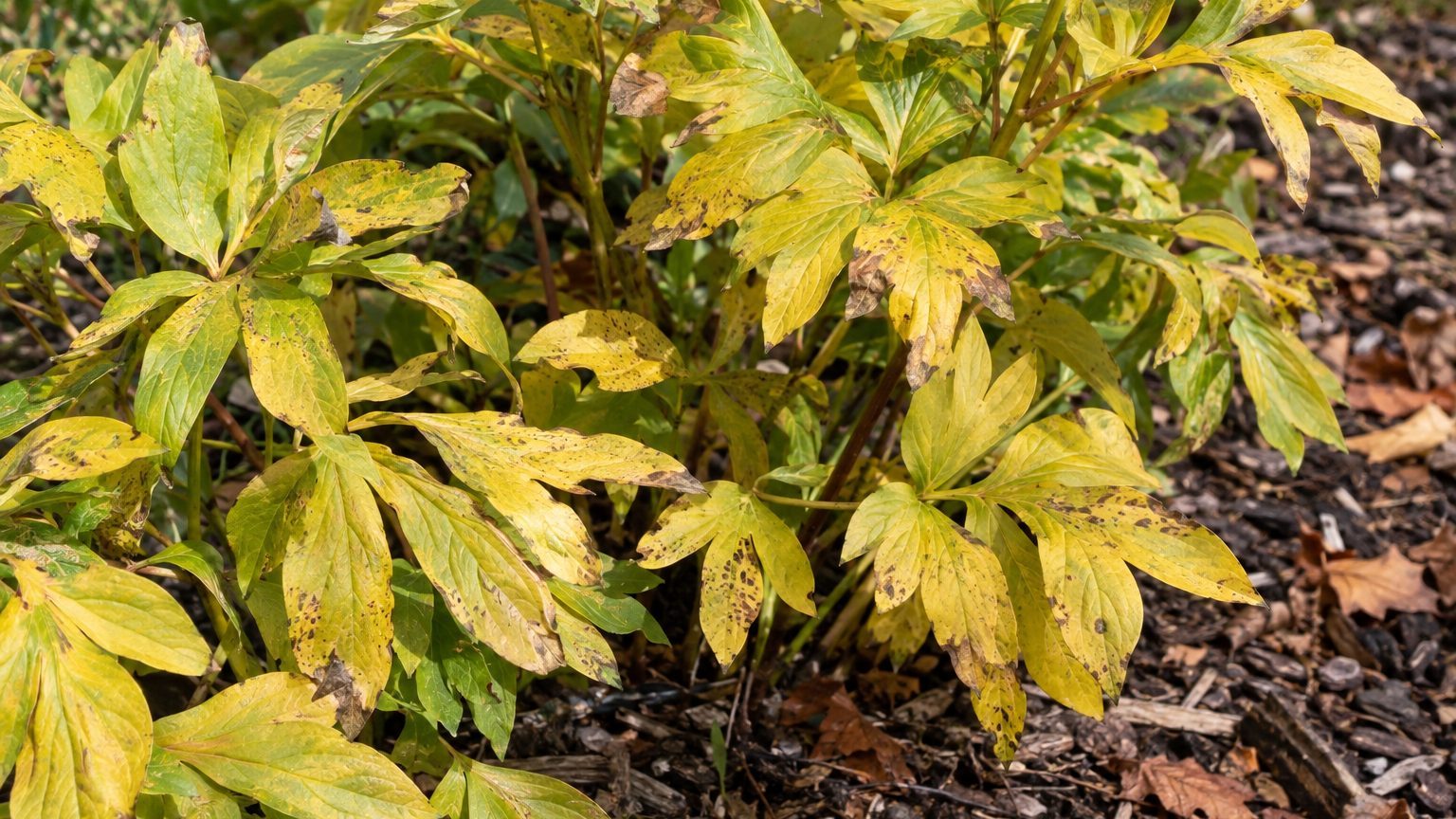
Yellowing leaves can reflect disease or poor nutrition, so the pattern matters more than the color alone. Spots, blotches, or a powdery coat suggest a fungal problem, while narrow yellow leaves without spots may point to a need for fertilizer. Which one it is depends on the shape of the yellow and where it sits on the plant.
Peony Leaves Turning Yellow: What You See

The pattern on the leaf tells you more than the color alone, so start by looking closely at a few affected leaves.
- Wedge-shaped sections of a leaf turn yellow, then reddish-purple, with the colored area stopping at the major leaf veins.
- The lower leaves go first, though the change can spread to the entire plant.
- Glossy, purplish-brown spots show on the upper side of the leaf, while the underside carries chestnut-brown spots.
- Occasional dead brown spots appear, and the damage is often heavier at the margins of the outer leaves.
- In Minnesota, this is most common from late summer to early fall.
Leaves that yellow with a little brown at the edge and look narrow, on a plant with otherwise healthy stems, point in a different direction than leaves carrying distinct spots.
From the almanac
Peonies in your state
The dates on this page depend on where you live. Your state's page carries its frost dates, its USDA zones and the year laid out month by month.
Northeast
Southeast
- Alabama
- Arkansas
- Delaware
- Florida
- Georgia
- Kentucky
- Louisiana
- Maryland
- Mississippi
- North Carolina
- South Carolina
- Tennessee
- Virginia
- West Virginia
Midwest
Southwest
West
Pacific Northwest
Canada
Peony Leaves Turning Yellow or Something Else?
Several peony problems start with yellow leaves but are different troubles. A close look at the leaf surface and the pattern of color sorts them out quickly.
Mosaic is a virus marked by yellowish blotches, rings, or target patterns, and affected plants are not noticeably dwarfed or deformed.
| Looks like | How to tell them apart |
|---|---|
| Mosaic virus | Conspicuous yellowish blotches, rings or target patterns on the leaves, with plants not noticeably dwarfed or deformed |
| Powdery mildew | Powdery white mold on the leaves, which may be deformed, turn yellow and drop early (described in Texas) |
| Alternaria leaf spot | Irregular brown, purplish or reddish spots, with leaves that yellow, wither and fall early (described in Texas) |
Mosaic is a mild disorder that seems to spread slowly, if at all, but a plant that has it should not be divided to make new plants. Leaf blotch is the other usual suspect, and it is covered below.
What Causes Peony Leaves Turning Yellow, and Where It Is Worst
A common cause is Cladosporium leaf blotch, a fungus also called red spot or measles. Warm, humid weather gives it ideal conditions for infection. The names reflect the symptoms, from blotches on leaves and stems to small red spots.
Early on, reddish-purple spots appear on the upper leaf surface and on stems. Eventually the spots merge into large, glossy, dark-purple blotches, light brown or brownish-gray underneath. On stems, merged spots form long, reddish-brown streaks. The disease is a common one in Indiana.
The fungus overwinters on plant debris and tends to be present every year once it has occurred. The fungus can return from infected plant debris left around the peony. A peony with narrow yellow leaves and no spots may just need fertilizer, but it could have a disease, particularly if its stems turned black near the ground the year before.
How to Treat Peony Leaves Turning Yellow
Work in this order, and match the action to what the leaves show.
- Inspect the spots on both sides of several leaves, so that you can tell blotch, mildew or mosaic apart before doing anything else.
- Inspect affected stems as well as the leaves before choosing a treatment.
- Collect and destroy fallen leaves around the plant, because the fungus overwinters on debris.
- Open up the spacing around crowded plants, so that air moves through the foliage and the leaves dry faster.
- Fertilize if the leaves are yellow and narrow with no spots, since a hungry plant can look like this.
- Remove the plant if it looks diseased through and through, such as with black stems near the ground and repeated yellowing.
A few fungicides are labeled for peonies for leaf blotch, but they must go on early and often to protect leaves before infection, not after the disease shows.
How to Prevent Peony Leaves Turning Yellow Coming Back
Prevention follows the season, and most of it is cleanup and airflow.
- Check the spacing between plants and thin out neighbors that crowd the peony.
- As new growth emerges, protect leaves early if you plan to use a labeled fungicide, since it works before infection and not after.
- During warm, humid weather, watch the lower leaves for spots.
- In Minnesota, inspect the lower leaves from late summer to early fall, when this yellowing is most common.
- After the leaves drop, collect and destroy all fallen leaves and debris so the fungus has nowhere to overwinter.
The fungus overwinters on plant debris, so cleanup can reduce material that carries it into the next growing season.
Where This Comes From
Disease timing can vary by place, so compare the symptoms with conditions in your yard.
Common Questions
Can You Divide a Peony That Has Mosaic?
Propagating diseased plants should be avoided. Mosaic is a mild disorder, but propagation of diseased plants should be avoided.
Will Leaf Blotch Come Back Every Year?
It tends to, because the fungus overwinters on plant debris and is usually present each year once it has occurred.
Should You Remove a Peony with Yellow Leaves?
Not at first. Fertilizing is worth a try, but a plant that is truly diseased may need to be removed.