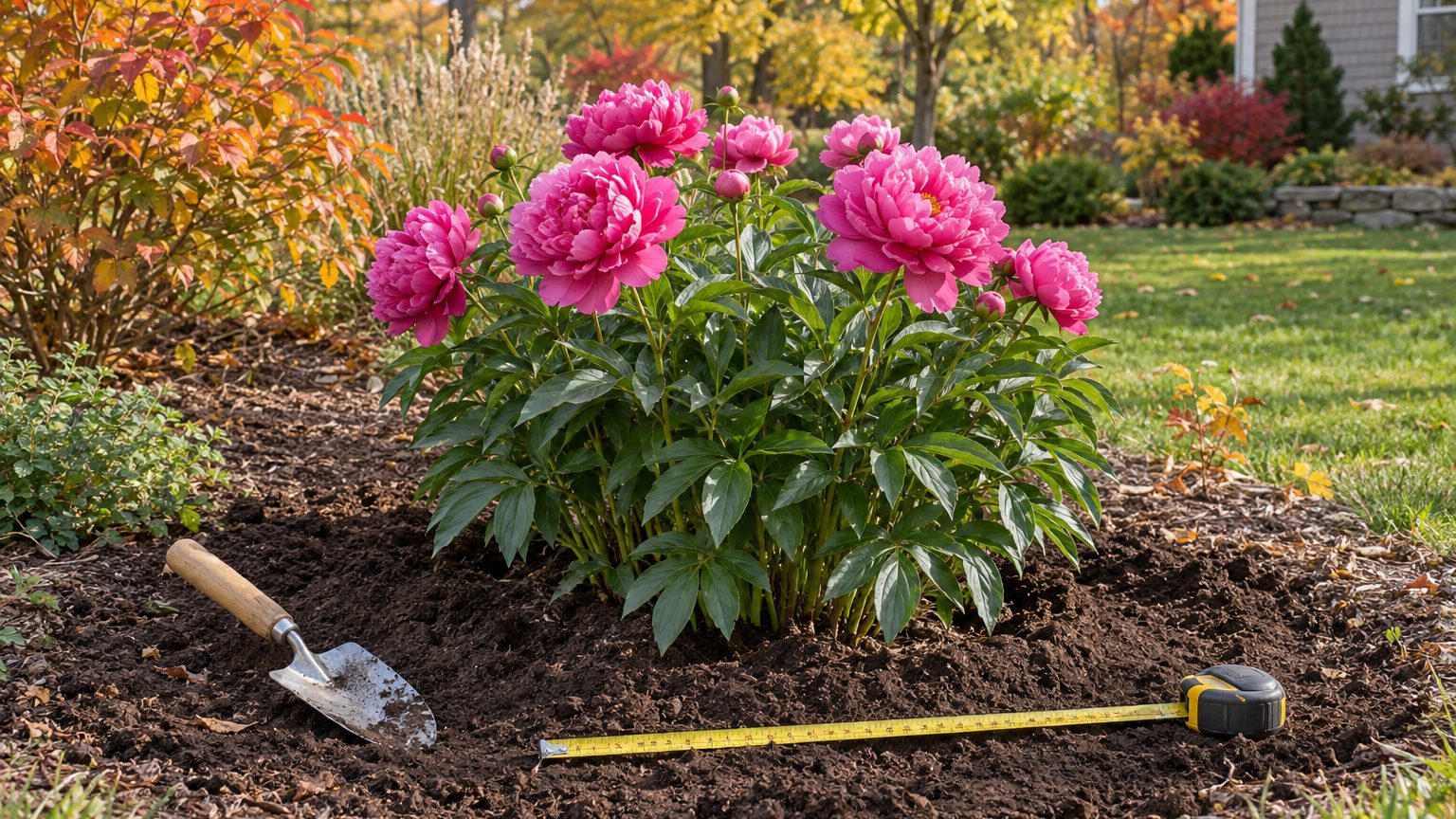
A peony can stay in the same spot for many years, so choosing the site carefully pays off. Pick a place with open sun, soil that drains after a storm, and enough room that air moves through the leaves.
Where Is the Best Place to Plant Peonies?
Across the country, the answer is a sunny, open spot with deep, well-drained soil and room to spread. Peonies tolerate part shade, but they pay for it in flowers. Peonies do not tolerate wet ground.
What shifts the answer is the type of peony and the climate. Standard and dwarf types need different spacing, and local climate should guide the choice of site.
The state selector just below this section leads to the page for your state, where the local picture is laid out.
From the almanac
Peonies in your state
The dates on this page depend on where you live. Your state's page carries its frost dates, its USDA zones and the year laid out month by month.
Northeast
Southeast
- Alabama
- Arkansas
- Delaware
- Florida
- Georgia
- Kentucky
- Louisiana
- Maryland
- Mississippi
- North Carolina
- South Carolina
- Tennessee
- Virginia
- West Virginia
Midwest
Southwest
West
Pacific Northwest
Canada
How to Prepare a Planting Site for Peonies

Preparation happens before the plant goes in, and it pays off for years because a peony is rarely moved once settled.
- Choose a spot with full sun, since in Utah the advice is at least 6 to 8 hours of direct light, and low light means fewer flowers.
- Check how water behaves after rain, because peonies need excellent drainage and do not tolerate wet feet.
- Test the soil pH, since in Indiana peonies are described as thriving at a pH of 6.0-7.0, and in Alaska a soil analysis will likely come back acidic and will tell you how much lime to add.
- Dig the planting area deep, because in Nebraska the advice is to work the soil 18 to 24 inches down, knowing the plant will stay for many years.
- Mix in well-decomposed organic matter such as compost, so the roots find rich, loose soil; in Missouri that means working it 10 to 12 inches deep across the general area.
- Mark the spacing before planting, so that neighbors do not crowd the crown and leaves dry quickly after rain.
Dig the individual hole at least several days ahead of planting, as advised in Washington, so the amended soil has time to settle. That hole can run from one foot up to 3 feet across. In Kansas, an area about 18 inches in diameter and about the same depth is the suggestion. Wide holes let the roots spread instead of curling.
Spacing and Air Circulation
In Kansas, Iowa and Indiana, the guidance for peonies is 3 to 4 feet apart. That gap keeps foliage from touching, so moisture does not linger on the leaves. In mixed beds, Washington guidance keeps other plants at least 12 inches from the crown.
Sun and Soil Needs by Peony Type
The basic needs of sun and drainage hold for every peony, but spacing is where the type shows up. Dwarf peonies stay smaller and can sit closer to their neighbors than the standard types.
Light is similar for all, though the numbers differ by place. Connecticut guidance calls for 8 hours or more for full sun, while Washington guidance asks for six hours.
| Peony Type | What changes | Why it matters |
|---|---|---|
| Dwarf | Leave a generous gap between plants | A smaller plant needs less room, so it fits a tighter bed |
| Standard | At least 4 feet between plants | Larger clumps need open space so air moves through the foliage |
Kansas distinguishes spacing by peony type, while Kansas, Iowa and Indiana recommend 3 to 4 feet as general spacing. Soil pH is where places disagree a little: Connecticut points to 6.5 to 7.5, deep and rich in organic matter, while Washington and Indiana say 6.0 to 7.0. Those pH ranges overlap.
Peony Placement Mistakes to Avoid
Planting in Too Much Shade
A peony in part shade will grow and may look healthy, yet it flowers less. Connecticut guidance says 5-6 hours of daily sun is tolerated with fewer blooms. If the plant already sits in shade, the better move is to relocate it to a spot with full sun, instead of waiting for flowers that may not come.
Crowding the Crown

Tucking peonies tightly between other plants traps damp air around the leaves. Keep neighbors at least 12 inches from the crown, as Washington guidance suggests for mixed beds, and give each plant the spacing its type needs. A dwarf can sit nearer its neighbors than a standard type.
Choosing Low, Wet Ground

Soggy ground is a poor home because peonies do not tolerate wet feet. Water that lingers after rain around a low corner of the yard is a warning. Pick a slightly higher, open spot instead, where water does not pool around the roots.
Where to Plant Peonies in Your State
The signal to act is a spot that gets full sun and drains quickly after rain. Once you have it, local timing and conditions depend on where you live, and each state has its own page with its months.
- Use the state selector to reach your state page, where the months for planting peonies in your area are laid out.
- Walk the yard on a sunny day before you go, and note which corner keeps its light the longest.
Common Questions
Can You Plant a Peony Near a Tree or Shrub?
Roots compete with peonies for water and nutrients, and shade cuts the light they need for flowers. A spot well clear of large trees, with open sun, is the safer choice. In Washington, guidance says to leave at least 12 inches between the crown and nearby plants.
Do Peonies Need Cold Winters?
Yes. In Washington, guidance says peonies need a location that has a month of temperatures below 40 degrees F. In a mild-winter yard, that is a reason to read your state page before buying plants.
Should You Mulch Around a Peony?
In Kansas, a couple of inches of mulch is considered sufficient. Keep it light and spread around the plant, so moisture does not sit against the crown.
Sources : peonysociety.org | gardenersworld.com | peonysenvy.com