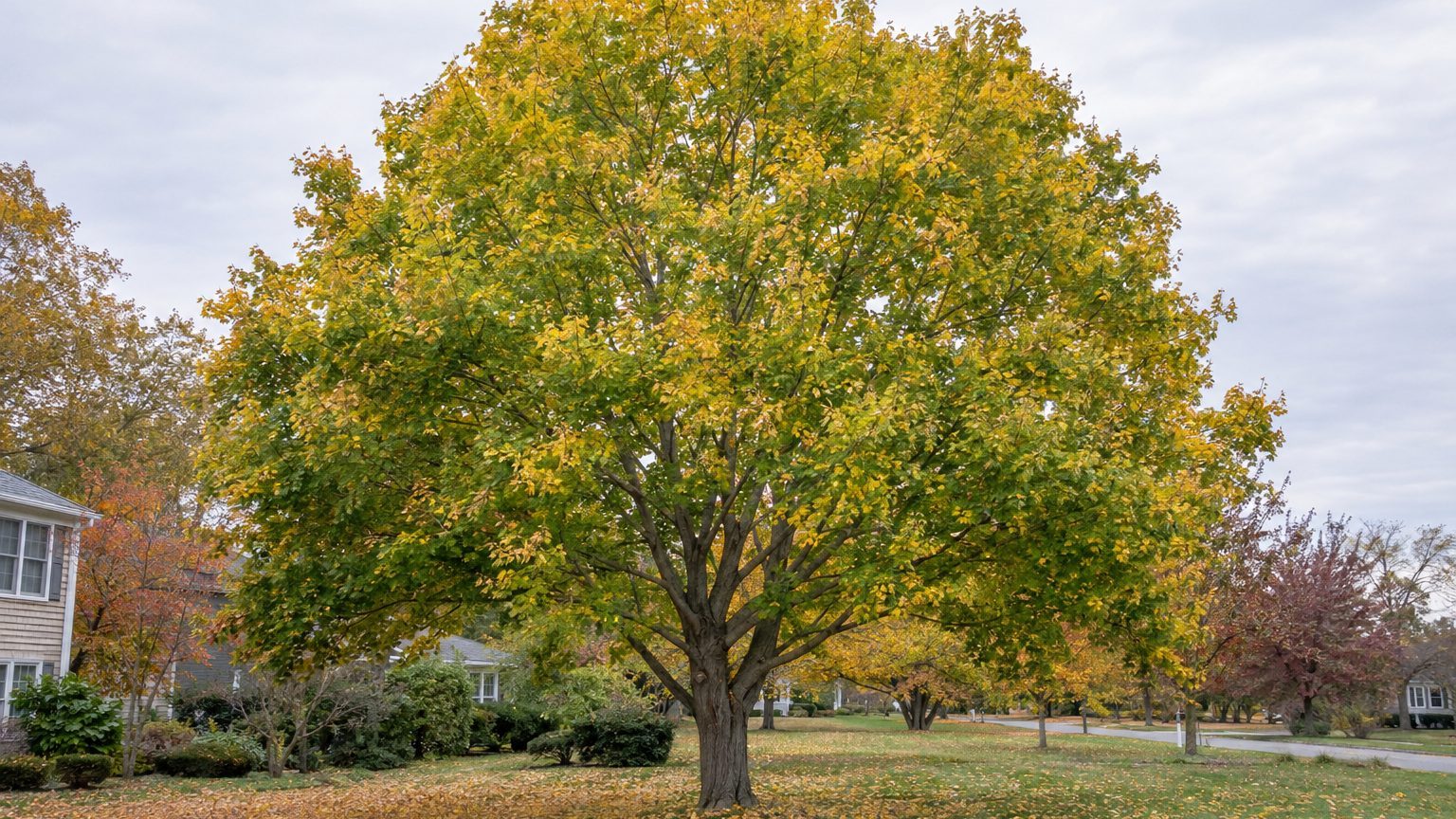
When the lindens bloom in early summer, the whole tree hums with bees, and the scent carries across the yard. American linden is a large native shade tree, and its size, the zones where it grows, how to plant it and what to do through the year all shape how it will fit into your yard.
What Is the American Linden?
American linden is a deciduous shade tree native to eastern North America. Heights run from 50 to 60 feet in some descriptions and 60 to 80 feet in others, so plan for a tall tree. Young trees are pyramidal, and mature trees settle into a rounded form.
The leaves are uneven and heart-shaped with a pointed tip, 4 to 8 inches long and almost as wide. They are larger and denser than those of Littleleaf Linden.
Flowers come in late June to early July, in very fragrant, light-yellow clusters that bees visit heavily. A small grey nut follows and stays on the tree until midwinter. The cultivar ‘Fastigiata’ grows narrower, forming an upright pyramid 30 to 45 feet wide.
From the almanac
Trees in your state
The dates on this page depend on where you live. Your state's page carries its frost dates, its USDA zones and the year laid out month by month.
Northeast
Southeast
- Alabama
- Arkansas
- Delaware
- Florida
- Georgia
- Kentucky
- Louisiana
- Maryland
- Mississippi
- North Carolina
- South Carolina
- Tennessee
- Virginia
- West Virginia
Midwest
Southwest
West
Pacific Northwest
Canada
Where Does the American Linden Grow Best?
American linden is hardy from USDA Zone 3b, and the zone range of 4A through 8B covers where it is typically grown. Its native range stretches from New Brunswick and Maine west to Manitoba, and south to Oklahoma, northern Arkansas, Tennessee and western North Carolina.
Full sun to partial shade suits it. The soil it likes is deep, moist and fertile, whether acidic or slightly alkaline. In the wild it grows in rich woodlands and along river bottoms.
The tree tolerates clay, sand and loam, as long as drainage is good. Drier, heavier soils are tolerated, and drought tolerance is moderate, so a young tree still needs help in dry spells.
How to Plant and Care for the American Linden Through the Year
Planting
Plant while the tree is dormant or while the soil is workable and roots can grow. Choose a spot with room for a wide, tall crown, in sun or light shade. Set the root flare level with the soil surface and keep mulch back from the trunk.
Spring
Spring is the time to watch for sprouts (suckers) rising from the base, since sprout growth can be a problem on this tree. Remove them while they are small. Water a newly planted tree regularly as the leaves open, because it prefers moist soil.
Summer
Flowers open in late June to early July, and the fragrance and bees are part of the show. Keep bee traffic in mind before you plan a seat or play area right under the crown. In dry weather, a deep soaking helps because drought tolerance is only moderate.
Fall
Leaves turn and drop, and the small grey nuts stay on the branches. Rake the leaves from the area around the base. Water a young tree before the ground freezes so the roots go into winter with moisture.
Winter
The nuts hang on until midwinter, so the tree is not bare right away. Winter is the dormant season for pruning a shade tree, once the leaves are gone and the branch structure is easy to read. Cut out crossing or damaged limbs, and remove base sprouts.
American Linden Problems: Pests, Diseases and Weak Points
Aphids are the main nuisance, and they are the pest most often seen on this tree. Several other insects can also trouble it, though a healthy tree is free of most serious pests.
Sprouts at the base are the other regular chore. They are easy to handle when removed early, and they do no harm to the tree if kept in check.
| Issue | How the American Linden handles it |
|---|---|
| Aphids | The usual nuisance, though most serious pests are absent |
| Other insects | Japanese beetle, linden borer, walnut lace bug, caterpillars, basswood leaf miner, elm sawfly, scales and linden mite can all be troublesome |
| Sprouts | Sucker growth at the base can be a problem |
| Drought | Moderate tolerance, and ‘Fastigiata’ is fairly drought tolerant |
| Drainage | Tolerates clay, sand and loam if well drained |
European linden bark borer is also on the list of possible insects. Check leaves and bark each season so a problem is caught while it is small.
Is the American Linden Right for Your Yard?
It suits a yard with space for a tall, wide crown, sun or light shade, and moist, fertile soil. It is a poor fit for a small lot or a spot close to the house. Expect some work with aphids and base sprouts.
- Local extension offices can confirm whether the tree suits your zone and soil before you buy.
- Your State by State Garden state page gives the planting months for your area, so check it before you dig.
Common Questions
Is American Linden Good for Bees?
Yes. The June flowers are very fragrant and extremely attractive to bees, which make a delicious honey from them.
How Wide Does American Linden Get?
Spread runs one half to two thirds of the height, and the narrow ‘Fastigiata’ cultivar reaches 30 to 45 feet wide.
Can American Linden Grow in Clay Soil?
It tolerates clay, sand and loam, provided the soil drains well. Deep, moist, fertile ground gives the best growth.