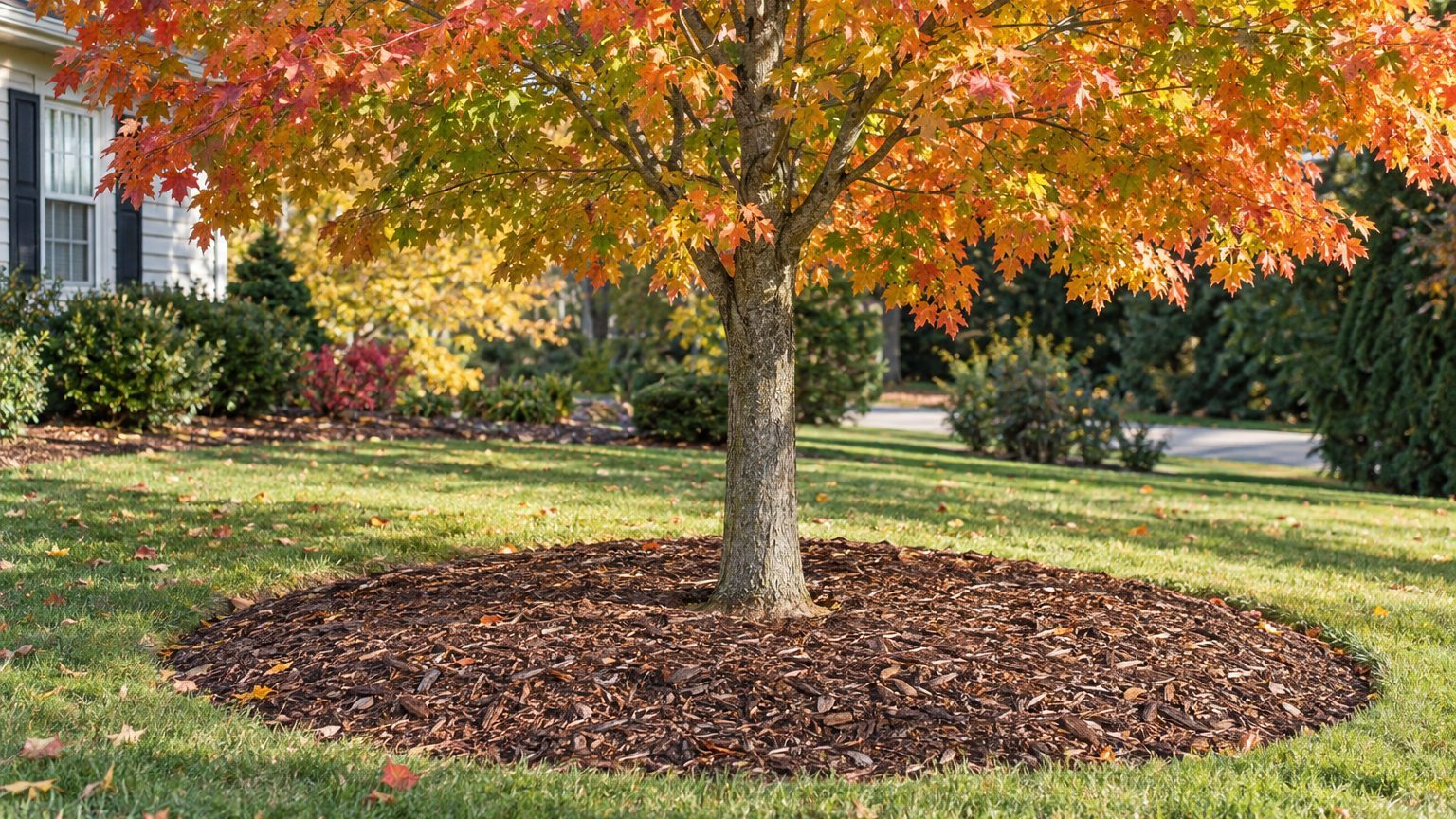
A ring of dark mulch under a tree looks tidy, but the shape of that ring decides whether the roots get a cushion or a slow rot at the trunk. Mulching around trees comes down to a wide, flat doughnut kept clear of the bark. Depth, width and the gap at the trunk each matter.
How Much Mulch Should Go Around a Tree?
Across the country, extension advice lands on a layer 2 to 4 inches deep, spread wide and kept off the bark. Thinner layers let weeds and moisture loss win, while a heavier pile smothers roots and holds water against the trunk.
The exact number shifts with climate and tree size. Cold northern yards often favor the upper end of the range, and 3 to 4 inches is common there, while a layer of about 3 inches is a steady choice where summers are hot and humid. Young trees need the ring to match their small root zone.
The state selector just below this section leads to the page for your state.
From the almanac
Trees in your state
The dates on this page depend on where you live. Your state's page carries its frost dates, its USDA zones and the year laid out month by month.
Northeast
Southeast
- Alabama
- Arkansas
- Delaware
- Florida
- Georgia
- Kentucky
- Louisiana
- Maryland
- Mississippi
- North Carolina
- South Carolina
- Tennessee
- Virginia
- West Virginia
Midwest
Southwest
West
Pacific Northwest
Canada
How to Mulch a Tree Correctly

Work from the ground up, and finish with a gap at the trunk, since that gap is what separates good mulching from the harmful kind.
- Clear the grass and weeds from the ring, keeping turf 4 feet away from the trunk in every direction, so the tree does not compete with sod for water.
- Find the trunk flare, the spot where the trunk widens toward the roots, and leave it visible, so the bark can stay dry and breathe.
- Spread the mulch evenly to a depth of 2 to 4 inches, so the soil holds moisture and stays steady in temperature without suffocating the roots.
- Pull the mulch back from the trunk, leaving a bare gap of several inches, so moisture does not sit against the bark and invite rot and pests.
- Widen the ring toward the dripline where you can, so more of the root zone gets the benefit.
- Top up the layer as it breaks down, so the depth stays in range and the mulch keeps feeding the soil.
The gap at the trunk varies by source. One recommendation is to leave just a narrow mulch-free band at the base, while other guidance calls for keeping the mulch 4 inches, or even 6 inches, away from the trunk flare. A wider gap costs the tree nothing, so leaning toward the larger number is a safe habit. For a young tree, a ring at least 6 feet across, reaching 3 feet out from the trunk, gives the roots room to settle.
Mulching by Tree Type
Mulching advice is mostly the same for every tree, but a few differences show up in the guidance. The size of the root ball and the planting stage change how wide the ring should be.
Trees planted into lawn also need the sod pushed back, since turf and young roots compete for the same water.
| Tree Type | What changes | Why it matters |
|---|---|---|
| Newly planted tree | Ring covers 2 to 3 times the diameter of the root ball | Roots are still inside that zone and need steady moisture |
| Young tree in a lawn | Ring at least 6 feet across, turf kept 4 feet from the trunk | Grass roots take water from small trees |
| Established tree | Ring extends toward the dripline | Feeder roots spread out under the canopy |
| Fruit tree in a cold climate | 3 to 4 inches deep, never deeper than 4 inches | Extra depth helps in cold winters, but too much holds moisture |
For most yards, the practical takeaway is simple: size the ring to the tree’s age, widen it as the tree grows, and keep the depth in range. Pine straw, bark and shredded leaves all work as mulch material around the base of a tree.
Mulching Mistakes to Avoid
Volcano Mulch
Mulch heaped in a cone against the trunk keeps the bark wet, which invites decay and pests. Rake it flat, pull it away from the trunk, and shape it like a doughnut with a hole in the middle. A ring 2 to 3 inches deep makes a good target.
Piling It Too Deep
More mulch does not mean more benefit. Past 4 inches, the layer holds too much water and can starve the roots of air. Check the depth with a ruler, scrape off the excess, and add fresh mulch only as the old layer thins.
Leaving Grass at the Base
Turf growing up to the trunk competes with the tree for water and invites mower damage to the bark. Remove sod from the ring, extend the cleared area outward, and let mulch take its place so a mower never has to get close.
Mulching Trees in Your State
The sign to act is a bare or thin ring: soil showing around the base, weeds creeping in, or mulch that has broken down into the dirt. Timing and local habits differ from state to state, so the month-by-month details sit on each state’s own page.
- Open your state’s page to see the months that suit tree care where you live.
- Check the ring again once the old mulch has settled, and renew it to the right depth.
- Pull any mulch back from the trunk before you leave the yard.
Common Questions
Can You Use Pine Straw or Shredded Leaves Around a Tree?
Yes. Pine straw, bark and shredded leaves all work, applied at 2 to 3 inches and held back from the trunk, as in North Carolina where this is common advice.
Does Mulch Help a Tree If It Already Has a Lawn Around It?
It does. Clearing the grass and replacing it with mulch cuts competition for water and keeps mowers away from the bark.
How Do You Know When to Add More Mulch?
When the layer has broken down and soil is visible, or when it drops below the 2 inch mark. Add enough to bring it back to the right depth without burying the trunk base.