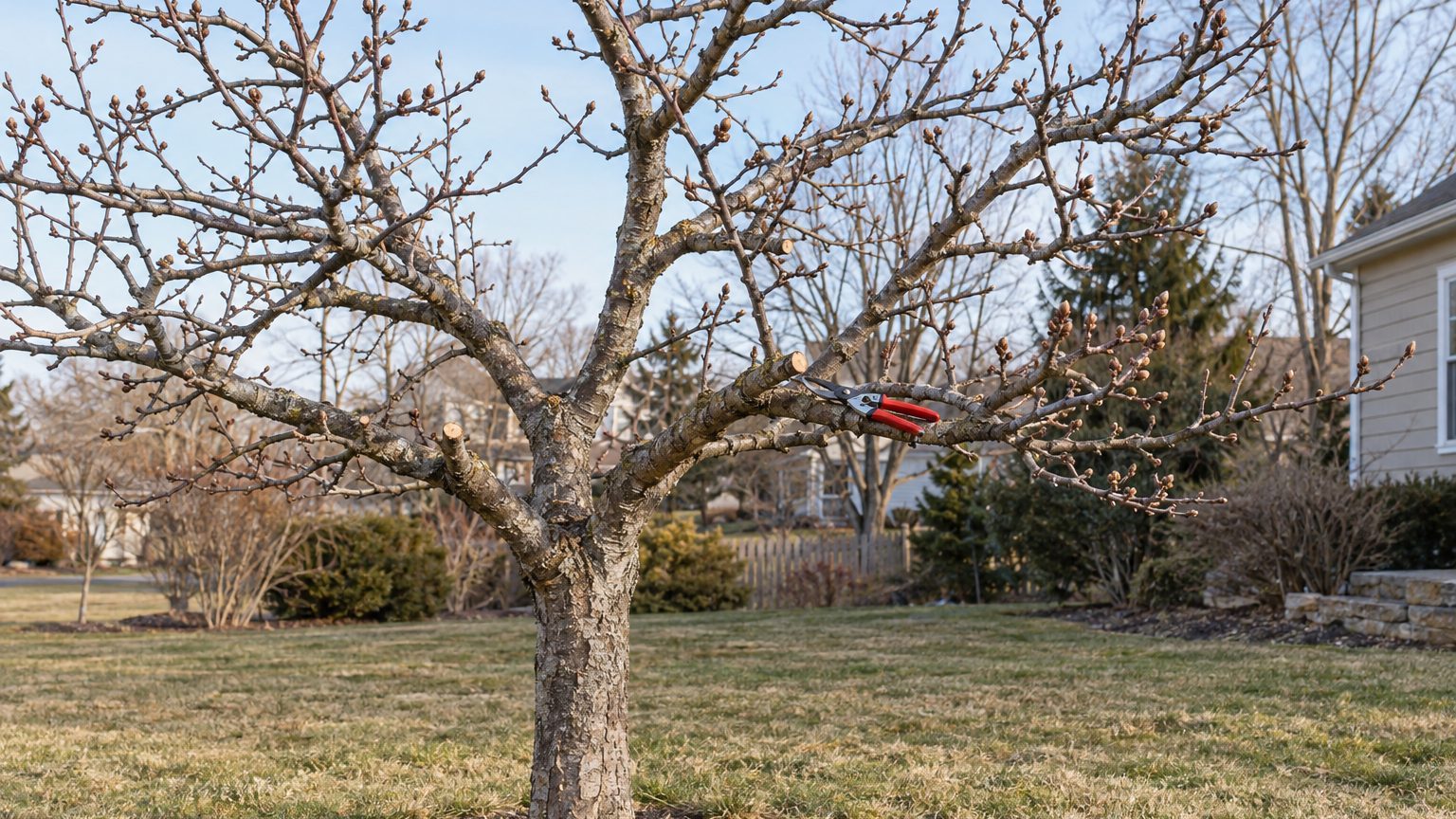
Bare branches against a gray late-winter sky are the signal fruit growers in Colorado look for. Apple, pear, peach, cherry and plum trees are pruned while they sleep, after the hardest cold has passed and before the buds open.
When to Prune Fruit Trees in Colorado

Dormant pruning in Colorado happens in late winter, with February and March the usual months and April still workable. The tree is at rest, the worst cold is behind it, and the buds have not yet swelled. That order leaves time to apply dormant oil as a preventative spray.
Pruning in fall or early winter is avoided, because new growth triggered by a cut may not harden before the cold arrives.
| Fruit tree | When to prune in Colorado | Why |
|---|---|---|
| Apples and pears | February to March, April if needed | Pruned first among fruit trees, once the deepest cold has passed |
| Peaches and nectarines | February or March | Pruned last, closest to bloom, because flower buds are easily hurt by cold |
| Cherries and plums | February to March, April if needed | Cut while dormant, before bud swell |
| Young trees | Late winter, while still dormant | Planted in April, so first shaping follows the same dormant window |
These months fit the Front Range and the plains, where Denver sits at 5,280 feet and the last spring frost falls between May 1 and May 11. Mountain towns and the western slope run on different clocks, and Colorado spans zones 3b to 7b, so a high-country orchard waits longer than a backyard tree in the city.
Colorado — the year and the numbers
- State
- Colorado
- USDA zones
- 3b-7b
- Last spring frost
- May 1 to May 11
- First fall frost
- September 30 to October 12
- Annual rain
- 15 in
- Lawn zone
- transition-season
- Source
- NOAA NCEI 1991-2020 Climate Normals, 32F freeze probabilities · Denver
How to Tell Your Fruit Trees Are Ready to Prune
The calendar gives the months, but the tree itself confirms them. A walk around the yard in late winter shows which signs are present.
- The branches are bare and the leaves are long gone, which tells you the tree is dormant and can handle cuts.
- The coldest stretch of winter, when temperatures dip below zero, has passed, so fresh wounds will not be hit by extreme cold.
- The buds are still tight and closed, which means there is room to prune and to spray dormant oil first.
- Buds that have begun to fatten at the tips mean the window is closing, so the remaining cuts should be finished soon.
- Peach buds that are close to showing color are your cue to prune peaches last, after the apples and pears are done.
If the buds have already opened, wait until the tree has finished flowering and settle for light corrections rather than major cuts.
When to Prune Peach and Apple Trees in Colorado
Apples sit at the front of the line. They are pruned in the heart of the dormant season, in February or March, once the severe cold has passed. A hard freeze after pruning does less harm to an apple than to a peach, so there is no reason to hold off until the last moment.
Peaches go last, in February or March, as close to bloom as the calendar allows. Their flower buds are easily hurt by cold, and cutting too early leaves them exposed to a late hard freeze. A few extra weeks of patience protect next summer’s crop.
A practical order for a yard with both: finish the apples first, then turn to the peaches when the buds begin to show signs of life but have not yet opened. Summer pruning is not something to plan around, since the dormant cuts do the main work of shaping these trees.
Where to Get Fruit Tree Advice in Colorado
Local conditions vary a great deal across the state, from plains to foothills to the western slope. Two places can help you fit the general timing to your own yard.
- Colorado State University Extension publishes guidance on growing tree fruit in Colorado gardens, and it is a good first stop in winter before you pick up the pruning saw.
- Your county extension office can speak to your elevation and microclimate, so call or visit in January or February to settle on your own pruning week.
Common Questions
Can You Prune Fruit Trees in Colorado in Fall?
Fall pruning is avoided. Cuts can push new growth that has no time to harden before winter, and the tree enters the cold weaker than it should be.
Should You Spray Dormant Oil When Pruning?
Late winter pruning leaves a gap before bud swell, and that gap is the time to apply dormant oil, also called horticultural oil, as a preventative spray.
Which Apple Trees Suit a Colorado Home Garden?
Dwarf apple trees are recommended for home gardeners, but they need careful training and staking. They are also less cold-hardy than semi-dwarf trees, which matters in colder parts of the state.