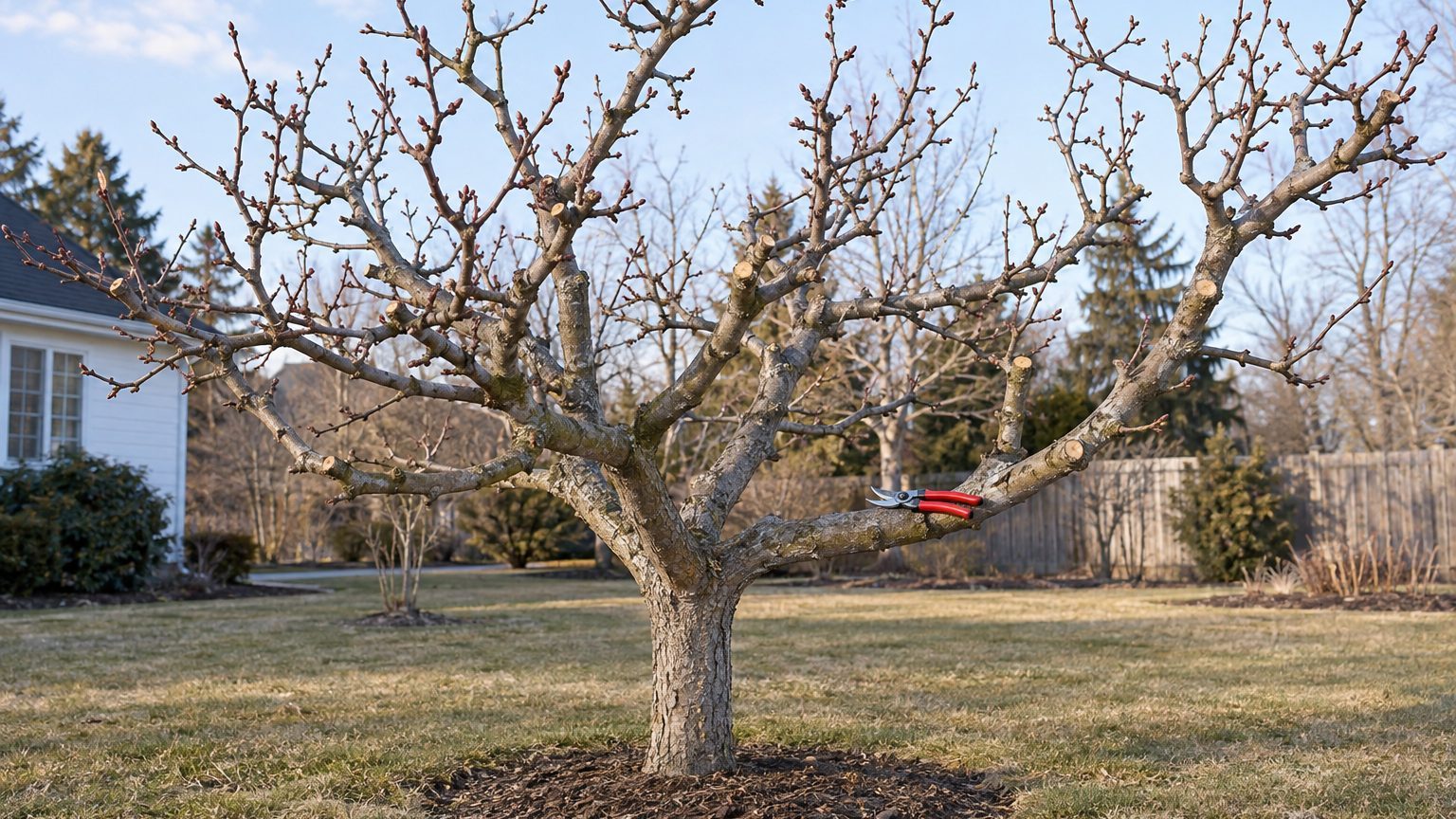
Bare branches against a gray March sky, buds still tight and closed: that is the moment to reach for the pruning saw in Connecticut. Fruit trees here are pruned in late winter into early spring, while they are still dormant and before the buds open.
When to Prune Fruit Trees in Connecticut

Dormant pruning of apples, pears, peaches, cherries and plums runs from March into April. Pruning in fall or early winter is avoided, because the new growth it triggers may not harden before the cold arrives.
| Fruit tree | When to prune in Connecticut | Why |
|---|---|---|
| Apples and pears | Early in the dormant window, March | The wood is bare and the buds are still closed, so cuts heal before growth starts |
| Peaches and nectarines | Last in the window, April, closest to bloom | Flower buds are easily hurt by cold, so you can see which ones survived |
| Cherries and plums | March into April, before buds swell | Pruning while dormant keeps cuts clear of new growth |
| Young trees | Late winter into early spring, March to April | Shaping the framework early guides how the tree grows that season |
Connecticut spans USDA zones 6a to 7b, so the coast near Bridgeport wakes up sooner than the inland hills and the northwest corner. Inland trees often stay dormant longer, which means your pruning may slide later in the window than a neighbor’s near the Sound.
Connecticut — the year and the numbers
- State
- Connecticut
- USDA zones
- 6a-7b
- Last spring frost
- April 2 to April 12
- First fall frost
- October 28 to November 10
- Annual rain
- 44 in
- Lawn zone
- cool-season
- Source
- NOAA NCEI 1991-2020 Climate Normals, 32F freeze probabilities · Bridgeport
How to Tell Your Fruit Trees Are Ready to Prune
The tree gives clearer signals than the calendar, and a few minutes of looking before you cut saves regret later.
- The branches are bare, because a tree without leaves is at rest and can handle cuts without losing stored energy.
- The hardest part of winter has passed, since pruning ahead of a deep freeze can leave fresh wounds exposed to damage.
- The buds are still tight, which tells you the tree has not yet started pushing sap and growth.
- Buds are just starting to swell on a peach, a signal to prune it now, because peaches go last and closest to bloom.
- The ground is workable and the days are mild enough that you can stand outside comfortably with loppers and a saw.
Once buds open into green tips, the dormant window has closed, and heavy cuts are better saved for the following winter.
When to Prune Peach and Apple Trees in Connecticut
Apples sit at the front of the line. They are pruned first, in the middle of the dormant stretch, when the wood is bare and there is no rush. Starting with them lets you work through the orchard in an order that makes sense for each tree.
Peaches come last, near bloom in April. Their flower buds are easily hurt by cold, so waiting lets you see what winter left alive and cut with that in mind. A hard cold snap after pruning matters less when the buds you kept are already known to be sound.
Summer pruning in late July or August is a second chance for light corrections. Severe cutting at that time weakens the tree, so most of the work belongs in winter or early spring. Treat summer as a time to snip a few stray shoots, nothing more.
Where to Get Fruit Tree Advice in Connecticut
Local questions about a particular orchard, variety or pruning cut are best answered by people who work with Connecticut trees. University of Connecticut Extension and your county extension office can help.
- The state extension service offers pruning guidance written for Connecticut growing conditions, handy to read before the saw comes out.
- Your county extension office can answer questions about a specific tree, so call when buds start to swell and you are unsure whether to cut.
Common Questions
Can You Prune Fruit Trees in Fall in Connecticut?
Fall pruning is avoided. Cuts made then can prompt new growth that has no time to harden before winter, so wait for the dormant window in late winter.
Can You Plant a Fruit Tree in Fall in Connecticut?
No. Winters here are too cold for a newly planted fruit tree, so planting happens in April and May, with bare-root trees going in while still dormant, before the buds open.
What Happens If You Prune an Apricot or Plum Too Early?
Apricot trees are generally hardy through winter but become tender as temperatures rise in late winter. Plum-apricot hybrids such as Spring Satin do not tolerate freeze-thaw cycles, so holding off on cuts until the dormant window is well along protects them.