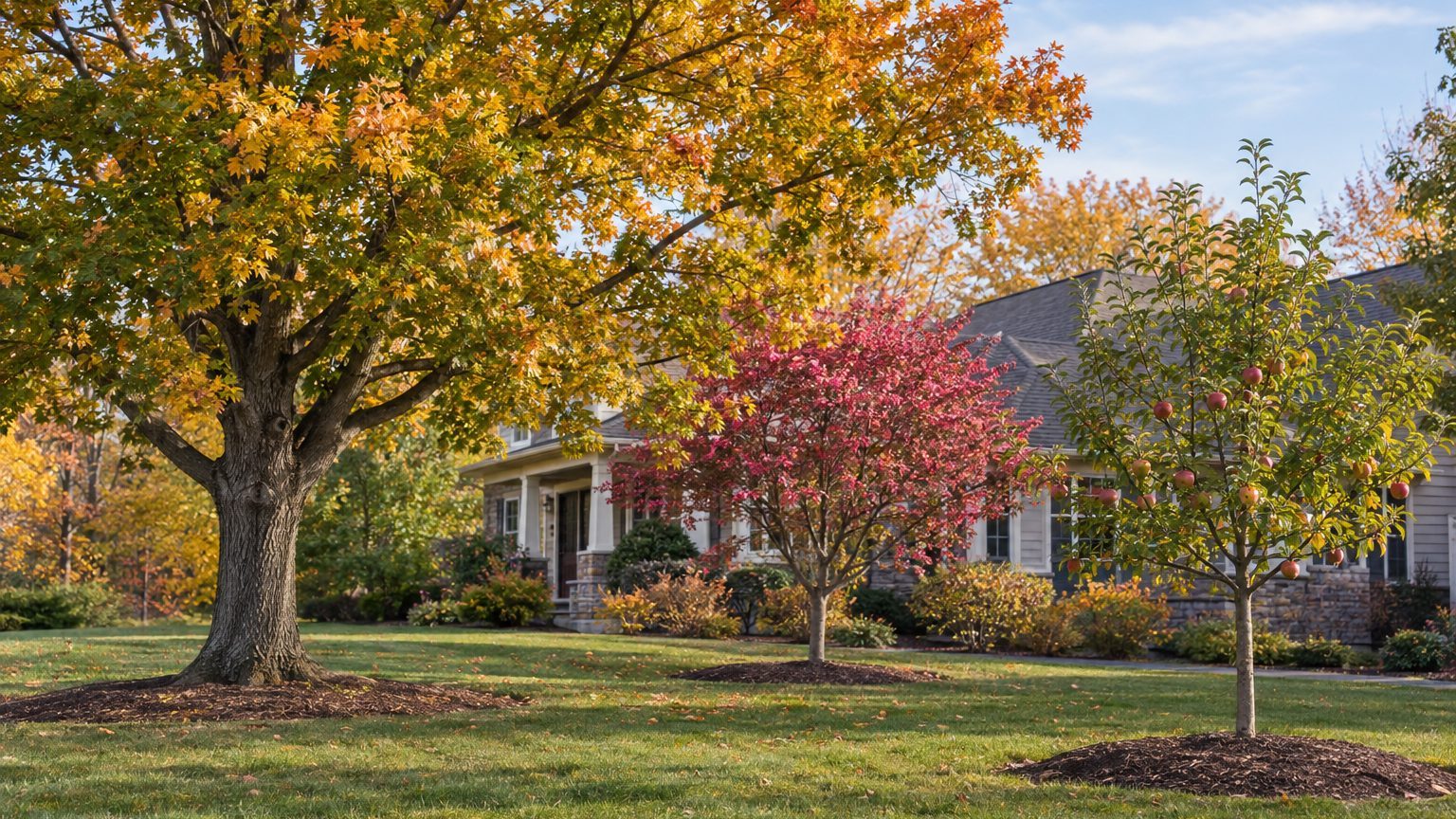
A shade tree you plant in spring may take longer to cast real shade than a flowering tree takes to bloom, and a fruit tree asks for the most attention of all. Yard trees fall into four groups: shade, flowering, evergreen and fruit. Mature size decides which ones fit your lot.
What Are the Main Types of Yard Trees?
Yard trees sort into shade trees, smaller flowering or ornamental trees, evergreens and fruit trees, and mature size separates them more than anything else. Shade trees can stay under 35 feet or climb past 100 feet. Climate decides which species within each group will thrive for you.
Smaller ornamental trees often top out under 25 feet, which suits tight front yards and spots near a house. Fruit trees come in sizes from patio dwarfs to full semi-dwarfs, so the same fruit can fit very different spaces.
The state selector rendered just below this section takes you to the page for your own state, where the local timing and conditions are covered.
From the almanac
Trees in your state
The dates on this page depend on where you live. Your state's page carries its frost dates, its USDA zones and the year laid out month by month.
Northeast
Southeast
- Alabama
- Arkansas
- Delaware
- Florida
- Georgia
- Kentucky
- Louisiana
- Maryland
- Mississippi
- North Carolina
- South Carolina
- Tennessee
- Virginia
- West Virginia
Midwest
Southwest
West
Pacific Northwest
Canada
How to Tell Tree Types Apart

Start with the job you want the tree to do, then work through the size and the space, in this order.
- Decide the purpose first (shade, flowers, year-round green or fruit), so that every later choice narrows the list instead of widening it.
- Measure the open space overhead and to the sides, so that the mature tree never grows into wires, eaves or a neighbor’s fence.
- Match the mature height to that space. Shade trees range from under 35 feet to over 100 feet, while many ornamental trees stay under 25 feet, so the wrong pick can outgrow a small lot.
- Look at the leaves and form, since deciduous trees drop leaves and let winter light through, while evergreens keep their needles or foliage and block wind and views all year.
- For fruit, pick the rootstock size, because a semi-dwarf apple, peach, apricot or plum wants about 15 to 18 feet between trees, and a smaller dwarf asks for much less.
- Check how the tree arrives (bare-root, containerized or balled), so that you plant at the right moment while it is dormant or the soil is workable and the roots can settle.
Bare-root deciduous trees do best when the trunk is under 2 inches across, and bare-root evergreens should be very small, under 2 feet tall. Smaller stock usually catches up with larger stock once it roots in.
Tree Types Compared by Tree Type
The groups differ most in how big they get and how much room they need. Fruit trees add one more variable, the rootstock, which sets the final size more than the variety does.
Where winters are cold, columnar and dwarf forms make fruit possible on small lots. Where summers run hot, size choices still follow the same logic.
| Tree Type | What changes | Why it matters |
|---|---|---|
| Shade trees | Mature height from under 35 feet to over 100 feet | A tall species needs open sky and distance from the house |
| Medium ornamental trees | Mature height of 25 to 50 feet | Fits a front yard but still needs clearance from structures |
| Small ornamental trees | Mature height under 25 feet | Works near walkways, patios and under power lines |
| Semi-dwarf fruit trees | 12 to 15 feet tall and wide, spaced 15 to 18 feet apart for apples, peaches, apricots and plums | Needs a real planting bed and room to reach |
| Dwarf fruit trees | 8 to 10 feet tall and wide | Suits a small yard and keeps fruit within reach |
| Ultra-dwarf fruit trees | 3 to 6 feet tall and wide | Grows in a container on a patio |
| Columnar fruit trees | Apples reach 12 to 15 feet tall and 3 to 4 feet wide | Gives height without taking much width |
Evergreens and the many flowering species are not broken out here, so judge them the same way: check the mature height on the plant tag and compare it with your space. For fruit, remember the long view, since peaches and nectarines may stay productive for 20 to 25 years while other fruit trees can go past 40.
Tree Selection Mistakes to Avoid
Planting a Giant Under Wires
A shade tree that can pass 100 feet will eventually push into utility lines and roofs, and removal costs more than the sapling ever did. Pick a small tree under 25 feet for spots near lines or the house, and save the large shade species for open ground.
Crowding Fruit Trees Together
Semi-dwarf apples, peaches, apricots and plums planted closer than 15 to 18 feet compete for light and make harvest and care harder. Space them from the start, or choose dwarf or columnar forms if the yard is small.
Ignoring Cold Pockets and Elevation
In California stone fruit country, planting above 2,000 feet is advised only on hilltops, because low spots collect frost and invite bacterial canker. Where your yard sits in a hollow or on a slope matters, so choose the higher, drier ground for fruit trees and keep frost-prone dips for hardier plants.
Best Trees for Your State
The right choice depends on your climate, so look at what grows well in your area and plant while the tree is dormant or the soil is workable. Peaches in the medium chill zone of Texas can ripen over 6 weeks from early May until late July.
- Before you shop, check which trees suit your local winters and summers.
- Visit it again before planting day to check the months that fit your state.
Common Questions
How Long Do Fruit Trees Keep Producing?
Many fruit trees stay productive for 40 or more years, while peaches and nectarines last a shorter 20 to 25 years. Plan to replace peaches sooner than apples.
Which Fruit Trees Fit a Patio?
Ultra-dwarf trees, only 3 to 6 feet tall and wide, grow well in containers. Columnar apples are another choice when you want height but little width.
Do Cherry Trees Need Staking?
Cherries grafted onto Gisela 5 rootstock stay under 10 feet tall, and after 2 to 3 years they no longer need staking. Until then, give the young tree a stake for support.