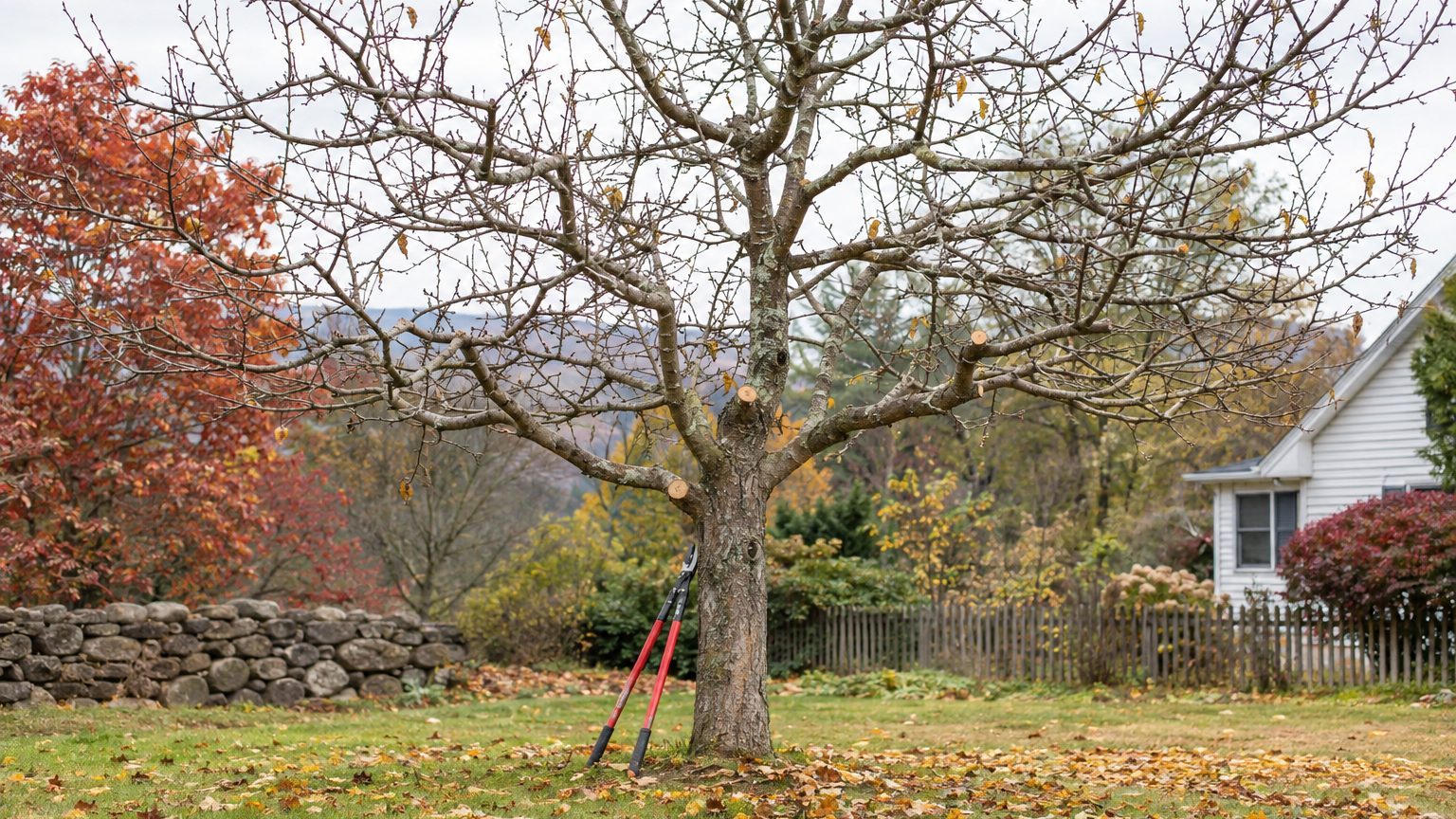
Late winter, before the buds swell, is when a bare fruit tree shows its framework best, and that is the moment to reach for the pruning saw. The goal is a short trunk, a few well-spaced main limbs and an open center that lets light reach the fruit. A little each year beats a big haircut after years of neglect.
When and Why Do You Prune Fruit Trees?
Across the country, fruit trees are pruned while dormant, in late winter before the buds open. Cold climates push the job toward the end of that dormant stretch, while mild climates open the window earlier. Peaches, apples and pears each ask for slightly different cuts.
The reason is structure. Pruning sets the scaffold limbs that will carry fruit, lets sunlight into the canopy and keeps the crop within reach. Fruit spurs grow very slowly, typically under 1 inch a year, so a branch that loses them needs a long time to recover.
The state selector just below this section leads to the page for your state, where the local pruning months are laid out.
From the almanac
Trees in your state
The dates on this page depend on where you live. Your state's page carries its frost dates, its USDA zones and the year laid out month by month.
Northeast
Southeast
- Alabama
- Arkansas
- Delaware
- Florida
- Georgia
- Kentucky
- Louisiana
- Maryland
- Mississippi
- North Carolina
- South Carolina
- Tennessee
- Virginia
- West Virginia
Midwest
Southwest
West
Pacific Northwest
Canada
How to Prune a Fruit Tree

Work from the trunk outward, and make each cut with a clear purpose. These steps follow the order most growers use on a young tree being trained.
- Cut the central leader 6 to 8 inches above the spot where you want branching to begin, so that buds just below the cut push out side limbs at the right height.
- Keep the bottom 25 to 36 inches of trunk clear of limbs, so you can walk, mow and spray around the tree without ducking under branches.
- Spread the chosen limbs wider where they grow too upright, since laterals should be spread to approximately 60 degrees from vertical in Utah and branches should ideally be at a 45-degree angle in Arizona.
- Remove watersprouts and any shoot growing straight up through the center, so that sunlight and air reach the fruiting wood.
- Keep side branches on each scaffold at least 15 inches from where the scaffold leaves the trunk, so that the main limb stays clean and carries its load.
Two shapes cover most home trees. The central leader system keeps a single upright trunk with scaffolds set roughly every 18 inches along it, which suits apples and pears well. The open center, or vase, keeps a short trunk with two, three or four scaffolds, and suits peaches because it lets light into the middle of the tree.
Pruning by Tree Type
Peaches, apples and pears share the same dormant-season timing, yet the shape and the height of the lowest limb differ. Where the fruit grows also matters. Some trees carry fruit on slow spurs, while others fruit on young shoots that you renew each year.
A good fruiting shoot on a peach is a fairly slim one, moderately long and roughly as thick as a pencil at the base.
| Tree Type | What changes | Why it matters |
|---|---|---|
| Peach and nectarine | Open-center shape, with the lowest limb fairly close to the ground and the highest limb a little higher up, all within easy reach. | Light reaches the center, where fruiting shoots form |
| Unbranched young peach | At planting, cut the young tree back to a modest height above the ground. | The cut forces the side limbs that become the framework |
| Apple | In Pennsylvania, the lowest scaffold sits at least 24 inches off the ground, and up to 36 inches where flowers or shrubs grow beneath it. | Leaves room for plantings and mowing beneath the canopy |
| Apple and pear | Scaffolds at least 6 inches apart vertically, evenly around the trunk | Limbs do not crowd each other as they thicken |
If you grow more than one kind, prune each to its own shape instead of treating the orchard as a single job. Apples and pears carry a good deal of their crop on spurs, so protecting those short branches protects the harvest. Peaches reward steady renewal of young shoots.
Fruit Tree Pruning Mistakes to Avoid
Heading Cuts Too Low
Topping a tree far below the first branching point leaves little to build on. A small unbranched whip from a southern nursery usually has no side limbs; Pennsylvania advice is to cut it back to 24 to 30 inches above the ground. Cut higher and the lower branches come in out of reach, while cutting lower leaves too little trunk.
Crowded Scaffolds
Leaving several limbs to leave the trunk at the same height makes a weak tree that splits under a heavy crop. Lateral buds spaced 3 to 4 inches apart along the leader give you plenty of choices when selecting branches. Keep the well-placed ones and remove the rest early, while the cuts are still small.
Leaving Limbs Too Upright
Steep limbs shade the tree, produce few fruiting spurs and tend to form tight, weak crotches. In Utah, spreading laterals out to about 60 degrees from vertical is advised to open up the canopy and encourages earlier fruiting. Use a wooden spreader or tie a limb down in the dormant season, and loosen it once the wood holds its new angle.
When to Prune Fruit Trees in Your State
The sign to watch for is the end of the cold stretch: pruning belongs in the dormant weeks, after the hardest freezes are behind you and before the buds swell and open. Months shift from state to state, so each state has its own page.
- Open your state page in late winter to find the local pruning months before the buds begin to move.
- Check it again before you buy or plant a bare-root tree, since the first cuts are made at planting.
Common Questions
How Much Can You Prune Off a Fruit Tree at Once?
Take only what the shape needs, starting with dead, broken and crossing wood. Heavy removal in one season pushes a flush of vertical watersprouts, so spread large corrections over several years.
Do Fruit Trees Need Pruning at Planting?
Yes, a bare-root whip is cut at planting to the height where you want the first branches. This sets the trunk length and starts the framework from the beginning.
What Tools Do You Need to Prune Fruit Trees?
Sharp hand pruners handle small shoots, loppers take limbs up to a modest thickness and a pruning saw handles the larger ones. Clean, sharp blades leave smooth cuts that close faster than ragged ones.