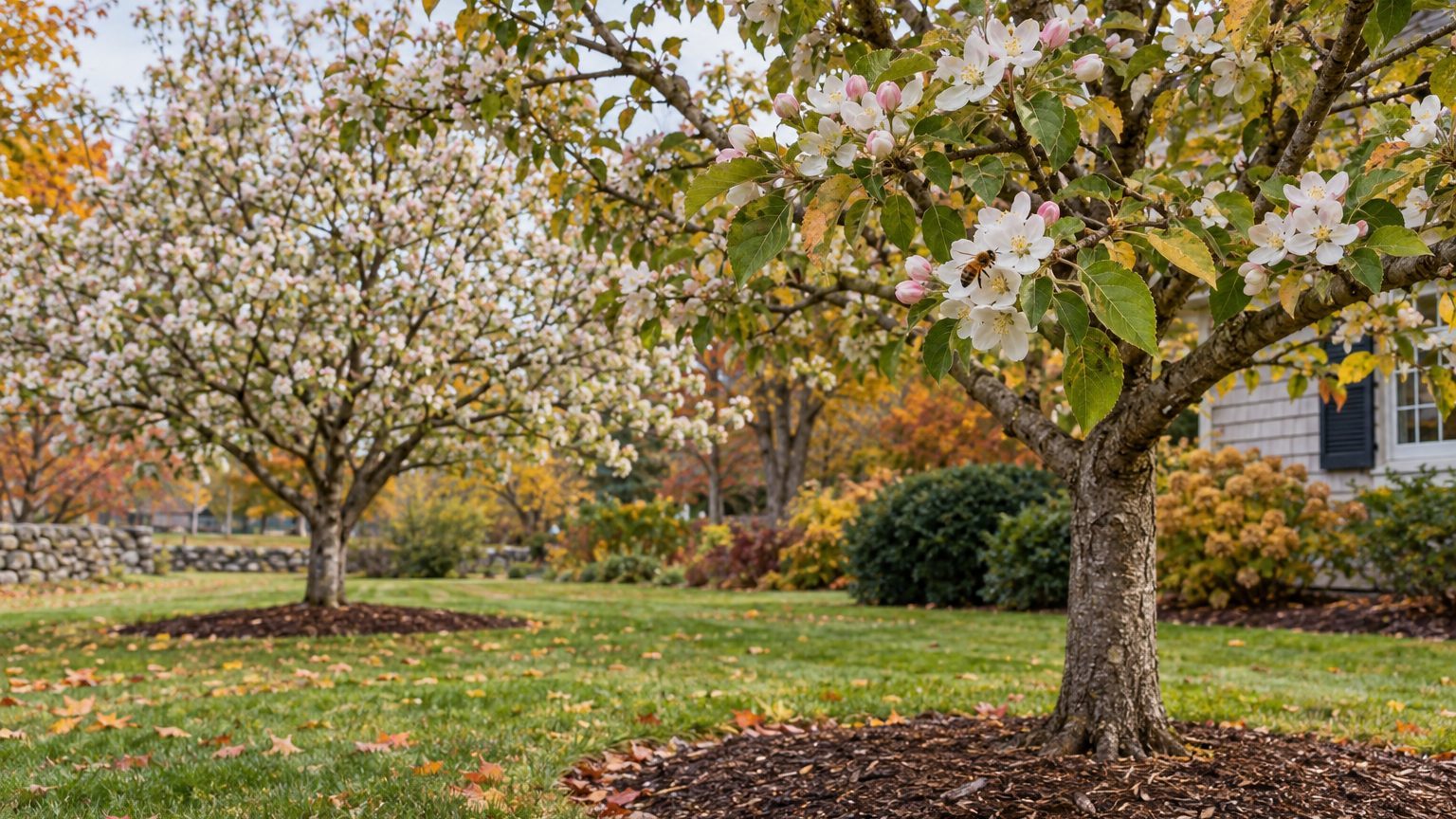
Bees working a crabapple or pear in spring is a sign that pollen is moving, and for many fruit trees that pollen has to come from a different tree. Apples, pears, plums and sweet cherries usually need a second variety nearby, while peaches usually do not.
Do Fruit Trees Need a Second Tree to Bear Fruit?
Many do, but not all. Apples, sweet cherries, pears and Japanese plums are generally cross-pollinated, so each needs a compatible variety of the same fruit blooming close by. Peaches are the usual exception, since nearly all of them are self-fruitful.
Climate shifts the picture too. Cool, rainy springs keep bees grounded, so even a well-matched pair can set a light crop. The state selector just below this section takes you to the page for your own state.
From the almanac
Trees in your state
The dates on this page depend on where you live. Your state's page carries its frost dates, its USDA zones and the year laid out month by month.
Northeast
Southeast
- Alabama
- Arkansas
- Delaware
- Florida
- Georgia
- Kentucky
- Louisiana
- Maryland
- Mississippi
- North Carolina
- South Carolina
- Tennessee
- Virginia
- West Virginia
Midwest
Southwest
West
Pacific Northwest
Canada
How to Pick a Pollination Partner

Choosing a partner comes down to a short sequence, done before you buy and again once the trees are in the ground.
- Identify whether your fruit is self-fruitful or cross-pollinated, so that you only buy a second tree when the first one truly needs it.
- Choose a variety that blooms at the same time as your main tree, because pollen only helps when the flowers are open together.
- Rule out triploid varieties as partners, since they do not produce viable pollen and would leave your main tree unpollinated.
- Plant the pair within 100 feet of each other, so that bees can carry pollen between them on a single foraging trip.
- Count the bees on your trees at bloom, because in Pennsylvania, if you do not see three to four honey bees per tree visiting the flowers, your fruit set may be less than desired.
In a larger planting, the partner variety can be spread through the rows. Orchard growers commonly follow a guideline of making 10 to 15 percent of the trees pollinizers, and placing them so that no tree is more than two tree spaces away from one. In a small yard, a single compatible tree or a crabapple on the neighbor’s side of the fence may already do the job.
Pollination Needs by Tree Type
Each fruit has its own habits. Some need a partner every time, a few are fine alone, and one native fruit needs several trees so that both sexes are present.
The table sets these differences side by side so you can match your planting plan to the fruit.
| Tree Type | What changes | Why it matters |
|---|---|---|
| Apple | Two different varieties within 100 feet | Many varieties cannot set fruit with their own pollen |
| Pear | Most need a pollinator, and bearing starts at 5 to 8 years | A partner is needed, and patience is too |
| Sweet cherry | Two compatible varieties within 100 feet | A single tree usually stays barren |
| Japanese plum | Cross-pollinated, with a compatible variety nearby | Matching varieties gives better fruit set |
| Peach | Nearly all are self-fruitful | One tree can fruit alone |
| American persimmon | Two or more varieties or seedlings | Planting a single tree leaves the flowers unpollinated |
For most yards, the practical result is simple. Plan for two trees if you want apples, pears, cherries or plums, and plant them close together. Pears take longer to bear than apples, cherries, plums or apricots, so do not read slow fruiting as a pollination problem. Peaches give you the most freedom, since one tree can stand on its own.
Pollination Mistakes to Avoid
Planting a Single Tree
One apple, pear or sweet cherry on its own often flowers heavily and then drops everything. Buy the partner at the same time, or choose a tree already grafted with more than one variety.
Spraying During Bloom
Insecticides applied while the flowers are open can kill the honey bees that carry the pollen. Avoid the use of insecticides during blooming, which may kill honey bees.
Ignoring Wet Spring Weather
Bees do not fly in cool, rainy weather, and a long stretch of it can leave flowers unpollinated even when the partner tree is right next door. You cannot change the weather, but you can plant more than one tree and add blossoms that attract bees nearby, so that the visits happen whenever the sun does come out.
Fruit Tree Pollination in Your State
The sign that matters is open bloom: when flowers open, bees need to be working them, and any spraying should stop. The timing varies with your climate, so your state’s page gives the months that fit your yard.
- Open your state’s page in early spring to see when bloom usually arrives where you live.
- Check it again before you buy trees, so that your two varieties flower together.
Common Questions
Can You Plant Two Trees of the Same Variety for Pollination?
Two trees of the same variety share the same pollen type, so they generally cannot pollinate each other. Plant two compatible but different varieties instead.
Does a Neighbor’s Fruit Tree Count as a Partner?
It can, if it is a compatible variety that blooms at the same time and stands within 100 feet of your tree. Bees do not care whose yard the tree is in.
Why Is a Pear Tree Blooming but Not Setting Fruit?
Pear blossoms offer nectar with only about 10 percent sugar, so bees often favor other nearby flowers whose nectar can reach as high as 60 percent. Look for a compatible partner within range, and check whether bees are visiting your pear bloom at all.