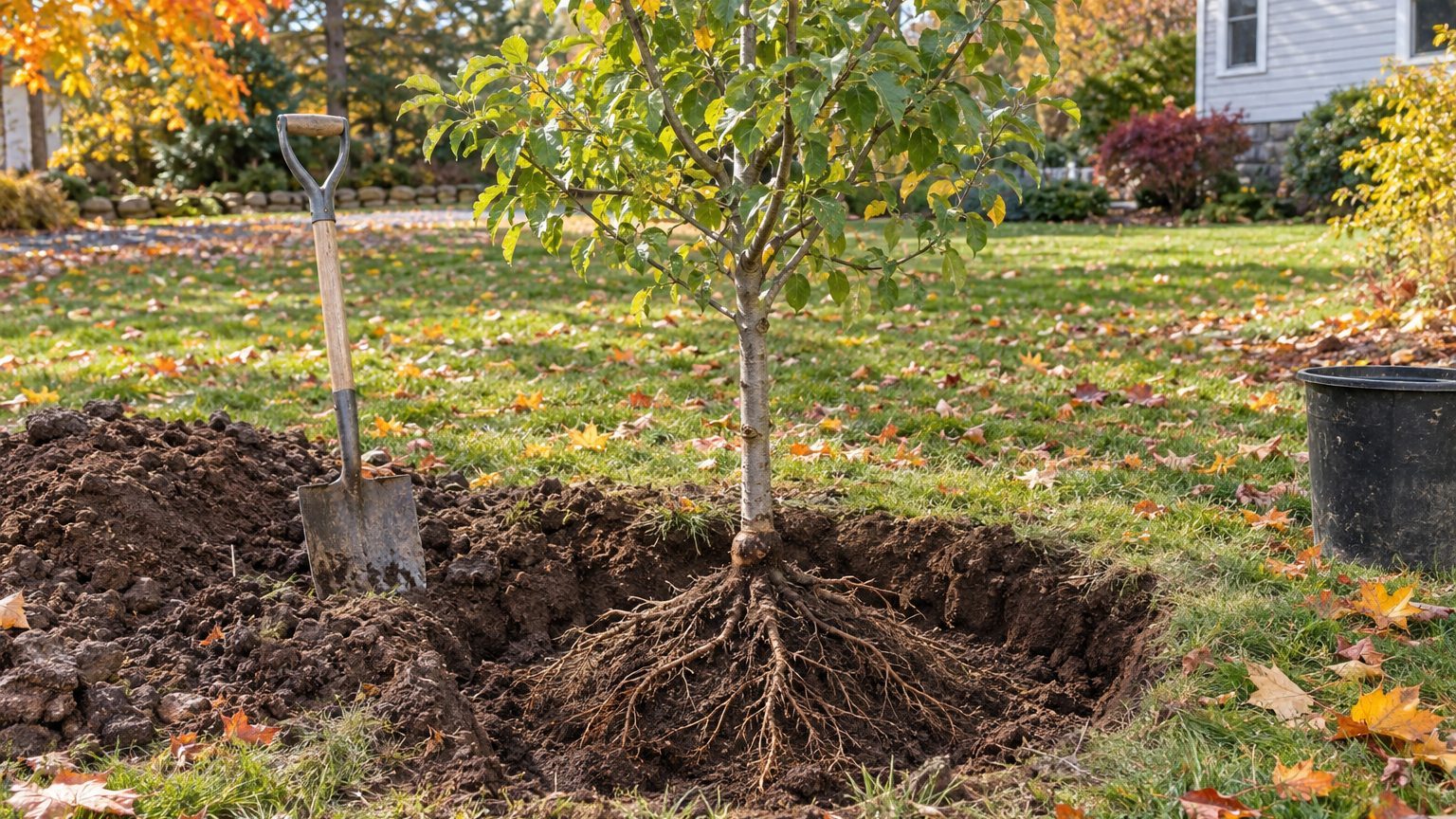
A bare-root fruit tree arrives in late winter as a bundle of roots and a bare stem, and a container tree can be set out whenever the soil is workable. Both go in the ground the same way, with the roots spread wide, the graft union kept above the soil and the hole sized to the root system rather than the pot.
When Should You Plant a Fruit Tree?
Plant a fruit tree while it is dormant or when the soil is workable and the roots can grow. For most of the country that means late winter to early spring for bare-root trees, before the buds open. Container trees are more forgiving, since their roots are already growing in soil.
Climate moves the window more than anything else. Where winters are mild, planting can begin earlier, and where the ground freezes hard it waits for the thaw. Peaches, apples and other tree types follow the same rule, but the calendar shifts with the weather.
The state selector just below this section leads to the page for your state, where the months are laid out for your climate.
From the almanac
Trees in your state
The dates on this page depend on where you live. Your state's page carries its frost dates, its USDA zones and the year laid out month by month.
Northeast
Southeast
- Alabama
- Arkansas
- Delaware
- Florida
- Georgia
- Kentucky
- Louisiana
- Maryland
- Mississippi
- North Carolina
- South Carolina
- Tennessee
- Virginia
- West Virginia
Midwest
Southwest
West
Pacific Northwest
Canada
How to Plant a Bare-Root Fruit Tree

Planting goes quickly once the tree is in hand, so prepare the spot before it arrives and work in this order.
- Plant the tree as soon as it arrives, so that the bare roots do not dry out while they wait.
- Dig the hole 1 1⁄2 to 2 feet wide, so that the roots can spread out instead of curling around a narrow pit.
- Make the hole about 1 1⁄2 feet deep, so that the tree sits on firm soil and cannot sink after watering.
- Set the tree so that the uppermost root is no more than 2 inches below ground level, so that the roots get air as well as moisture. For a container tree, loosen any roots circling the root ball first so they grow outward.
- Backfill with the soil you dug out and water it in, so that no air pockets are left around the roots.
- Plant semi-dwarf trees 10 feet apart along the row so the crowns have room to fill out. Leave 16 feet between rows so sunlight and air can reach every tree and a mower or cart can get through.
In the first year, water the tree regularly and keep mulch a few inches back from the trunk so the bark stays dry. Keep mowers and trimmers away from the trunk, because young bark is easily damaged, and let the roots, not the branches, do the work while the tree settles in.
Planting by Tree Type
Tree type changes the size of tree to buy, the shape it is bought in, and how the framework branches are set. The numbers below were written for particular regions, so treat them as a sound guide rather than a rule for every yard.
| Tree Type | What changes | Why it matters |
|---|---|---|
| Peach, nectarine, apricot | A 4-foot tree is the ideal planting size where growers in the mid-Atlantic buy | A small tree will never catch up to a sturdier one |
| Apple | A vigorous one-year-old whip that stands 4 to 7 feet tall is the best choice. | A strong first-year stem gives the frame a good start |
| Apple, Mountain West training | The first scaffold sits about 18 inches above the ground | Branches low on the trunk make a sturdy, open frame |
| Peach, Midwest training | The lowest scaffold branches should start at least 15 inches above the ground. | Branches placed too low are hard to manage and shade the trunk |
For you, this means choosing the tree by trunk and height before you choose it by price, and noting that a thicker trunk, for peach in cooler orchard country, starts the strongest. Branch heights also differ by fruit, so check which fruit you are buying before you set your cutting heights.
Fruit Tree Planting Mistakes to Avoid
Burying the Graft Union
The graft union is the knobby bend low on the trunk where the fruiting variety joins the rootstock. If soil covers it, the upper part of the tree can root on its own and the rootstock loses its influence over size. In North Carolina, grafted trees are planted with the union at least 2-3 inches above the soil line. Check the bend after backfilling and again after the first heavy rain, when soil settles.
Planting into Wet Soil
Soggy ground drives air out of the root zone, and a newly planted tree has little ability to cope with it. Where late winter is rainy, the soil can stay too wet to plant for a long stretch. Squeeze a handful. If it stays in a sticky ball, wait for it to crumble, and do not tramp around the hole while it is wet.
Letting Roots Dry Out
Bare roots dry quickly, and the damage is done before any leaf shows it. In California, the advice is to get the tree in the ground within a few days of buying it. If the hole is not ready, wrap the roots in damp material and keep them in shade. Buying a tree and planting it the same weekend is the simplest cure.
When to Plant Fruit Trees in Your State
The sign that starts the work is soil that crumbles in your hand while the tree is still dormant, with the buds closed. Each state has its own months, laid out on the page for that state.
- Your state page gives the months for bare-root trees, so check it before you order.
- It also gives the months for container trees, so look there when a garden center has stock in spring.
- Use the selector under the first section to reach it, then set the date on your calendar and dig when the soil is ready.
Common Questions
How Long Does a New Fruit Tree Take to Bear Fruit?
Some trees take 2–3 years before they produce fruit, so the first seasons go to roots and framework. Patience in those years pays back in sturdier branches later.
Should You Cut Back an Unbranched Tree at Planting?
Yes, while the tree is still dormant. In Illinois, an unbranched peach is headed back to 27 inches above the ground. If the branches that are there will not make good scaffolds, the tree is topped at 27 to 30 inches and the side branches are cut to 3 to 5 inches long.
How High Should the Lowest Branches Be on a Young Fruit Tree?
Keep the trunk short. In Kansas, a trunk of not more than 18 inches is best, and the first set of framework branches is spread over 12 to 18 inches of the leader just above it. In Utah, following scaffolds are spaced 6 to 8 inches apart up the trunk, and the lowest branch of a second tier sits at least 24 inches above the top branch of the tier below, to limit shading.