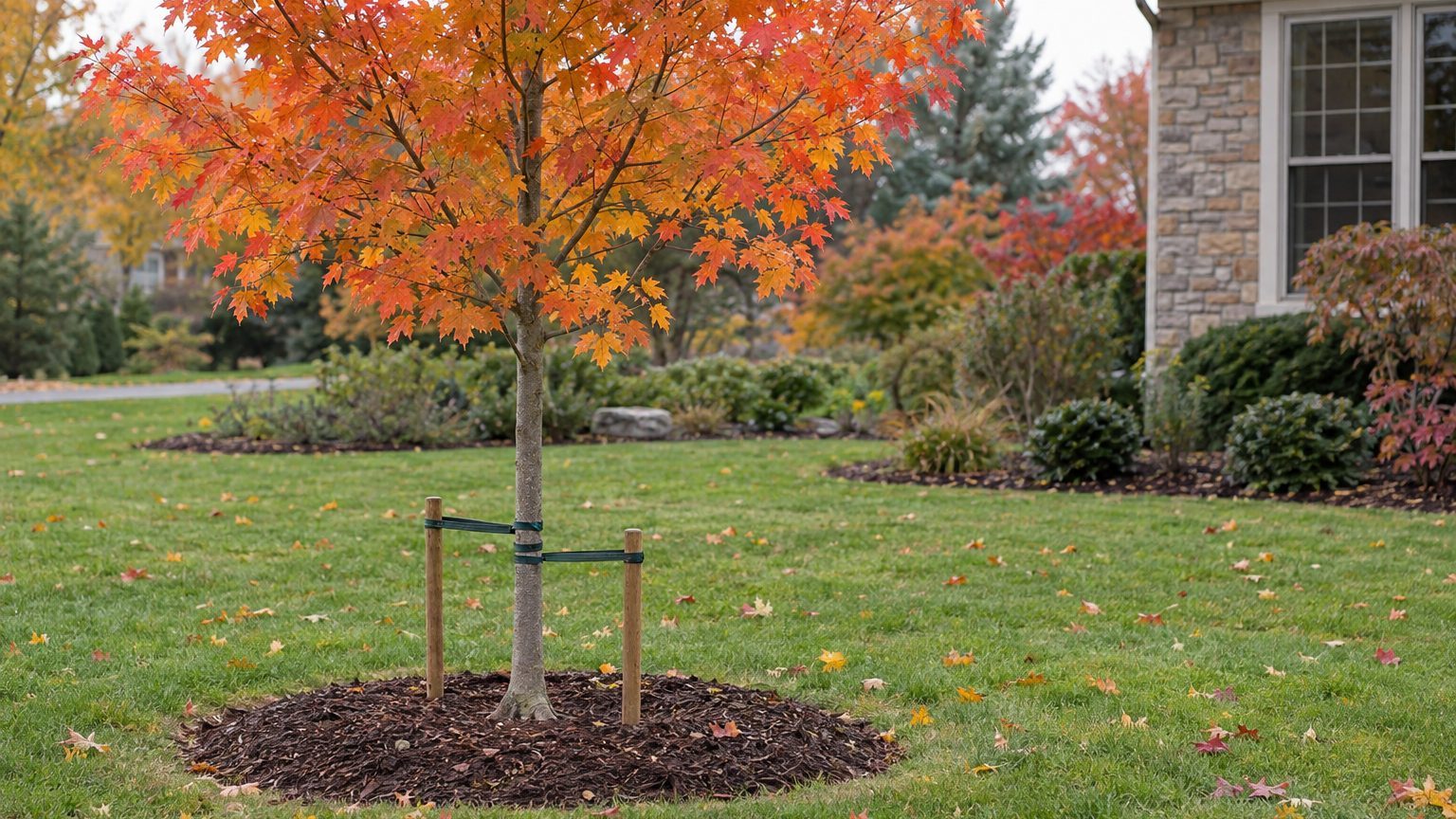
A young tree leaning after a windy storm makes most homeowners reach for a stake. In most yards the tree does not need one, because a trunk that moves a little in the wind grows thicker and stronger. Staking helps only a weak tree or one on an exposed site, and it should come off once the roots hold.
Does a Newly Planted Tree Need Staking?
Usually no. A tree that stands upright on its own after planting does best left free, and staking is reserved for sites and specimens that call for it. Extension guidance describes staking as typically unnecessary, with a few exceptions.
What changes the answer is the tree and the place. A weak tree, a tree on a windy site or one that cannot stand without help may need support for the first 6 months or year. Some apple trees on dwarfing rootstocks, such as M-9 and M-26, usually need support of some kind.
The state selector just below this section leads to the page for your state.
From the almanac
Trees in your state
The dates on this page depend on where you live. Your state's page carries its frost dates, its USDA zones and the year laid out month by month.
Northeast
Southeast
- Alabama
- Arkansas
- Delaware
- Florida
- Georgia
- Kentucky
- Louisiana
- Maryland
- Mississippi
- North Carolina
- South Carolina
- Tennessee
- Virginia
- West Virginia
Midwest
Southwest
West
Pacific Northwest
Canada
How to Stake a Tree

When a tree does need support, the work happens at planting time, and the goal is a tree that is held steady while the trunk can still flex. These steps go in order.
- Drive the stakes into solid, undisturbed ground outside the root ball, so that the post never pierces the roots you just spent time protecting.
- Drive each stake at least 6 inches into the soil so it holds firm when wind pushes against the tree.
- Use two stakes, placing one on each side of the trunk at least 18 inches away, so the pull on the tree stays balanced.
- Place the ties low, between 1/3 and 2/3 of the distance from the ground to the first branch, so that the top of the tree is free to move and the trunk is not forced to snap at the tie.
- Fasten the ties just snugly enough to support the tree, so the trunk can still sway 6 to 8 inches and grow stronger as it moves.
- Check the ties regularly through the growing season, so that nothing begins to rub the bark or bite into the trunk as it thickens.
The stakes and ties should come off as soon as the tree can stand alone. In a mild climate such as Florida, small fruit trees are ready within 2 to 6 weeks, while large trees may need up to 6 months. A forgotten tie turns into a band around a growing trunk, so removal matters as much as installation.
Staking by Tree Type
Most shade and ornamental trees need nothing at all, and the exceptions come from the tree or the site, not from a calendar.
Timing also varies with how long a tree takes to settle. The table sets out what changes for the types where the answer shifts.
| Tree Type | What changes | Why it matters |
|---|---|---|
| Trees on M-9 and M-26 rootstocks | Usually need support of some kind, and sometimes M-7 does too | The rootstock does not hold the tree upright without help |
| Small fruit trees | Stakes come off within 2 to 6 weeks in a mild climate such as Florida | Small trees firm up quickly, so long staking only weakens them |
| Large trees | Support comes off no more than 3 to 6 months after planting in that same climate | A bigger trunk needs longer to anchor, but still should not stay tied |
| Weak or windy-site trees | May stay staked for the first 6 months or year | A lean or constant wind can pull the roots loose before they grip |
For a home planting, this means a healthy tree with a straight trunk goes in without stakes. A tree on a dwarfing rootstock or on an open, breezy lot gets two stakes, and every one of them has a removal date in mind from the day it goes in.
Tree Staking Mistakes to Avoid
Leaving Stakes on Too Long
A tree held rigid grows a thin trunk and a weak root system, and ties left on can girdle the bark. Guidance runs from about 3 months up to no longer than a year, and in Alabama up to 12 to 18 months at most. Remove the support once the tree stands alone, usually after one growing season.
Tying the Tree Too Tight
A tight tie stops the swaying that builds trunk strength. In Oregon, the advice is to let the trunk move up to 2 inches in any direction. Loosen the ties so the tree is held but still flexes, and check them as the trunk thickens.
Driving Stakes into the Root Ball
A stake pushed through the root ball cuts the roots the tree needs to establish. Set stakes in solid ground outside the root ball instead. If guy wires are used, attach them on the lower half of the trunk, below 2/3 of the tree’s height, to lower the chance of the trunk breaking at the attachment point.
Staking Trees in Your State
The sign to watch is a tree that leans or rocks at the base after planting, or one set in a gusty spot. Once the trunk stands firm without help, the stakes can go. Months for each state sit on that state’s page.
- The planting months for your climate are listed on a separate page for your state, so you can set stakes at planting time.
- Look there again when the tree has grown a season, to decide when the ties should come off.
Common Questions
Can You Stake a Tree Too Loosely?
Yes. A tree that tips over or leans hard in a gust is held too loosely. The ties should keep it upright while still letting the trunk move, so snug them until the lean stops without locking the trunk in place.
What Should You Use to Tie a Tree to Its Stakes?
Choose a wide, flexible strap that spreads the pressure across the bark. Thin wire or rope can cut into the trunk as it grows, which is the reason ties need checking and removing on schedule.
How Many Stakes Does a Young Tree Need?
Two stakes on either side of the trunk are the usual setup, driven in near the base but outside the root ball. Wooden stakes that stand fairly tall are common for this, and they give the ties a place to sit low on the trunk.