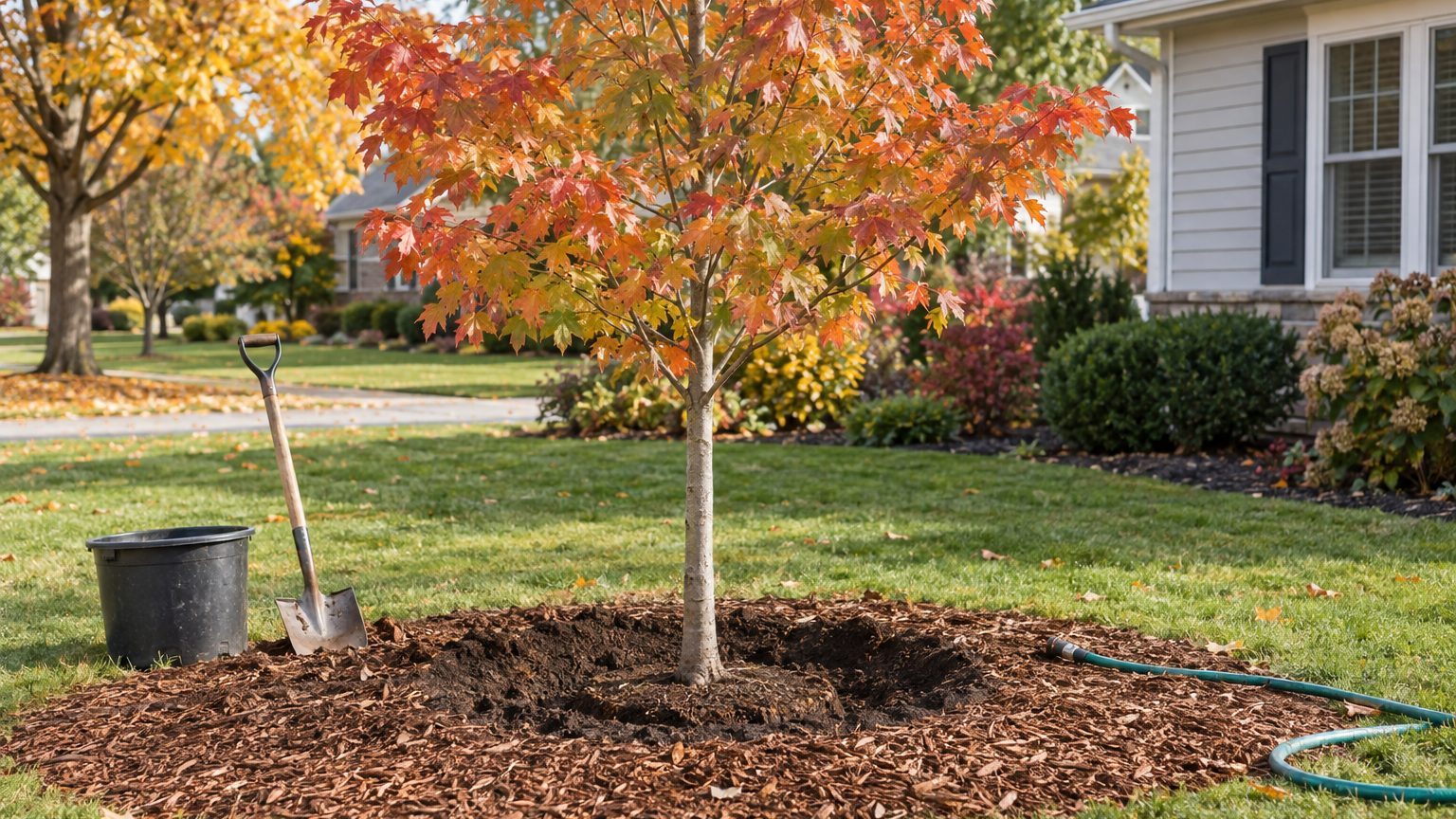
How a newly planted tree is set in its hole helps decide whether the roots spread or sit in a soggy pocket. The hole is wide and shallow, the trunk flare stays visible, and the first watering soaks the whole root ball.
What Is the Right Way to Plant a Tree?
Dig a wide, shallow hole, set the tree so the roots sit at the depth they grew in the nursery, refill with the soil you dug out, and water well. Width matters more than depth, because new roots spread sideways through loosened soil near the surface.
The details shift with the kind of tree (container, balled, or bare-root) and with your soil. Where drainage is poor, the tree rides a little higher so water runs away from the trunk instead of pooling around it.
The state selector just below this section leads to the page for your state, where timing is spelled out for your climate.
From the almanac
Trees in your state
The dates on this page depend on where you live. Your state's page carries its frost dates, its USDA zones and the year laid out month by month.
Northeast
Southeast
- Alabama
- Arkansas
- Delaware
- Florida
- Georgia
- Kentucky
- Louisiana
- Maryland
- Mississippi
- North Carolina
- South Carolina
- Tennessee
- Virginia
- West Virginia
Midwest
Southwest
West
Pacific Northwest
Canada
How to Plant a Tree Step by Step

The order of the work matters, because each gesture protects the roots from a different problem.
- Size the root ball to the trunk before you buy or dig, so that the roots can support the top. As a rule of thumb, allow 10 to 12 inches of root ball width for each inch of trunk caliper, which means a tree with a 3-inch caliper needs a root ball of at least 30 to 36 inches.
- Dig the hole about 6 to 12 inches wider than the roots are when spread out, so that the surrounding soil is loose enough for new roots to push into.
- Set the tree so the root ball sits 1 to 2 inches above grade, which allows for settling and for mulch. If drainage is poor or the soil is compacted, set the tree 2 to 4 inches above the surrounding ground so that water drains away from the trunk.
- Check that the trunk flare is visible, and on a grafted tree that the bud union stays above the soil line. Burying either one invites rot at the base.
- Backfill with the soil you removed and firm it gently, so that air pockets close without crushing the roots. Skip heavy amendments, which can make the hole drain differently from the ground around it.
- Spread about 3 inches of mulch in a ring, keeping it off the trunk, so that the soil stays evenly moist and the bark stays dry.
Water slowly right after planting, until the whole root zone is soaked. In Oregon, about 3 to 5 gallons of water per tree every week should be enough. Hotter, drier places call for more attention, so check the soil itself before watering.
Planting by Tree Type
Container, balled, and bare-root trees all want the same wide hole, but they arrive in different states. What the roots look like on planting day sets how much care the first season takes.
Bare-root trees are planted while dormant and suit smaller stock, so the roots are never out of the ground long.
| Tree Type | What changes | Why it matters |
|---|---|---|
| Bare-root deciduous | Trunk caliper under 2 inches | Smaller trees recover faster once the roots are bare |
| Bare-root evergreen | Very small, under 2 feet tall | Larger evergreens lose too many roots when dug without a ball |
| Grafted fruit tree | Bud union 2 to 3 inches above the soil line | The graft stays dry and the variety above it stays true |
| Shade tree | Choose a planting spot at least 15 to 20 feet from the foundation and well away from power lines. | Room for the mature crown without damage to the house or wires |
| Peach and similar fruit trees | Space trees 12 to 16 feet apart, adjusting for the rootstock and how the trees are trained. | Each tree gets light and airflow |
In practice, check the trunk size and the label before you dig. A shade tree needs its siting decided first, while a fruit tree needs its union tracked and its spacing planned.
Tree Planting Mistakes to Avoid
Planting Too Deep
A hole dug to the full depth of the root ball often leaves the trunk flare buried. Keep the roots within 1 to 2 inches of the surface and let the flare show.
Piling Soil Over Existing Trees
Raising the grade around a nearby tree to match a new bed smothers its roots. Adding more than 1 to 3 inches of soil is discouraged, and even that only in a limited way. Build a mulch ring instead and keep the original soil level.
Planting When the Soil Is Cold
Roots grow only when the soil is warm enough. Where fall planting is common, as in Indiana, soil should be well above 55 F at a depth of 6 inches.
When to Plant Trees in Your State
The sign to watch is soil that is workable and not frozen, with roots able to grow. A dormant tree can go in then, and a tree in leaf is better planted when the soil is warm.
- Pick your state from the selector on this site to find the months that fit your climate.
- Check that page again in late winter if you plan a spring planting, and again in late summer if you plan to plant in fall.
Common Questions
How Far from the House Should You Plant a Shade Tree?
Keep a shade tree at least 15 to 20 feet from the foundation, and look up for power lines before you choose the spot. The crown and roots both grow far beyond what the nursery pot suggests.
Should You Add Fertilizer or Rich Soil to the Planting Hole?
Plain backfill is the usual choice, because roots then grow out into the surrounding ground instead of circling in a richer pocket. Mulch on top does more for a young tree than anything mixed into the hole.
What Size Tree Is Easiest to Establish?
Smaller stock settles in faster. Bare-root deciduous trees with a caliper under 2 inches, and very small evergreens, lose fewer roots in the move and catch up quickly once watered regularly.