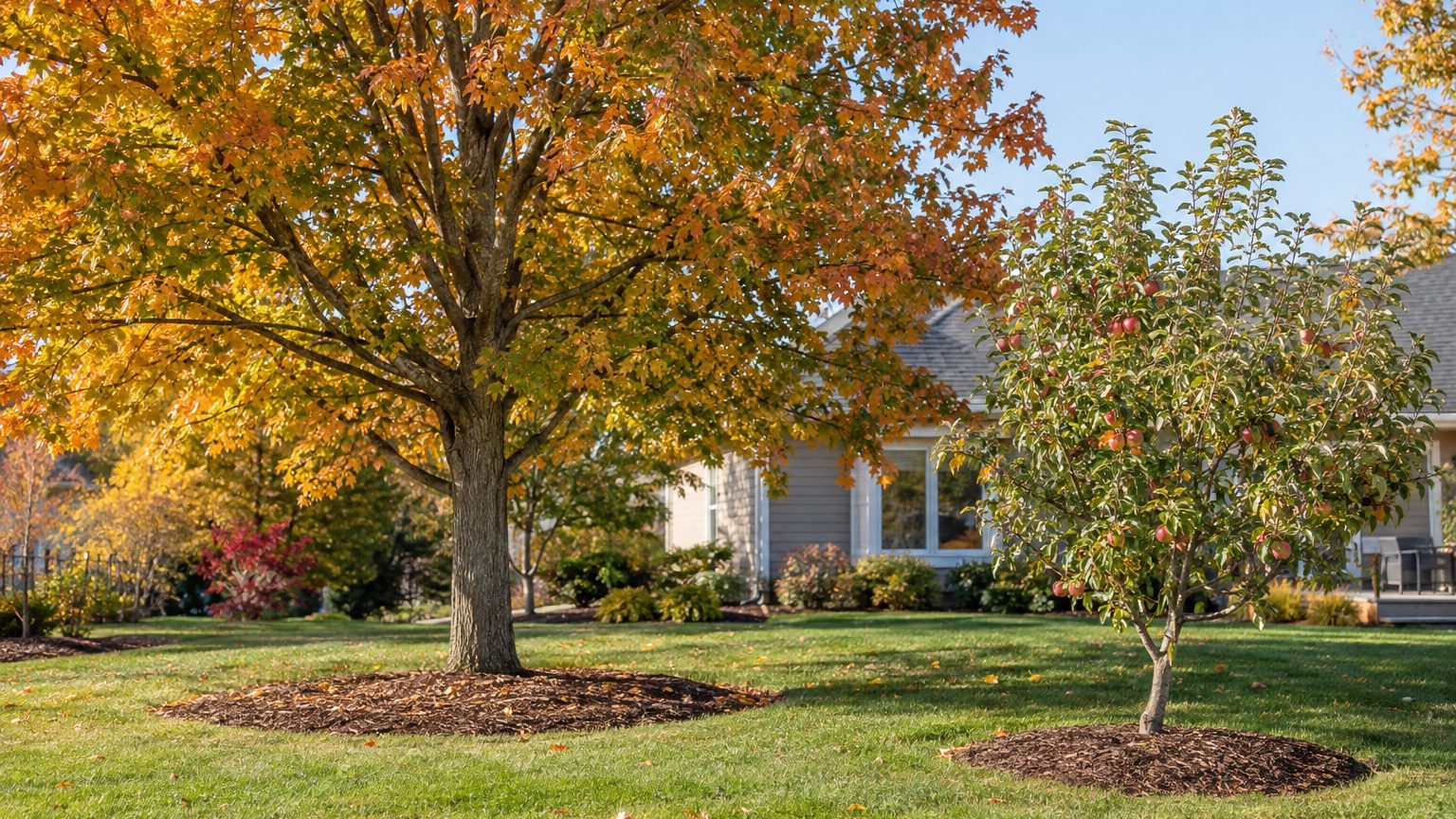
A bare-root sapling leafs out in early spring, a crabapple blooms in spring, and a young maple needs regular water while it establishes. Planting trees well comes down to matching the tree to the season and to your climate, which means knowing how the year runs, which types suit a yard, and what grows where.
Tree Care Calendar by Season
A tree asks for something different at each point in the year, and most of the work is simply being there at the right moment.
- In early spring, plant bare-root trees while they are still dormant, because roots that wake up in the nursery bed have no time to settle once leaves open. For container trees, wait until the soil is workable and follow local planting guidance.
- Once buds swell on fruit trees, watch the forecast, since open blossoms are the part of the tree that frost damages and a cold night can cost you the crop.
- Thin crowded fruit when local guidance recommends it so the branches are not overloaded and the remaining fruit can grow larger.
- Water young trees regularly and deeply while their roots establish in the surrounding soil.
- Before planting outside the locally recommended window, check guidance for your climate. The air cools but the soil stays warm, and roots keep growing until the ground chills.
- In winter, leave the tree alone. Fruit trees use the cold to rest, and where winters are mild, the chilling that fruit trees need builds up over the cold season. In Texas, late winter just before new spring growth emerges is the best pruning time for many landscape plants.
Exact months shift a good deal from one climate to the next, so the state selector just below this section leads to the page for your state.
From the almanac
Trees in your state
The dates on this page depend on where you live. Your state's page carries its frost dates, its USDA zones and the year laid out month by month.
Northeast
Southeast
- Alabama
- Arkansas
- Delaware
- Florida
- Georgia
- Kentucky
- Louisiana
- Maryland
- Mississippi
- North Carolina
- South Carolina
- Tennessee
- Virginia
- West Virginia
Midwest
Southwest
West
Pacific Northwest
Canada
Types of Trees for Home Yards and What Each Needs
Yard trees fall into a few families, and the family tells you most of what you need to know about size, sun and care. Pick the family for the job first, whether that is shade, spring flowers, a screen or fruit, and the species follows.
Fruit trees split into pome fruits, such as apples and pears, and stone fruits, such as peaches, cherries and plums. Both groups need winter cold to set fruit and a sunny, open spot.
| Tree type | What it gives you | What it needs |
|---|---|---|
| Shade trees (maples, oaks) | Summer shade and fall color. In California, black oak grows slowly to 30-70 ft and nearly as wide. | Plenty of room overhead and underground. Sugar maple tolerates shade while young. |
| Flowering trees (redbud, crabapple) | Pink to purple blooms in early spring on a small, multi-stemmed redbud. In North Carolina, Southern crabapple reaches about 20 to 30 feet and provides food for early bees. | Well-drained soil. Redbud takes full sun to part shade. |
| Conifers (pines, Douglas-fir) | Year-round shade and windbreaks. | More sun for pines, since Douglas-fir tolerates shade better than they do. |
| Stone fruit (peach) | In the medium-chill zone of Texas, a series of peaches can ripen from late May to early July. | Winter cold, sun and a site where spring frost is less likely to reach the blossoms. |
Dogwood belongs with the flowering trees and likes the same kind of well-drained spot, while apples and pears follow the stone fruits in wanting sun and winter chill.
Best Trees by Region and Hardiness Zone
Winter cold, spring frost on blossoms, summer heat and soil decide what thrives, and each part of the country has its own short list of trees that handle those limits.
- Upper Midwest and northern plains (Minnesota, North Dakota, Wisconsin, and the Prairie provinces): Crabapples tolerate a wide range of soils as long as they drain well. Disease-resistant cultivars are worth choosing, since the columnar Siberian crabapple is highly susceptible to fireblight.
- Alaska and the far north (Alaska, Yukon): Hardy crabapple cultivars survive temperatures down to -40°F in the Interior. Siberian and Dolgo crabapples grow well and bear edible fruit.
- New England and New York (Maine, New Hampshire, New York): Red maple adapts to many soils, while paper birch and aspen want full sun and fade in shade. Eastern redbud does well in average, medium-moisture, well-drained soil.
- Great Lakes, Corn Belt and Central Plains (Iowa, Indiana, Ohio): Redbuds grown from a northern seed source are more likely to take the cold, and they like moist, well-drained soil. Common hackberry grows fast but its limbs can break in wind and ice.
- Mid-Atlantic, Kentucky and Tennessee (Pennsylvania, Virginia, Tennessee): Where a site already has tree cover, shade-tolerant eastern hemlock, blackgum and sugar maple suit it. Mixing white pine with hardwoods makes a sturdier planting, and American holly gives winter color.
- Deep South (Georgia, Alabama, South Carolina): Eastern redbud likes moist soil but handles most sites. Pin oaks tolerate city conditions.
- Desert Southwest (Arizona, Nevada, New Mexico): ask your local extension office which trees shade a yard on little water. Afghan pine and Arizona cypress are evergreens for screening and windbreaks.
- Pacific Northwest (Oregon, Washington, British Columbia): Douglas-fir tolerates more shade than the pines, and grand fir tolerates more still. Western larch needs more moisture and light than either.
Sugar maple shows how much heat and dryness matter. In Arkansas, sugar maple is best kept to the northern tier because it struggles in hot, dry summers.
Common Tree Problems and What Causes Them
Young Tree Declining After Planting
A newly planted tree that sulks is often a victim of the nursery container. Large trees raised in small pots can be root bound, with roots circling instead of spreading. Loosen or cut circling roots at planting, and choose a tree sized to its container.
Staking can also cause damage. Tie a tree with wide, soft material, because wire or nylon rope eventually cuts into the growing trunk.
Fruit Tree Not Producing
A healthy tree with plenty of leaves but no fruit has usually run into a spring frost that killed the open blossoms, too little winter chill for the variety, or too little sun. Check the branches for brown, shriveled blooms after a cold night, and note whether the tree sits in shade for part of the day.
Yellowing Leaves
Yellow leaves on a young tree, along with soil that stays soggy below the surface, point to roots sitting in water. Poke a finger into the ground beside the trunk. Where the soil drains poorly, ease off watering and avoid planting in low, wet spots.
Borer Holes in the Trunk
Small round holes with fine sawdust at the base of the trunk, on a tree already stressed by drought or damage, signal borers. Some borers target stressed trees, so steady watering and avoiding trunk wounds from mowers and string trimmers can help protect them.
Tree Planting Guides by State
Dormancy windows and frost risk vary widely, so the timing that fits a tree in your yard is set by your state. The state guides cover planting and pruning timing.
- Best Time to Plant Trees in your state gives the planting months for your climate, so you know when the ground is workable and the tree is resting.
- When to Prune Fruit Trees in your state explains the pruning window for your climate, so you can have the loppers ready ahead of it.
Common Questions
What Does a Hardiness Zone Tell You About a Tree?
A zone shows the winter cold a tree survives. For gardeners in Florida, star magnolia can be planted in USDA Hardiness Zones 5A through 8B. Find your own zone and match it to the range on the tree tag before you buy.
When Do You Plant a Bare-Root Tree?
In Utah, bare-root trees should be dormant, so early spring is the best planting time. Plant them soon after you bring them home and keep the roots from drying out in the meantime.
How Do You Mulch Around a New Tree?
Spread mulch in a wide ring over the root zone and leave a gap around the trunk. Mulch heaped against the bark holds moisture where it should stay dry, and it invites rot and pests.