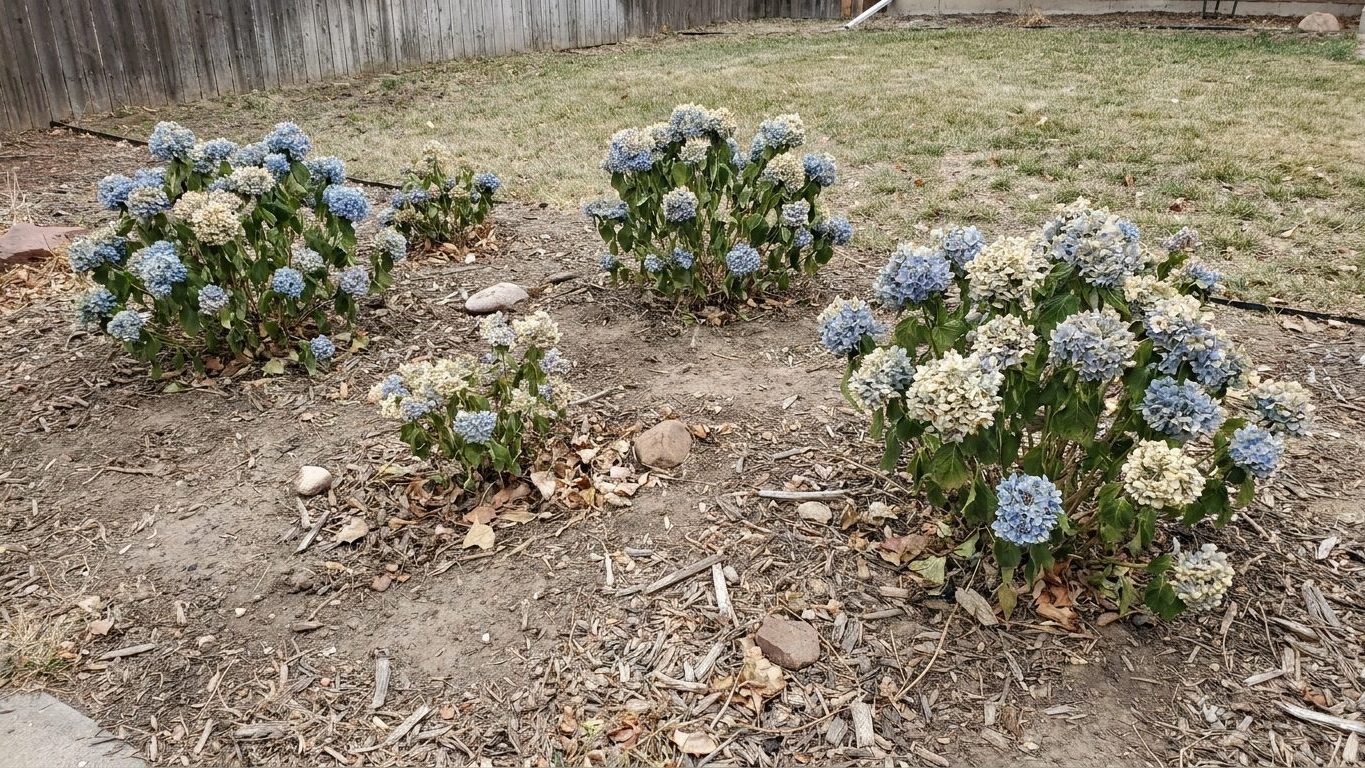
Minnesota’s winters rule out most bigleaf hydrangeas but reward panicle and smooth types with reliable summer blooms year after year. Plant in spring once the ground thaws or in late summer before frost returns, prune bigleaf wood right after it flowers, and feed on a schedule matched to the state’s short growing season. The details below cover exactly when and which.
Hydrangeas Care Calendar for Minnesota

NOAA NCEI 1991-2020 Climate Normals put the last spring freeze in Minneapolis-St Paul at April 17 to April 30 and the first fall freeze at October 11 to October 23, with the state spanning USDA zone 3a to 5a.
- Dormancy: the one safe window to move a plant, roots undisturbed, falls in late winter before new growth pushes.
- Planting: set new shrubs in April, May, August or September, once the soil has thawed and warmed enough to work.
- Bud protection: shield tender new growth through the last spring freeze window of April 17 to April 30, since a late cold snap can still take the season’s first flush.
- First feeding: fertilize in March, before the plant breaks dormancy.
- Bloom-season feeding: feed again in May and July, matching the plant’s two pushes of active growth.
- Pruning bigleaf: cut spent bigleaf wood in June or July, right after the flowers fade, never once fall arrives.
- Fall wind-down: stop feeding and let new wood harden before the first fall freeze of October 11 to October 23.
That six-month rhythm, tied to two frost dates rather than a single mark on the calendar, decides more for a Minnesota hydrangea than any other single factor.
Best Hydrangeas for Minnesota
The USDA Plant Hardiness Zone Map puts Minnesota at zone 3a to 5a, colder than most states in this guide. That single fact eliminates more hydrangea types than it allows, mostly by killing overwintering flower buds rather than the plant itself.
Whether a shrub blooms again next summer comes down to where it sets those buds, on last year’s stems or on the current season’s new growth. New-wood bloomers shrug off a hard winter here.
| Kind | Verdict here | Why |
|---|---|---|
| Panicle | Reliable statewide | Blooms on new wood, so winterkill at the state’s cold edge doesn’t touch the flower buds. |
| Smooth (Annabelle type) | Reliable statewide | Also flowers on new wood and rebounds from a hard dieback every spring. |
| Bigleaf | Root-hardy, blooms unreliable | Sets buds on last year’s wood, which winter lows across zone 3a to 5a often kill before spring. |
| Oakleaf | Marginal, sheltered spots only | Suits the milder edge of the state’s zone range but loses buds in an exposed yard. |
| Climbing | Slow, mostly foliage | Needs years of shelter to reach flowering wood in a climate this short. |
Mountain hydrangea and other regional selections are uncommon enough here that they belong on the varieties page rather than this table. For most yards, the practical choice sits between panicle and smooth.
When to Plant, Prune and Feed Hydrangeas in Minnesota
NOAA NCEI 1991-2020 Climate Normals set the Minneapolis-St Paul freeze windows at April 17 to April 30 in spring and October 11 to October 23 in fall, and those two brackets anchor every date below.
Planting, pruning and feeding don’t share one clock. Each follows its own trigger, tied to root growth, bud set or frost risk rather than a fixed month.
| Task | Window here | Counted from |
|---|---|---|
| Plant | April, May, August, September | Spring slots wait out the freeze risk, fall slots leave time to root before frost returns. |
| Prune bigleaf | June, July | Right after the spent flowers fade, ahead of next year’s buds forming on that same wood. |
| Feed | March, May, July | Once before growth starts, then twice more through the active growing months. |
A shrub planted in September still needs several weeks of root growth before that October freeze window closes, which is why the earlier fall slot is the safer bet in a short-season state like this one.
Hydrangeas Problems in Minnesota and What Causes Them
No flowers despite a healthy plant

A bigleaf hydrangea that leafs out fine but skips flowering usually lost its buds over winter, either to the cold itself across zone 3a to 5a or to a late freeze after they swelled. Switching to a new-wood bloomer sidesteps the problem entirely.
New growth blackened in spring

Tender shoots that emerge early and then turn black and limp got caught by a freeze still inside the April 17 to April 30 window. The fix is patience, not protection: hold off uncovering plants until that window has fully passed.
Blooms cut short in fall

Flowers that fade fast or brown early are often just running out of season, since the first freeze can arrive as soon as October 11. Stopping feeding after July, per the calendar above, lets wood harden before that date instead of pushing soft late growth.
Minnesota North to South: How the Dates Shift
The state-level frost dates above describe Minneapolis-St Paul, and the rest of Minnesota shifts from that mild southern reading in a fairly predictable direction.
- The Twin Cities and the south (the mild end of zone 5a): carries the latest last spring freeze relief and the widest practical planting window in the state.
- Central Minnesota (zone 4a to 4b): sits between the two extremes, with a season noticeably shorter than the metro but gentler than the northern counties.
- The North and the Arrowhead (zone 3a, the coldest end): runs two to three weeks tighter at both ends of the season, per the caution built into the frost data, which trims the safe planting and pruning windows accordingly.
Anyone gardening outside the metro should treat the dates on this page as a starting point and lean on the tighter northern range if the county sits near the Canadian border.
Minnesota Extension Offices and County Contacts
Extension research runs county by county, and the University of Minnesota Extension is the state’s land-grant service for exactly this kind of local answer.
- University of Minnesota Extension: extension.umn.edu connects to the county office nearest you for site-specific advice.
- Which ones hold up here: a deeper look at bloom-on-old-wood versus bloom-on-new-wood varieties for this state.
- What goes wrong here: the pests and diseases that show up on Minnesota hydrangeas beyond winterkill.
September still falls inside the planting window here, so a new shrub going in now has just enough time to root before the ground closes for winter.
Common questions
Do hydrangeas survive Minnesota winters?
Panicle and smooth hydrangeas survive reliably across the state’s zone 3a to 5a range because they rebuild their flowering wood each spring. Bigleaf hydrangeas usually survive as a plant but often lose the flower buds themselves.
When is it safe to plant hydrangeas in Minnesota?
April, May, August and September are the state’s planting months, with spring planting timed after the last freeze clears around April 17 to April 30 and fall planting left early enough to root before mid-October.
Why didn’t my hydrangea bloom this year in Minnesota?
The most common cause is a bigleaf variety that lost its old-wood buds to winter cold or a late spring freeze. Pruning at the wrong time in fall can also remove next year’s buds before they get the chance to open.