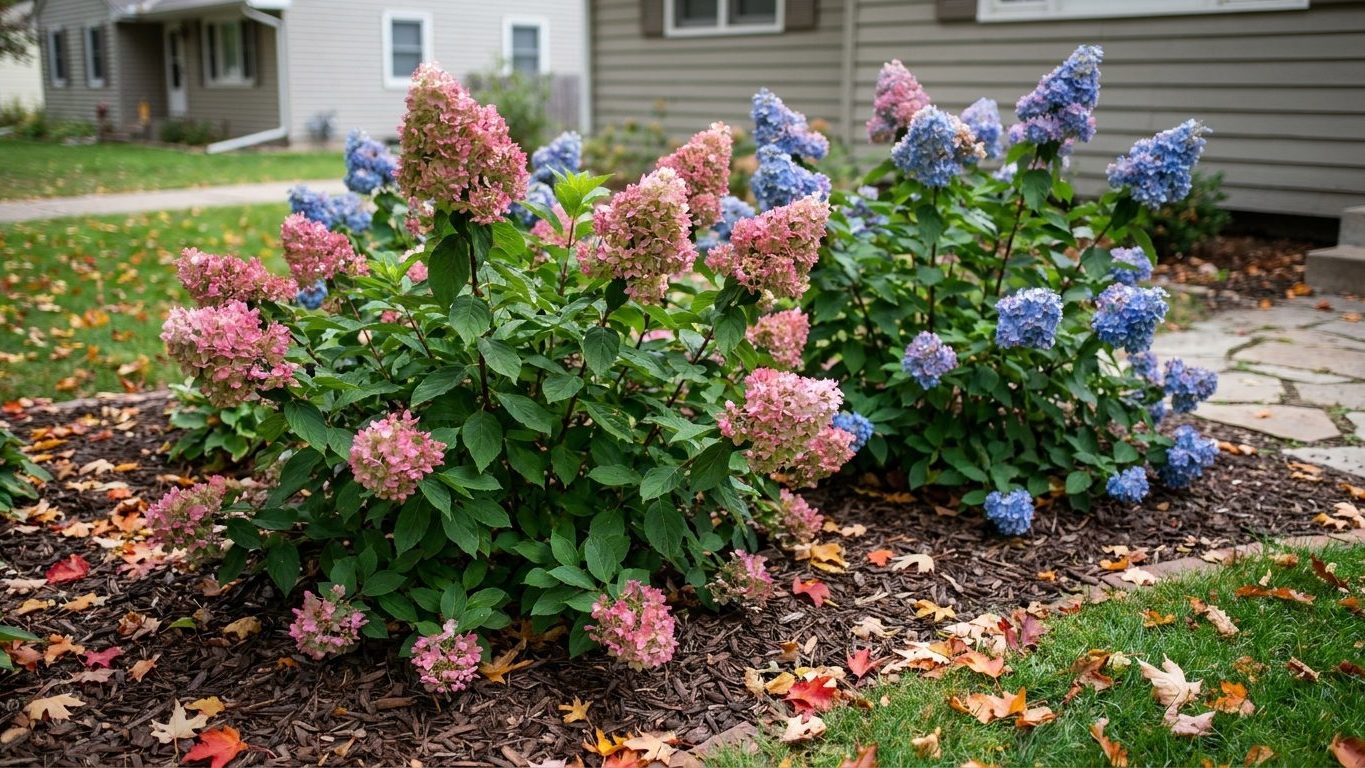
Hydrangeas in Minnesota face a short, sharp list of threats: winter bud kill, aphids, powdery mildew, leaf spot, botrytis blight, and deer browsing. Cold damage outranks every insect or fungus here. Knowing which problem is showing up, and what separates a recovering shrub from a dying one, matters most in Minneapolis-Saint Paul.
Hydrangea pests and diseases Minnesota: The Short Answer
NOAA NCEI 1991-2020 Climate Normals put Minneapolis-Saint Paul’s last spring frost between April 17 and April 30, with the first fall frost landing October 11 to October 23. That window is what a hydrangea has to leaf out, bloom, and harden off again, and it is why winter injury outdoes any single insect or fungus here.
Add a hardiness range of zone 3a to 5a across the state, and a stem that survives a cold December can still lose every flower bud before April arrives. Here is the full list, in the order each one tends to show up over a Minnesota season.
Winter bud blast and stem dieback

Cold settles into unprotected stem tips and flower buds over winter, hitting bigleaf types built for warmer zones hardest. Wood that looks fine in March can leaf out only from the base, with no blooms above it. Choose panicle or smooth varieties bred for colder zones, and mulch crowns heavy each fall.
Aphids
Clusters of small green or black insects gather on new growth soon after leaves open, curling tips and leaving a sticky residue that draws sooty mold. A strong hose spray most mornings knocks populations down before they build, and ladybugs usually finish the job without any spray at all.
Powdery mildew
A gray-white film spreads across leaf surfaces during Minnesota’s humid July and August stretches, especially on plants crowded against a fence or wall. It rarely kills a hydrangea but slows next year’s buds. Space shrubs for airflow and water the soil, not the foliage, in the evening.
Cercospora leaf spot
Small purple-brown spots appear on lower leaves first during wet summer weeks, spreading upward and causing early leaf drop by late August. It rarely threatens a healthy shrub but looks alarming. Rake and discard fallen leaves each fall so spores don’t overwinter in the mulch bed.
Botrytis blight
Cool, damp stretches in spring or fall coat flower clusters and soft stems in a gray fuzzy mold, turning petals brown almost overnight. It thrives where water sits on the plant overnight. Prune out affected blooms immediately and avoid overhead watering during any cloudy, wet stretch.
Deer and rabbit browsing

Once perennial food sources die back in late fall, deer and rabbits strip buds and bark from exposed stems all winter, the same stems that would have carried next year’s flowers. A physical fence around the shrub beats any repellent spray for reliability through a Minnesota winter.
Minnesota — the year and the numbers
- State
- Minnesota
- USDA zones
- 3a-5a
- Last spring frost
- April 17 to April 30
- First fall frost
- October 11 to October 23
- Annual rain
- 32 in
- Lawn zone
- cool-season
- Source
- NOAA NCEI 1991-2020 Climate Normals, 32F freeze probabilities · Minneapolis
How to Work Out the Dates for Your Own Yard
Matching a symptom to its cause starts with the calendar, since Minnesota’s problems don’t all show up at once. NOAA NCEI 1991-2020 Climate Normals give Minneapolis-Saint Paul a last spring frost of April 17 to April 30, and every problem below reads differently depending on how many weeks past that date it is.
- Check the calendar first: if it’s late April to early May and stems look dead, wait two to three weeks past the frost window before calling it dieback rather than late leaf-out.
- Scratch the bark near the soil line: green tissue under the surface means the crown survived even if every stem above did not, which rules out disease entirely.
- Look at which leaves are affected first: spots starting on lower, older leaves point to Cercospora leaf spot, while a gray film across upper leaves in July or August points to powdery mildew.
- Check for sticky residue or curled tips: this narrows things to aphids rather than a fungal problem, especially in the first weeks after leaf-out.
- Note the weather in the week before symptoms: a cool, damp stretch right before petals turn brown and fuzzy points to botrytis blight, not simple flower fade.
- Inspect stems at snow melt for gnaw marks: bark stripped in clean patches near the ground is deer or rabbit browsing, not winter dieback.
Once you know the problem, timing decides the fix. Fertilize only in March, May, or July, plant new shrubs in April, May, August, or September, and save bigleaf pruning for June or July: a badly timed cut turns a minor issue into a season with no blooms.
Minnesota North to South: How the Dates Shift
Minnesota’s frost dates and hardiness zones don’t hold steady from the Iowa border to the Canadian one, and that shift changes when each problem on this list actually shows up. USDA Plant Hardiness Zone Map data spans zone 3a to 5a across the state, with the mildest pocket sitting around the Twin Cities.
- The Arrowhead and the North Shore (Duluth, Grand Marais, International Falls): winters run colder and longer here, so bud blast and stem dieback show up more often and more severely, and deer start browsing exposed stems earlier in fall.
- The Twin Cities metro (Minneapolis, Saint Paul, Bloomington): this is the reference zone for the state’s frost dates, with the longest frost-free stretch and the mildest winters, which gives powdery mildew and leaf spot more time to develop in a humid summer.
- Southern Minnesota (Rochester, Mankato, Albert Lea): frost dates land close to the Twin Cities window, but slightly more humid summers give Cercospora leaf spot and botrytis blight a longer stretch to take hold before fall arrives.
Whichever part of the state you garden in, the Minnesota hydrangea calendar page lines up planting, fertilizing, and pruning windows to your own frost dates rather than a statewide average.
Mistakes Minnesota Punishes
Skipping fall mulch
USDA Plant Hardiness Zone Map data places Minnesota at zone 3a to 5a, cold enough that bare crowns left exposed all winter lose stems and buds a few inches of mulch would have blocked. Pile mulch over the crown once the ground starts to freeze, not before, so mice don’t nest in it.
Pruning bigleaf in fall
Cutting stems back after summer removes the flower buds already set for next year, since bigleaf hydrangeas bloom on old wood. Save any pruning for June or July instead, right after this year’s blooms fade, so next year’s buds have time to form before frost.
Fertilizing outside the window
A late summer feeding pushes soft new growth that has no time to harden before the first fall frost arrives October 11 to October 23. Stick to March, May, and July applications only, and let the plant slow down naturally as the season winds down.
Minnesota Extension Offices and County Contacts
Every number here starts from the Twin Cities and the state’s zone 3a to 5a range, but a county office narrows it to your own soil and microclimate. University of Minnesota Extension keeps that detail at extension.umn.edu.
- Your Minnesota hydrangea calendar: the frost dates and pruning window laid out month by month for this state.
- Which hydrangeas grow well in Minnesota: varieties ranked from safest to riskiest for this climate.
- Your county extension office: local staff who can confirm a diagnosis and check soil test results specific to your yard.
Common questions
Why do my Minnesota hydrangeas have no flowers but healthy leaves?
Winter cold likely killed the flower buds while the crown and stems survived underneath. This hits bigleaf varieties hardest in zone 3a to 5a winters. Switch to a panicle or smooth variety, or mulch the crown heavier each fall to protect next year’s buds.
Are hydrangeas deer resistant in Minnesota?
No. Deer and rabbits browse hydrangea buds and bark through winter once other food sources die back, and a hungry deer will strip a young shrub down to bare stems. A physical fence around the plant works better than repellent sprays through a long Minnesota winter.
Can I treat powdery mildew without chemicals?
Usually, yes. Spacing shrubs for airflow and watering the soil instead of the leaves in the evening cuts down the humid conditions mildew needs. It rarely kills a hydrangea outright, so a cultural fix is often enough without reaching for a fungicide.