Skip to content

Rose Curculio on Roses: How to Spot Them and Get Rid of Them

Rose Curculio on Roses: How to Spot Them and Get Rid of Them

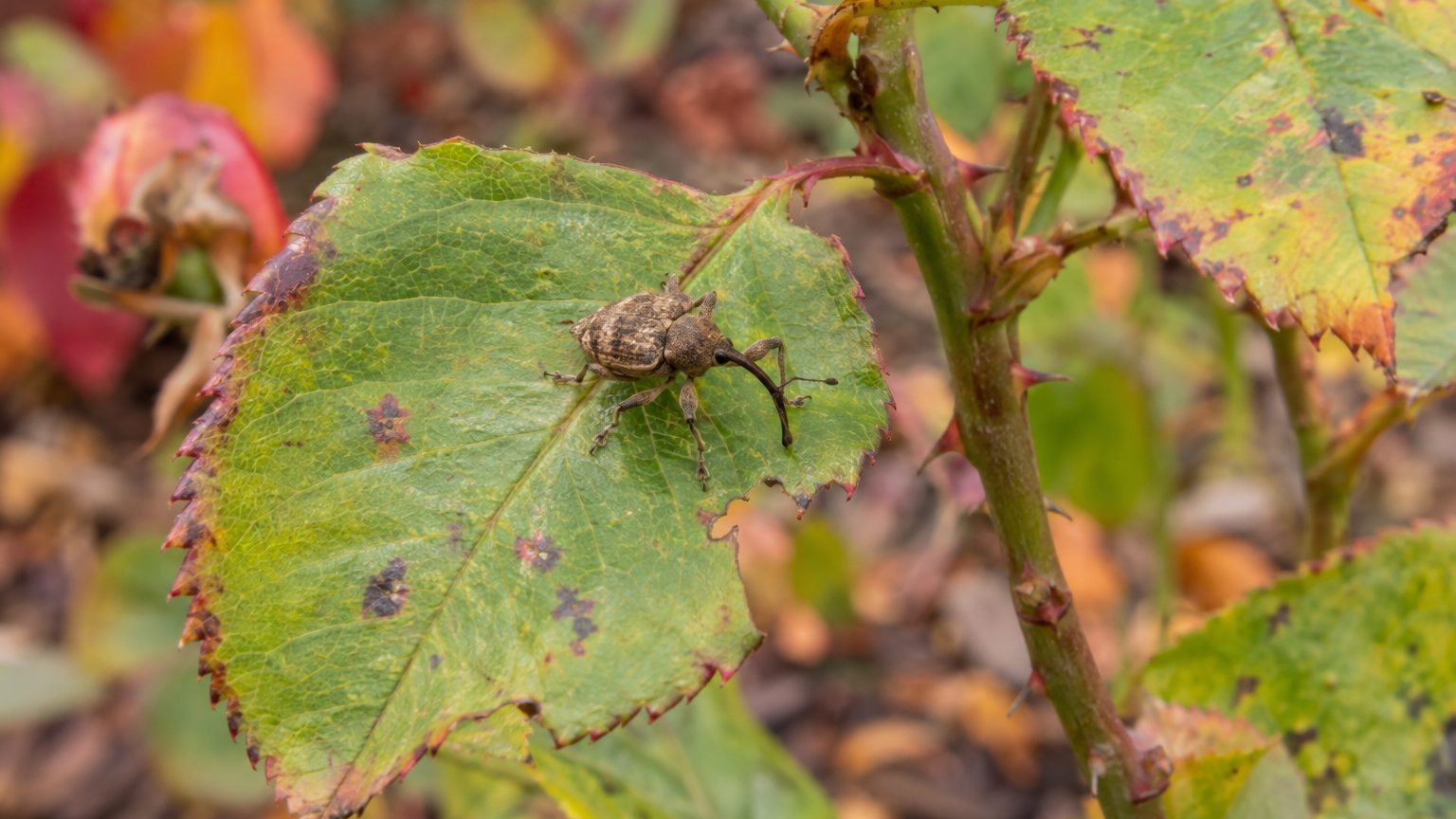
Ragged holes in rosebuds or buds that never open often point to a small red and black weevil feeding on the plant. Rose curculio feeds on buds, petals and cane tips, and its larvae finish the job from inside the bud. The adult is red and black with a long snout, while the larvae remain hidden inside the bud.

Rose Curculio: What You See

Rose Curculio on a rose

Start with the insect itself, because its colors and snout help distinguish it from other insects on a rose.

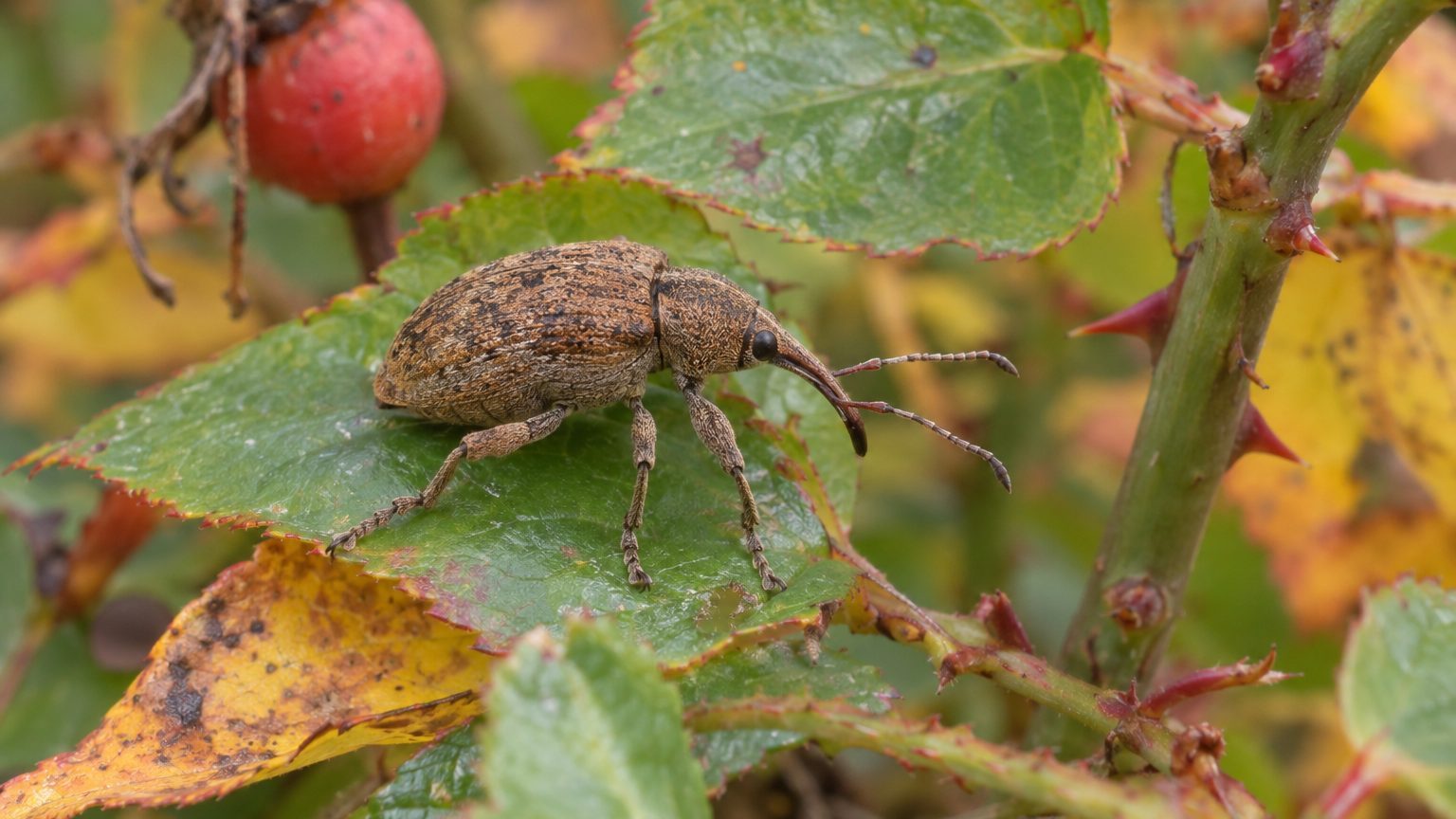
  • The adult has a bright red back and thorax with a black head that stretches into a long snout.
  • It is a hard-bodied beetle about 1/4 inch long, with long black legs and distinct antennae.
  • In California, adults drill holes in buds, and flowers that open may have ragged petals.
  • Stems may bend over just below a bud that has been fed on, as reported in Minnesota.
  • Shoot tips die back, and where weevils are numerous in California, terminal shoots may be killed.
  • Buds that never open may hold plump, legless, pale orange to whitish larvae with a brown head.

In California, adults emerge from the soil in spring.

Rose Curculio or Something Else?

The damage is easy to blame on the wrong insect, because chewed buds have more than one culprit. A hole in a bud tells you something ate it. It does not tell you what.

Check the plant itself and the inside of the bud before you decide.

Looks like How to tell them apart
Earwig feeding, with holes in buds and sometimes young shoots Rose curculio shows a red and black weevil with a long snout on the bud, and a bud that stays shut may hold a pale larva with a brown head

Raspberries and other caneberries can host the same weevil, so cane fruit growing near the roses is worth a glance when buds look chewed.

What Causes Rose Curculio, and Where It Is Worst

The cause is a weevil with one generation a year. Adults feed on buds, and females lay eggs inside them. The eggs hatch into larvae that keep feeding inside the bud, often killing it before it opens.

Mature larvae drop to the ground and pass the winter as pupae in the soil around the base of the plant. In California, adults emerge from that soil in spring, and the cycle starts again right under the same shrub.

Wild roses are the main host for this native weevil. Garden roses with hips draw adults, and pink and yellow ones are named as favorites. Yellow and white roses are also described as preferred hosts.

How to Treat Rose Curculio

How to Prevent Rose Curculio Coming Back

  • In early spring, watch for the first red and black adults as they come out of the soil, since in California that is when they emerge.

Where This Comes From

Wild roses are the main host of this native weevil.

Common Questions

Do Rose Curculios Attack Raspberries Too?

Yes, though less commonly than roses. Both the rose curculio and the western rose curculio feed on caneberries and roses.

How Many Generations of Rose Curculio Are There Each Year?

One. The weevil has a single generation, so the larvae you see in buds will become the adults of next spring.

What Do Rose Curculio Eggs Look Like?

The eggs are oval and about 1/25 inch long. They sit hidden in the bracts and buds of the flowers, so you are far more likely to notice the damage than the eggs.
Leafcutting Bees on Roses: How to Spot Them and Get Rid of Them

Leafcutting Bees on Roses: How to Spot Them and Get Rid of Them

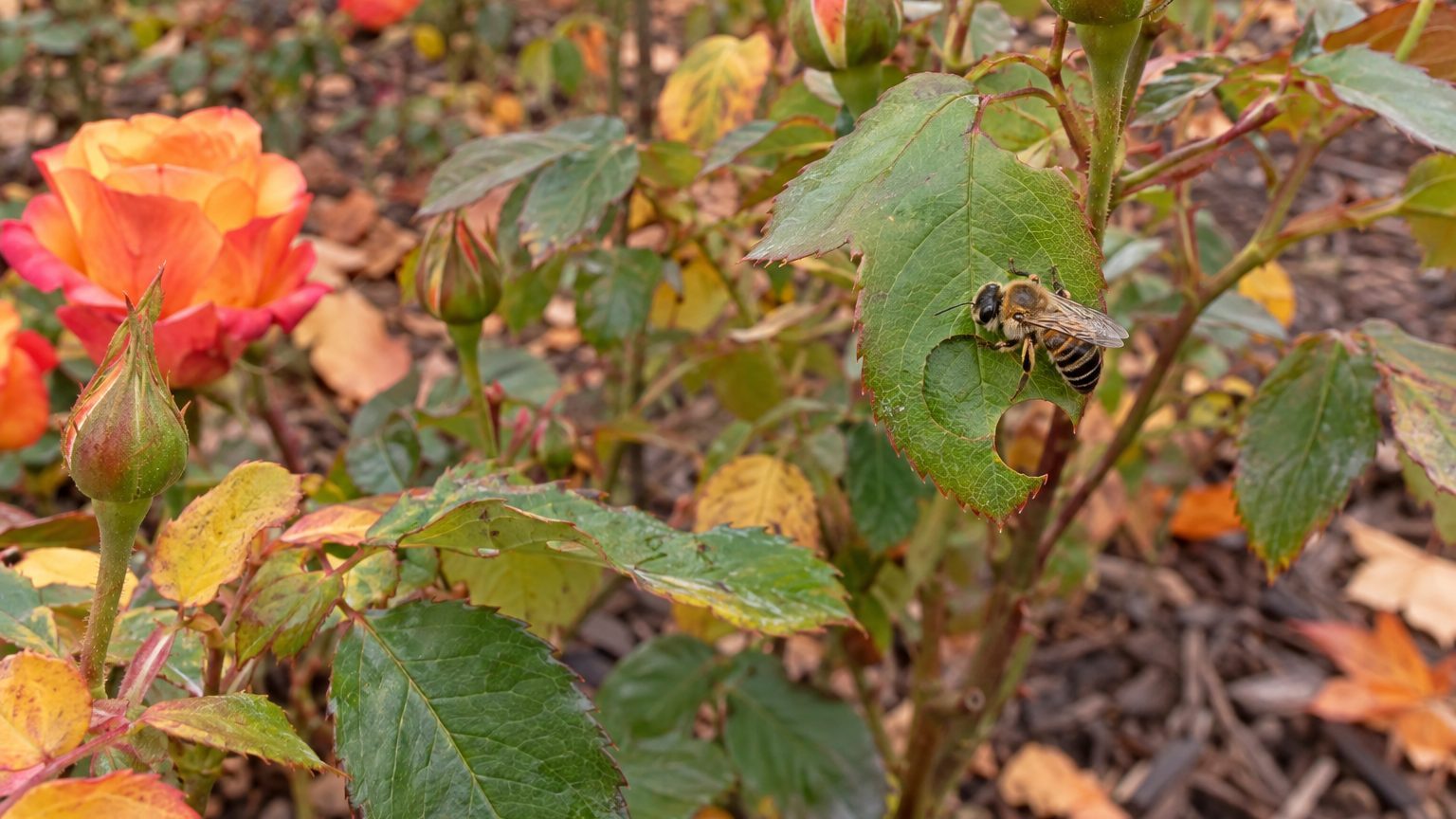
A rose leaf with a neat, round-edged bite missing from its margin is the signature of a leafcutting bee at work. The cut looks deliberate because it is. The bee carries the piece away to line a nest, and the damage on a healthy rose is usually more curiosity than threat.

Leafcutting Bees: What You See

Leafcutting Bees on Roses: How to Spot Them and Get Rid of Them

The clearest sign is on the leaves, and the bee itself is easy to overlook while the cuts are not.

  • Smooth half moon or semicircular holes appear along the edge of the leaf, about 3/4 inch across, with a clean cut unlike the ragged edge chewing insects leave.
  • Precise ovals or circles may be missing from the foliage, and flower petals can be trimmed the same way.
  • Look for holes that begin at the leaf margin rather than in the middle of the blade.
  • The bee looks like a honey bee but is often darker in color, and it is seen near the roses while the cutting is going on.
  • In Minnesota, the cutting shows up from late May to early June.

Other plants nearby, such as lilac, redbud and ash, can carry the same notches.

Leafcutting Bees or Something Else?

Notched leaves have more than one possible author, and the edge of the cut tells most of the story. A bee removes a clean piece, while chewing insects leave a torn outline.

The bee’s nesting habit gives a second check. Look for a drilled hole in a freshly pruned cane or in nearby soft, rotted wood.

Looks like How to tell them apart
Leaf-feeding insects Ragged, uneven edges on the leaf, where the bee’s cut is very smooth and semicircular
Honey bees visiting the flowers Honey bees are often paler, while leafcutting bees tend to be darker and are the ones leaving round notches on the foliage

Pith-boring insects in cut canes can also be blamed for tunnels, but a bee nest sits inside the pith of a pruned cane and is lined with round pieces of foliage.

What Causes Leafcutting Bees, and Where It Is Worst

The cause is a native solitary bee building nests. Females do not form colonies. Each one excavates a tunnel several inches deep in rotted wood, hollow twigs, bee nest boxes or the pithy stems of thick-caned plants such as roses.

Once the tunnel is ready, she cuts leaf pieces to line individual cells, then stocks each with pollen and nectar for the young. Your rose is simply the source of the lining material.

Damage is more serious in isolated rural plantings, and where the bees are abundant and concentrate on cultivated plantings. On most garden roses, the damage is minor.

How to Treat Leafcutting Bees

Treatment is mostly a matter of deciding whether anything is needed, because the bees pollinate and rarely do major harm. If you want to act, work in this order.

  1. Confirm the cut, looking for smooth semicircles at the leaf edge, so that you are not treating a different pest.
  2. Leave the bees alone, because they are beneficial pollinators and should not be killed.
  3. Skip insecticides, since they are ineffective for preventing leaf cutting and harm helpful insects.
  4. Drape cheesecloth or other loose netting over the roses during the weeks when the bees are most active, so that they cannot reach the leaves.
  5. Keep the plant healthy with good culture, so that it tolerates the lost tissue easily.

Netting is the only known control for leaf injury. In most yards the notched leaves are an aesthetic blemish that harms no otherwise healthy plant.

How to Prevent Leafcutting Bees Coming Back

Prevention is limited, but a few timed habits reduce nesting in your canes and keep the plants strong.

  • Whenever you prune, seal the cut ends of canes with wax or a couple drops of white glue.
  • Before late May, have netting ready if you want to protect prized plants, since in Minnesota the cutting begins then.
  • Through the growing season, water and feed regularly so the plant stays healthy enough to shrug off notches.
  • Whenever you prune later in the year, seal those fresh cane ends again so bees cannot excavate the pith.
  • In fall cleanup, leave sprays in the shed, since pesticides harm the bees you want to keep.

Sealing matters because bees excavate the pith of pruned canes, though the largest canes suffer little since tunneling rarely girdles the cambium.

Where This Comes From

The examples here cover Minnesota, New Hampshire and Iowa. Timing and local advice may differ elsewhere.

Common Questions

Are Leafcutting Bees Harmful to Roses?

Seldom. They are native, largely beneficial pollinators, and a healthy rose easily tolerates some lost leaf tissue.

Can Leafcutting Bees Kill a Rose Cane?

Unlikely. They sometimes nest in the largest canes but restrict tunneling to the pith and rarely girdle the cambium.

Do Leafcutting Bees Sting?

The evidence here does not address stinging.

Japanese Beetle on Roses: How to Spot Them and Get Rid of Them

Japanese Beetle on Roses: How to Spot Them and Get Rid of Them

Beetles clustered on rose blooms in the middle of a summer day are a familiar sight in much of the country. Japanese beetles feed on over 250 plant species, and roses rank among their favorites, so the rose bed is often where you spot them first. Knowing what they look like, when they arrive and how to respond keeps the damage in check.

Japanese Beetle: What You See

Japanese Beetle on Roses: How to Spot Them and Get Rid of Them

Start with the adult beetle itself, since it is the part you can catch in the act.

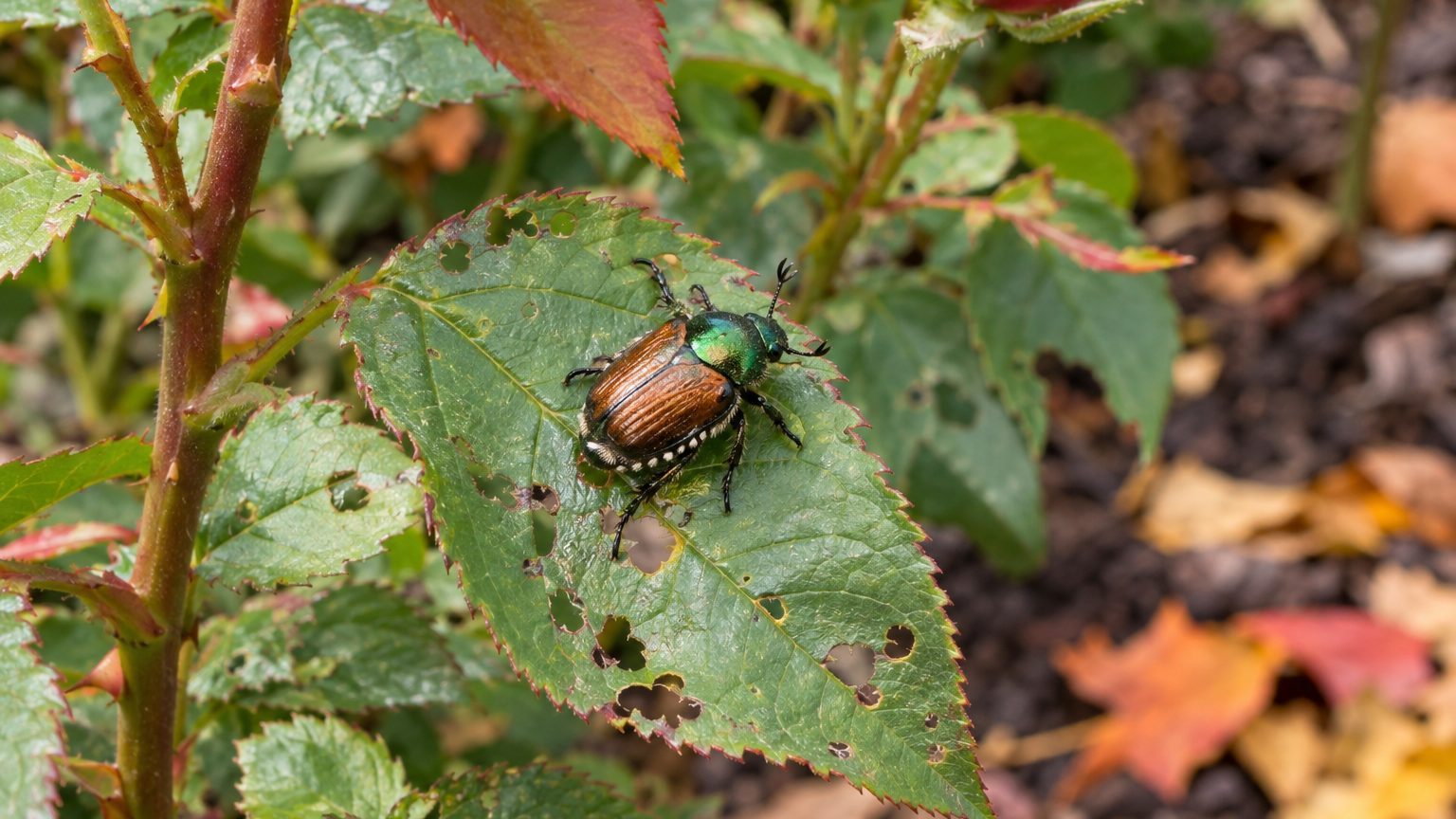
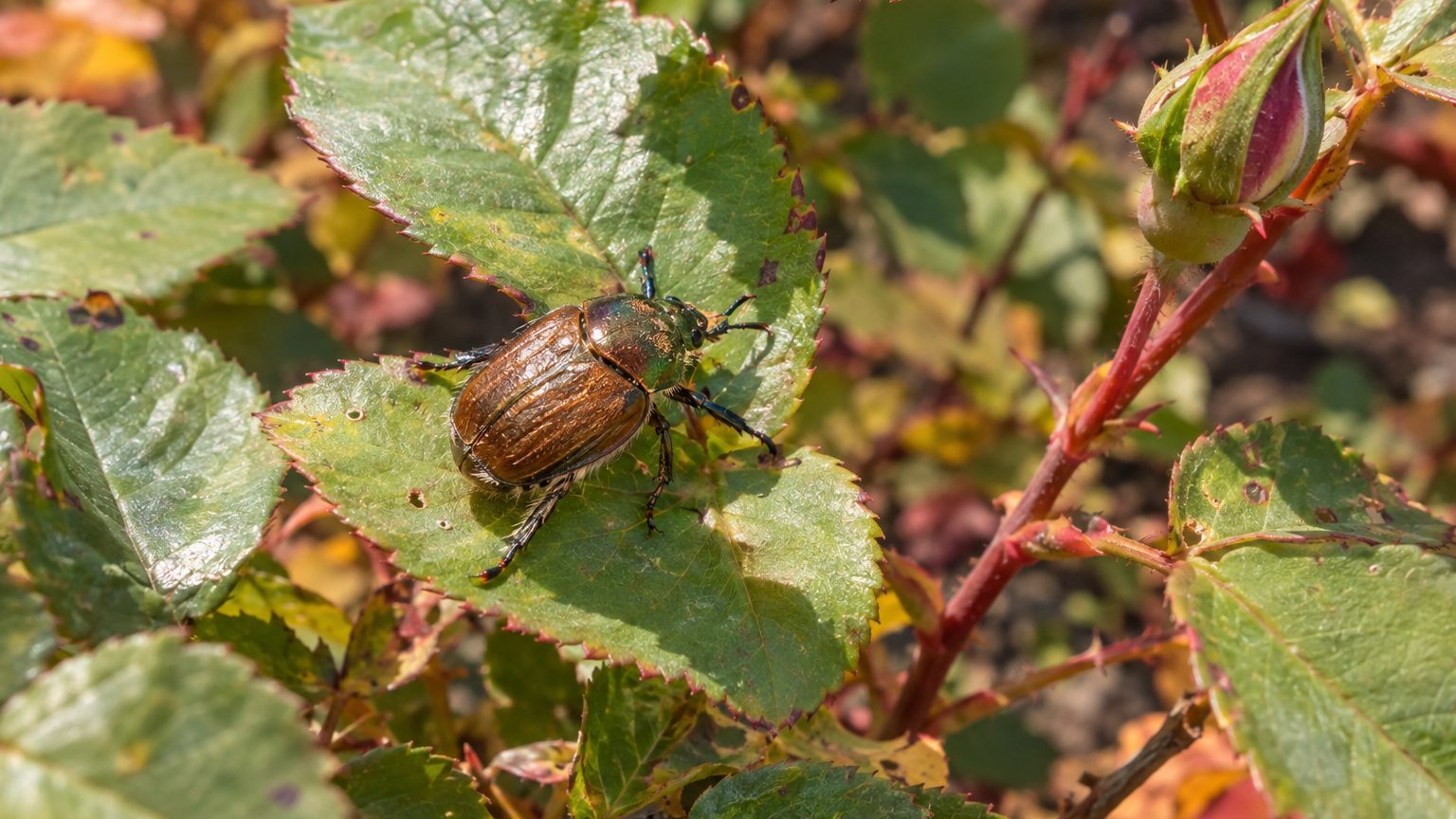
  • Tufts of white hair show around the abdomen, just below the wing covers, and that is the sign that sets this beetle apart from similar ones.
  • The beetles work on the topmost, youngest leaves first, whatever the height of the plant.
  • In Georgia, they feed during the day and are most active from midmorning to early evening, so a midday check finds them where an evening check may not.
  • Flowers and buds get eaten along with the foliage, and roses are among the plants they go for first.
  • Adults usually turn up from late June through September in Indiana.
  • In Indiana, the grubs live in the soil and measure 1/4 to 1 inch long, which is why they get mistaken for other white grubs.

Because the feeding starts at the top of the bush, a quick look at the newest growth tells you more than a glance at the lower canes.

Japanese Beetle or Something Else?

Several beetles visit roses, and a few grubs in the soil look much the same. A chewed leaf alone does not settle the question, so pair what you see with where and when you see it.

Looks like How to tell them apart
Other beetles feeding on rose blooms and leaves Look at the rear of the beetle for tufts of white hair at the end of the abdomen, and note whether it feeds in daylight.
May/June beetle and masked chafer grubs in the soil In Indiana, the Japanese beetle grub is 1/4 to 1 inch long and resembles them, so the grub alone proves little. Adults with white tufts feeding on the bush above point to Japanese beetle.

If the grubs turn up in soil but you see no adults with white tufts on your plants, other beetles may be behind them. If you are unsure, have the specimen identified locally.

What Causes Japanese Beetle, and Where It Is Worst

The cycle starts in the ground. Adults lay their eggs in the soil, and the grubs overwinter deep down, then finish their growth the following spring. In Indiana, the adults emerge from the ground in mid-summer. Once emergence begins, a bed that looked clear can soon fill with beetles.

The timing shifts with the place. In South Carolina, adults begin emerging in mid-May and are present through August. In central Maryland, emergence begins in mid-June and peaks in early July, and the beetles stay active for about 4-6 weeks. In Wisconsin, they typically begin to emerge in late June and early July.

Your neighbors’ yards matter too, because adults can fly an average of 1 to 2 miles. This continuous migration means beetles keep arriving after you clear a bush. Japanese beetles are not established in California, so gardeners there are not dealing with them.

How to Treat Japanese Beetle

Treatment is mostly steady attention during the weeks when beetles are present, and it follows this order.

  1. Check the bushes early in the season before damage appears, so that you catch the first beetles before they draw others in. Begin scouting at that stage.
  2. Handpick beetles and drop them into soapy water, which removes them from the bush without any chemicals.
  3. Clip off buds when beetles are abundant, since roses unfold too fast and are too attractive for sprays to protect the flowers fully.
  4. Spray the bushes to protect the leaves, using only a product approved for roses and Japanese beetles in your area.
  5. Repeat the spraying when beetles keep arriving. In Maryland, 2 or 3 spray applications may be needed to prevent serious injury to roses and grapes.
  6. Let the bushes bloom again once beetles become scarce, so the plant can put its energy back into flowers.

Beetle bags from the store are not the answer, and beetles are hard to control once established, especially at population peaks. Community-wide programs that bring neighbors into integrated pest management can reduce their influence to a great extent.

How to Prevent Japanese Beetle Coming Back

Prevention follows the beetle’s calendar, from the soil in spring to the last adults of late summer.

  • In Georgia, scout for adults and grubs from early spring.
  • Before the first flight, which begins in mid-May in South Carolina, look over the bushes so that you find the first beetles quickly.
  • When beetles are abundant in summer, clip the buds and protect the leaves instead of trying to save every flower.
  • Once the beetles become scarce, let the bushes bloom again.
  • Into late summer, keep checking, as adults can still be found through September in Indiana.
  • Throughout the season, talk with neighbors about a shared plan, since the beetles move between yards.

Adult beetles seldom become a problem when a regular spray schedule already controls other insects.

Where This Comes From

The timing and treatment details here are specific to the states named in the text. Timing, spraying advice and approved products vary by state.

Common Questions

What Other Plants Do Japanese Beetles Eat?

Beyond roses, preferred hosts among garden plants include crape myrtle, zinnia, marigold, canna, evening primrose and dahlia. Grapes are a favorite too, and during population peaks the beetles can defoliate entire trees.

How Long Do Japanese Beetles Live?

In South Carolina, adults can live from 30 to 45 days. Since emergence stretches over weeks, new beetles keep replacing the old ones through the season.

Are Japanese Beetles a Problem in California?

Japanese beetles are not established in California. A beetle on a California rose is more likely something else, so check for white tufts at the end of the abdomen before treating.

Hoplia Beetle on Roses: How to Spot Them and Get Rid of Them

Hoplia Beetle on Roses: How to Spot Them and Get Rid of Them

Round holes in the petals of a white, yellow, apricot or pink rose usually point to hoplia beetle. The damage is easy to mistake for something worse, yet the beetle is small and the season for trouble is short. Knowing what the beetle looks like and when it flies makes the fix simple.

Hoplia Beetle: What You See

Hoplia Beetle on Roses: How to Spot Them and Get Rid of Them

Look at the open flowers first, because that is where this beetle gives itself away.

  • Neat, round holes appear in the petals of open flowers, mostly on white, yellow, apricot and pink roses.
  • The adult is oval and about 1/4 inch long, small enough to hide among the petals.
  • Its head and thorax are a dark, reddish brown, and the wing covers run from dark to light brown.
  • Early buds can be chewed badly enough that the first flowers are destroyed.
  • In California, the trouble shows up from late March to May and then stops.

If the holes appear in light-colored blooms and a small brown beetle is sitting inside the flower, you have your answer.

Hoplia Beetle or Something Else?

Not every chewed rose is a hoplia problem. A few other kinds of damage get blamed on this beetle, and a quick look at the leaves and the plant’s overall health sorts them out.

The beetle is a flower feeder, so damage that sits anywhere other than the blooms deserves a second look.

Looks like How to tell them apart
Chewed leaves with holes or ragged edges Hoplia beetle leaves the foliage alone, so leaf damage with untouched petals comes from another chewing insect.
Grubs in the soil near the rose, with a plant that looks weak Hoplia grubs are crescent-shaped and live in soil, but they do not feed on rose roots, so a declining plant needs another explanation.
Holes only in dark-colored blooms Hoplia adults go for light-colored flowers, so damage on dark roses alone with no beetles in the blooms points elsewhere.

When the damage sits on pale petals and the foliage looks clean, hoplia beetle is the likely cause. When the leaves are chewed too, look for a different pest.

What Causes Hoplia Beetle, and Where It Is Worst

The beetles live as grubs in the soil and fly into gardens as adults to feed on roses and other flowers. After feeding for several weeks, the adults fly back to their egg-laying sites. There is a single generation each year, which is why the problem arrives and leaves on a fairly fixed schedule.

Hoplia beetle is common in many parts of the state, especially the Central Valley. It is mostly a problem there from Sacramento south to Bakersfield. Adults are generally active from late March to early May, and damage is usually confined to a 2- to 4-week period in late spring.

Outside California, the beetle’s presence and flight period may differ.

How to Treat Hoplia Beetle

Hand removal is the practical response to beetles feeding on the flowers.

  1. Check the open, light-colored blooms regularly during the flight season, so that you catch beetles before they have chewed through the petals.
  2. Handpick the beetles off the flowers they are feeding on, so that each one is removed rather than driven to another bloom.
  3. Shake the blooms gently over a bucket of soapy water, which drops hidden beetles straight into it.
  4. Leave the beetles in the soapy water, so that they cannot climb out and return to the roses.
  5. Skip any treatment of the leaves, since the beetles do not feed on them and the foliage is not where they are found.
  6. Do not use a spray or other product unless it is approved for roses and this beetle in your state.

In California, damage is usually confined to a 2- to 4-week period in late spring, so the routine does not run long. Once the adults have fed and flown back to their egg-laying sites, the roses are left in peace until the next year.

How to Prevent Hoplia Beetle Coming Back

Hoplia beetle cannot be kept away for good, but a gardener who knows the calendar is rarely caught off guard.

  • Before the season opens, plan to watch your white, yellow, apricot and pink roses most closely, since those are the blooms the adults prefer.
  • As the first buds swell, begin looking inside them and the newly opened flowers, because early buds are the ones the chewing can destroy.
  • Through the weeks when adults are flying, keep removing beetles from the flowers so that fewer feed and fewer return to lay eggs.
  • After the adults have gone, stop the daily checks and leave the foliage alone, since this beetle does not feed on leaves.

In affected California gardens, repeat the checks and handpicking during the flight season.

Where This Comes From

The details here describe California gardens. Timing and approved products vary by state, so do not apply California dates elsewhere.

Common Questions

Do Hoplia Grubs Eat Rose Roots?

No. The larvae are small, crescent-shaped grubs that live in the soil and feed on roots, but they do not feed on the roots of rose plants.

Do Hoplia Beetles Feed on Flowers Other than Roses?

Yes. The adults fly to gardens where they feed on roses and other flowers.

Is Hoplia Beetle a Problem Outside California?

Hoplia beetle is common in many parts of California. Outside California, its local presence and active period may differ.

Fuller Rose Beetle on Roses: How to Spot Them and Get Rid of Them

Fuller Rose Beetle on Roses: How to Spot Them and Get Rid of Them

Rose leaves with ragged, scalloped edges and no insect in sight usually mean something is feeding after dark. The likely culprit is the fuller rose beetle, a flightless weevil that chews leaves, buds and flowers at night and, in California, is known to hide by day. Knowing its look and its habits makes it much easier to confirm.

Fuller Rose Beetle: What You See

Fuller Rose Beetle on Roses: How to Spot Them and Get Rid of Them

Start with the faint white band along each side of its wing covers.

  • A faint white band runs along each side of the body, on the wing covers.
  • The body is light brown to ash-gray, with a short snout and elbowed antennae that spring from it.
  • Adults measure about 3/8 inch long, small enough to vanish among the leaves.
  • Leaf edges look notched, serrated and ragged, and flowers get chewed too.
  • During the day the adults sit on the undersides of leaves, and they cannot fly (a habit noted in California).
  • In North Carolina, adults first appear in July and keep emerging through November.

A flashlight after dark, aimed at the leaf edges, can help you catch one at work.

Fuller Rose Beetle or Something Else?

Ragged leaves can come from many chewing pests, and stunted growth has many causes, so one clue is never enough. Pair what you see on the plant with when and where you see it.

The pairs below separate this weevil from the usual look-alikes.

Looks like How to tell them apart
Another chewing insect, with notched leaf edges A fuller rose beetle feeds at night; in California, adults often hide on leaf undersides during the day.
A rose that grows poorly and looks short of water or nutrients Damaged roots cause that stunting, so check the leaf margins for notches too. If they are clean and the beating test below turns up nothing, the symptoms may have another cause.

Notched edges together with weevils that drop from the canes when you shake them point to this beetle. Clean leaves and no weevils point elsewhere.

What Causes Fuller Rose Beetle, and Where It Is Worst

The adults emerge from the soil and crawl up the rose to feed, since they cannot fly. Males of this species have never been found. Eggs are laid in groups, in protected plant parts or in or on the soil.

The host list is very long. Citrus, strawberry, beans, peach, rhubarb and potato are all on it, along with azalea, begonia, gardenia and hibiscus. A rose growing near any of these can be visited by the same weevils.

Timing depends on where you garden. In North Carolina, most beetles overwinter as larvae in the soil, then pupate in spring near the surface. Adults appear from July onward. Fuller rose beetles feed on roses and many other host plants.

How to Treat Fuller Rose Beetle

Work in the order below, starting with confirmation and ending with local advice on what is approved for your state.

  1. Check the undersides of leaves by day to look for hiding adults.
  2. Go out after dark with a flashlight, because feeding happens at night and the weevils are easiest to catch in the act.
  3. Beat the shrub over a light sheet or tray and collect the adults as they drop, which shows you whether weevils are present at all.
  4. Watch for fresh leaf damage or set ground traps, since both tell you when adults are emerging in your yard.
  5. Water through dry spells, because roots damaged by larvae cannot take up water well, and in Florida severely damaged plants have died in drought.
  6. Contact your state’s extension service before using any spray, so that you get only what is registered where you live.

Keep your expectations modest. Most of what you see is leaf damage, and a bush that is otherwise growing steadily can carry some notched edges.

How to Prevent Fuller Rose Beetle Coming Back

Because the cycle runs from soil larvae to leaf-feeding adults, prevention is mostly about watching at the right moments.

  • In North Carolina, larvae pupate near the soil surface in spring, and adults first appear in July.
  • Look under the leaves by day for adults hiding there.
  • From July through November in North Carolina, shake the canes over a tray once in a while, since adults keep emerging through the fall.
  • Severely damaged roots can leave the plant vulnerable during drought.

Repeat the same night walk when fresh leaf damage appears.

Where This Comes From

Timing and local advice change from state to state, so confirm dates and approved treatments with your own state’s extension service.

Common Questions

Do Fuller Rose Beetles Kill Roses?

Rarely. The weevils do little serious harm beyond how the plant looks. Under a heavy attack, adults can eat the whole leaf except the midrib. The dangerous case is a root system damaged badly enough that the plant dies in drought or picks up a fungal infection, as reported in Florida.

Are the Larvae in the Soil a Problem for Roses?

Not usually. The larvae are root feeders, but they do not seriously damage roses. Poor, stunted growth is the sign that root damage has become heavy.

What Else Does This Weevil Feed On?

Many plants. Citrus, strawberry, beans, peach, rhubarb and potato are among the main hosts. Apple, azalea, begonia, blackberry, gardenia, hibiscus, lily, raspberry and others also get chewed.

Caterpillars on Roses on Roses: How to Spot Them and Get Rid of Them

Caterpillars on Roses on Roses: How to Spot Them and Get Rid of Them

Ragged leaves with see-through patches usually point to small larvae feeding on the underside, and most of them are not true caterpillars at all. They are sawfly larvae, and they behave differently from moth and butterfly caterpillars. Knowing which one you have decides whether you pick, prune or simply tolerate the damage.

Caterpillars on Roses: What You See

Caterpillars on Roses on Roses: How to Spot Them and Get Rid of Them

The larvae that most often get called caterpillars on roses are small, tapered and slimy, and they are easiest to spot by the damage they leave on the leaves.

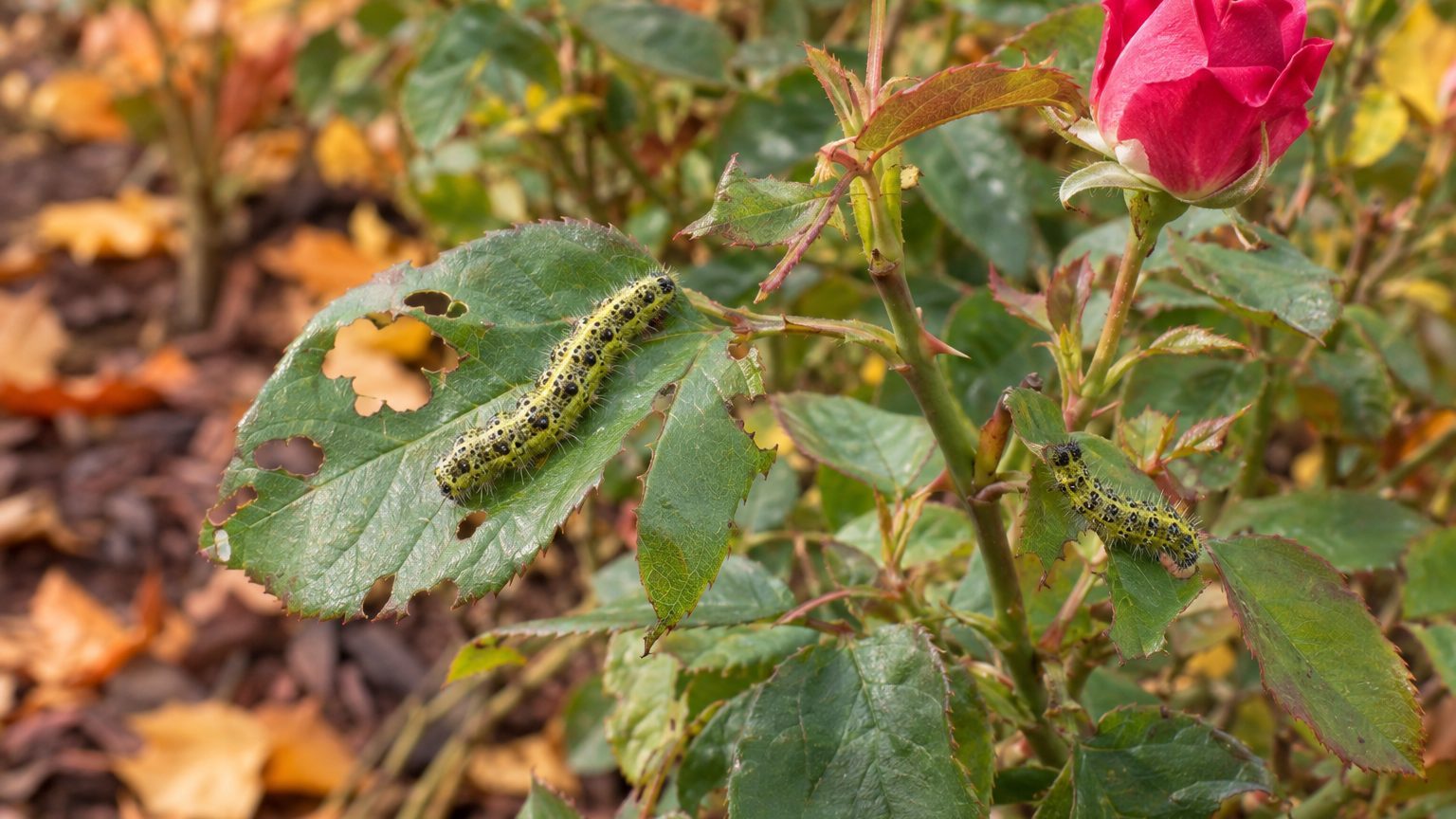
  • Leaves show windowpane damage, small papery patches that are nearly see-through, because the larvae eat the soft tissue and leave the veins.
  • The larvae sit on the underside of the leaf, where they look like tiny caterpillars with a bead-like head and jointed legs.
  • Their shape is tapered and their skin looks slimy, which gives them a vague resemblance to a true slug.
  • Full-grown larvae reach up to ¾ inches in length, and older ones chew entirely through the leaf instead of leaving a thin layer.
  • Heavily fed-on leaves turn brown, curl and dry out, and in Kentucky the first damage shows up in April.

In Wisconsin the damage typically starts in early to mid-May and can run through mid-June.

Caterpillars on Roses or Something Else?

Several different insects chew rose foliage, and the fix depends on which one you have. Sawfly larvae are related to wasps, so they are not caterpillars even though they look like them.

Real caterpillars, the young of moths and butterflies, turn up on roses only infrequently, so check the clues below before assuming.

Looks like How to tell them apart
Roseslug sawfly larva Slimy, tapered body with a bead-like head, found on the leaf underside, leaving windowpane patches with the veins intact.
Leafroller or tent caterpillar Leaves tied or rolled together with silk, and a caterpillar or its frass hiding inside when you open the roll (seen in California).
Budworm caterpillar Flower buds bored into, with the caterpillar or its frass found inside the bud.

Other caterpillars reported on roses in South Carolina include the corn earworm, stinging rose caterpillar and puss caterpillar, so wear gloves when handling any hairy one. Their feeding leaves holes or irregular areas in the leaf blade instead of windowpanes.

What Causes Caterpillars on Roses, and Where It Is Worst

The cause is an insect that specializes in roses. Female roseslug sawflies are shiny black with yellowish-orange markings. The roseslug sawfly is native to Europe and now feeds on wild and cultivated roses alike.

No soil type or climate zone is singled out, so any rose can be visited. Timing differs by place: damage starts in April in Kentucky and in May and June in Wisconsin, with northern Wisconsin running slightly later.

The kinds of sawfly differ too. In California the bristly roseslug is the most common, and it occurs mainly in cooler areas such as near the coast. The curled roseslug and the roseslug are occasional pests there, and at least three sawfly species attack roses in California.

How to Treat Caterpillars on Roses

The damage from rose slugs is mostly cosmetic, so a calm, hands-on approach is usually enough. Work in this order.

  1. Turn the leaves over and look on the underside, so that you find the larvae where they actually feed.
  2. Hand pick the larvae you find, which removes them before they grow large enough to chew right through the leaf.
  3. Prune out infested buds and rolled leaves, since they often hide caterpillars inside, and look for the caterpillar or its frass to confirm.
  4. Dispose of the clippings promptly in a sealed bag, so that nothing crawls back onto the plant.
  5. Check the plant regularly because new damage can keep appearing throughout the growing season.
  6. Contact your state extension service before reaching for any spray, so that you learn what is approved where you live.

Leaves that are already brown and dry will not recover.

How to Prevent Caterpillars on Roses Coming Back

Prevention comes down to timing your checks to the season, since the larvae follow a predictable calendar.

  • In Kentucky, start inspecting leaf undersides in April, when roseslug damage first appears.
  • In Wisconsin, look closely from early to mid-May through mid-June, or slightly later in northern parts of the state.
  • Keep checking regularly, and remove any rolled leaves or damaged buds as soon as you see them.

A short look at the plant can catch feeding damage early.

Where This Comes From

The details here come from university extension guidance written for Kentucky, Wisconsin, South Carolina and California. Rules and timing vary by place, so confirm what applies to you with your state’s extension service.

Common Questions

Do Rose Slugs Kill Roses?

Rarely. Rose slugs and sawflies generally cause mostly cosmetic damage, though heavy infestations can turn leaves brown and curl them.

Can Rose Slugs Spread to Other Plants?

They specialize in roses, but there are reports of them damaging strawberries and raspberries as well.

Why Are the Leaves Turning Brown with See-Through Spots?

Windowpane patches on the leaf, together with larvae on the underside, point to sawfly feeding. The thin areas eventually brown and dry.

Rose Cane Borers on Roses: How to Spot Them and Get Rid of Them

Rose Cane Borers on Roses: How to Spot Them and Get Rid of Them

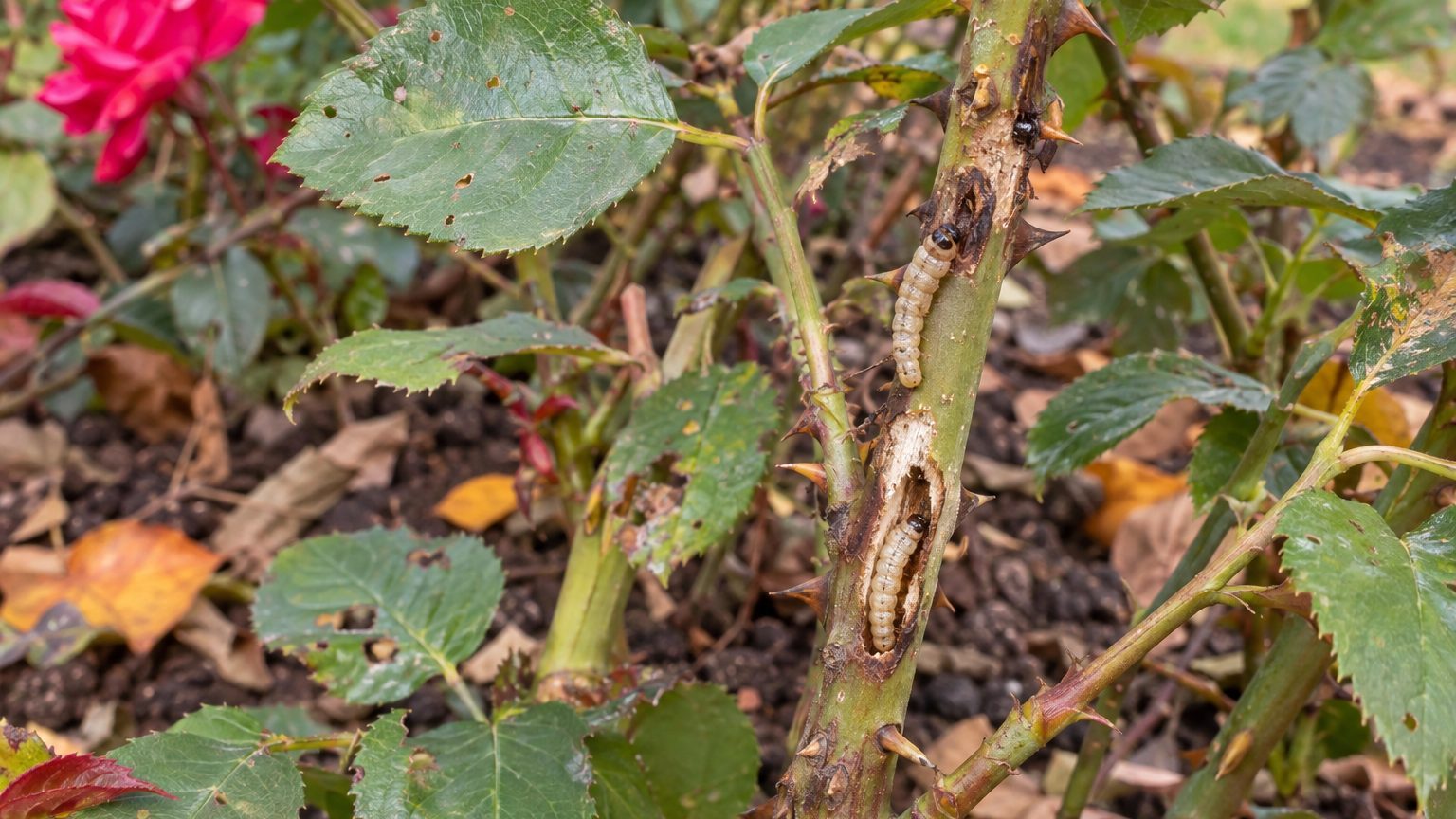
A rose cane that browns and dies back from a fresh pruning cut may have a cane borer, but a hole alone can also belong to a harmless hunting wasp. The larva tunnels inside the cane, so the damage shows at the cut end or in a wilting tip. The fix starts with your pruning shears.

Rose Cane Borers: What You See

Rose Cane Borers on Roses: How to Spot Them and Get Rid of Them

Look at the cut ends of your canes first, then at the tips and leaves.

  • A tunnel in a freshly cut cane can come from a cane borer or a harmless hunting wasp, so look for browning or dieback as well.
  • In Arizona, this tunneling starts soon after winter pruning, and January is when gardeners there tend to find it.
  • Canes brown and die back from the cut, and the damage becomes more serious as the larva burrows toward the base of the cane.
  • Two rings of punctures circle the cane, and they sit 4-6 inches below the growing tip, which then wilts.
  • The adult rose stem girdler is a slender, flattened, metallic beetle with copper-colored wing covers, and it is slightly less than 1/4 inch long.
  • Small, sparse, yellow or wilted leaves can accompany tunnels, while rose stem girdler larvae can cause gall-like swellings and cane breakage.

The rings are about 1/2 inch apart, so they are easy to miss unless you run your eye slowly along the cane.

Rose Cane Borers or Something Else?

Not every tunnel in a rose cane means trouble. Hunting wasps nest in the same soft pith, and their holes can look just like a borer’s entry.

Yellow, thin leaves also have many causes, so the cane itself has to settle the question.

Looks like How to tell them apart
A tunnel in the cut end of a cane, from hunting wasps The wasps are small, harmless and beneficial, and they nest in the pith without injuring the plant, so the cane stays green and keeps leafing out past the tunnel.
Small, sparse, yellow or wilted leaves Split the cane and look for a tunnel, then check the tip for rings of punctures below it. A borer shows browning that creeps down from the cut or a wilted tip.

A hole alone proves nothing. A hole with browning wood below it, or with a wilting tip above a ringed stem, points to a borer rather than a wasp.

What Causes Rose Cane Borers, and Where It Is Worst

The cause is an insect that lays eggs on or in the cane, and the larva does the rest from the inside. On freshly pruned roses, the open cut gives it an easy way into the pith. Fresh pruning cuts can provide an entry into the pith.

Timing depends on the borer and the place. In Arizona, the trouble comes soon after winter pruning, so January is when you watch the cut ends. In Kentucky, the raspberry cane borer adult appears about June, punctures the rings in the cane and lays an egg between them.

The rose stem girdler also attacks wild rose, raspberry and blackberry. Where larvae tunnel, canes swell, weaken and break. Cane borers can enter freshly cut canes, while the rose stem girdler can cause gall-like swellings and cane breakage.

How to Treat Rose Cane Borers

Treatment is mostly careful pruning, done in this order.

  1. Find the hole or browning at the cut end, then cut back gradually to locate healthy wood.
  2. Cut the cane back an inch or two at a time until the hole is no longer visible.
  3. Keep cutting until the pith is clean and the cane is healthy, since leftover damaged wood lets the problem continue.
  4. Remove a browning, dying cane a few inches at a time until all the damaged wood is gone, which saves as much of the healthy cane as possible.
  5. Seal the new cut with white wood glue, so that the next insect cannot enter the same way.

For anything beyond pruning and sealing, ask your county or state extension office what is approved where you live.

How to Prevent Rose Cane Borers Coming Back

Prevention is a matter of closing wounds and checking canes on time.

  • Seal every pruning cut with glue right away to keep cane borers from entering.
  • In Arizona, check the cut ends in January for holes, since that is when the first damage turns up.
  • About June in Kentucky, run your eye along the canes for rings of punctures, when raspberry cane borer adults appear.
  • Through the growing season, look regularly for wilting tips and browning canes, and cut them back to healthy wood before the larva reaches the base.
  • After every pruning session, seal the fresh cuts, including any made to remove damage.

Keeping wood glue in your tool bucket makes it easy to seal fresh cuts.

Where This Comes From

The details here come from university extension and government pages written for gardeners in Arizona, Kentucky and other states. Pest timing and approved treatments vary by place, so check with your state’s extension service before you act on anything beyond pruning and sealing.

Common Questions

Can a Cane Borer Kill a Rose Cane?

Yes. Tip dieback is the early sign, and as the larva works down toward the base of the cane, the whole cane can die.

What Do Cane Borer Eggs Look Like?

The eggs of the rose stem girdler are round and flattened, and they measure 1/16 inch, which makes them hard to spot without a close look.

Do the Same Borers Attack Raspberries and Blackberries?

They do. The raspberry cane borer attacks blackberry, raspberry and rose, and the rose stem girdler can thin out a raspberry planting or even kill it. Check any nearby bramble patch as well.

Aphids on Roses: How to Spot Them and Get Rid of Them

Aphids on Roses: How to Spot Them and Get Rid of Them

Sticky, curled new growth and tight clusters of tiny insects on rose buds are classic signs of aphids. Those insects are aphids, and the fix is usually simple and gentle. A strong rinse and help from insects that prey on aphids can keep a small infestation in check.

Aphids: What You See

Aphids on Roses: How to Spot Them and Get Rid of Them

Start with the clusters themselves, because the insects give themselves away before any damage does.

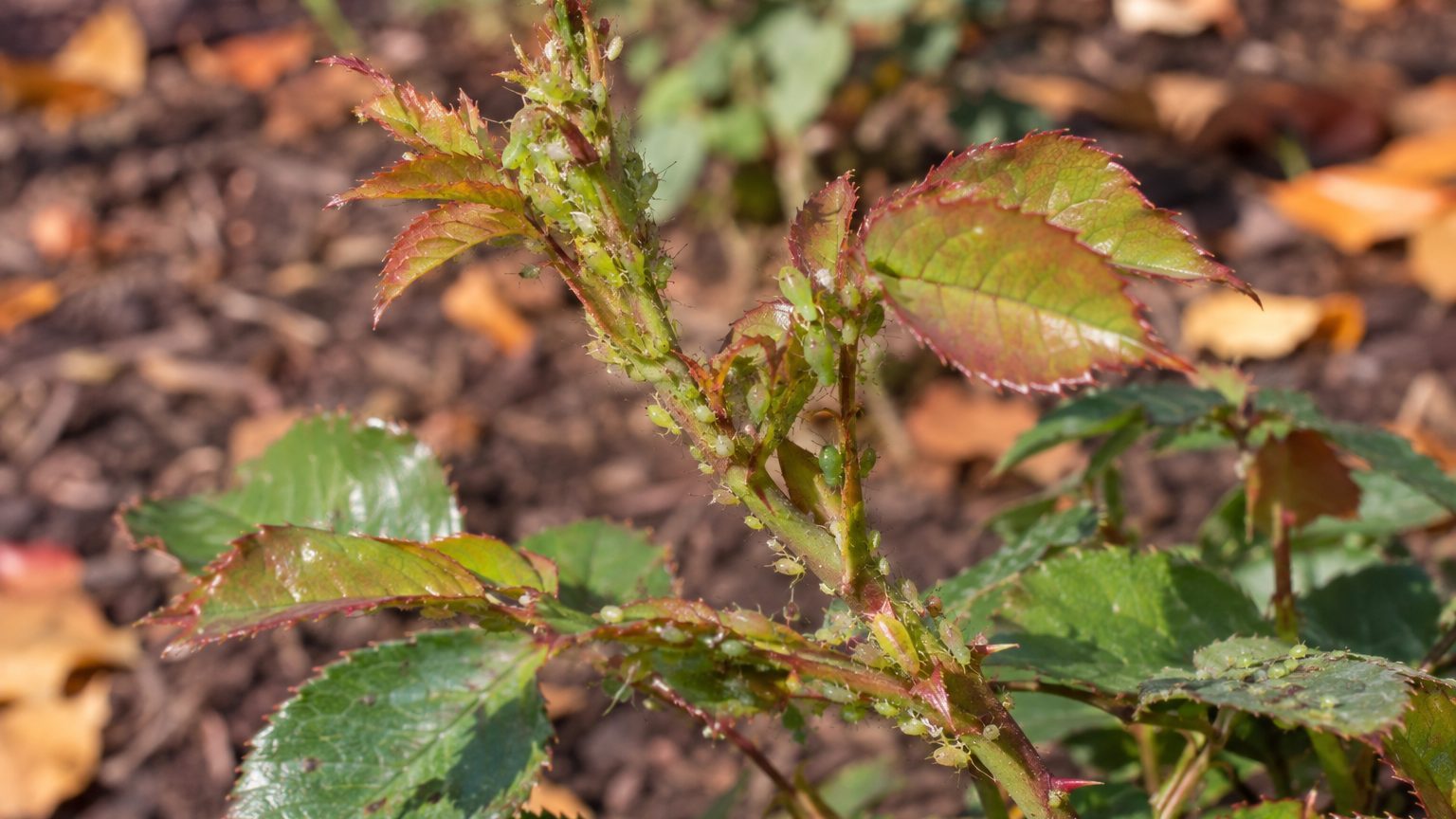
  • Soft-bodied insects packed tightly along buds and shoot tips, each only about ⅛ inch long in the case of the rose aphid.
  • Colonies tucked on the underside of leaves and on young, tender growth, where the sap is easiest to reach.
  • A shiny, sticky film on leaves and nearby surfaces, which is the honeydew the insects excrete as they feed.
  • Curled leaves and twisted buds or branch tips, the distortion that comes from sap being drained.
  • Pale cast skins left on the leaves, which in Georgia can be the only hint that aphids were there.
  • Blackened streaks on leaves where sooty mold has settled on the honeydew.

In South Carolina, aphids can turn up at any point from spring to fall, and winged adults appear when a colony gets crowded and leave to start new ones.

Aphids or Something Else?

Some of what you see on a rose is aphid fallout rather than the insect. A dark coating or white flecks can send you after the wrong problem, so pair what you see with where it sits and what is around it.

Looks like How to tell them apart
Black, sooty film on leaves Sooty mold grows on honeydew, so the leaves feel sticky and the film sits below clusters of aphids on new growth.
White flecks scattered on leaves Cast skins are left behind as aphids grow, so they gather near colonies, often beside sticky honeydew.

Aphids on roses are not always the rose aphid either. The potato aphid and the cotton aphid also feed on roses, so the insects on your canes may be a different species from the one in the pictures.

What Causes Aphids, and Where It Is Worst

Aphids reproduce quickly and run through multiple generations in a year, and they favor rapidly growing tissue such as buds and shoots. A flush of soft new growth on a rose is exactly the meal they look for. Roses also share the yard with other hosts, including zinnias and coreopsis, so colonies can move in from nearby plantings.

Natural enemies usually keep aphids at levels you never notice, and tiny parasitic wasps do a lot of that work. Trouble starts when those helpers fall behind and numbers jump. Ants make it worse, because in Georgia they are drawn to the honeydew and tend to nurture the aphids.

Aphids are common rose pests, but their timing varies by place. Timing varies by place. In South Carolina, populations can appear from spring to fall. In California, a naturally occurring fungal disease may control aphids when conditions are wet or humid.

How to Treat Aphids

Begin with the gentlest step and move up only if the colonies keep growing.

  1. Inspect the shoot tips, buds and leaf undersides, so that you know whether you have a few insects or a crowd, since a low population does little damage to a rose bush.
  2. Rinse the plant with a strong stream of water, which knocks the aphids off and washes away some of the honeydew.
  3. Leave the natural enemies alone, because the parasitic wasps and other predators are doing steady work that you want to keep.
  4. Look along the canes for ants, since in Georgia they may tend aphid colonies.
  5. Reach for insecticidal soap if the colonies rebuild, as it is among the alternatives to plain water.
  6. Before using any insecticide, check that it is approved where you live and suitable for roses.

In California, the convergent lady beetle is sold at nurseries for release against aphids, though it may give only limited control even when released properly. Sooty mold grows on the honeydew and blackens leaves.

How to Prevent Aphids Coming Back

Prevention is mostly about timing your attention to the way roses grow through the season.

  • Check tender shoots and buds as soon as new growth appears, since young, succulent growth is where aphids settle first.
  • When you feed the roses, choose a slow-release or low-nitrogen formula, because high nitrogen levels in the plant encourage aphids to reproduce.
  • Through the growing season, look under the leaves regularly, as aphids can arrive from spring to fall in South Carolina.
  • Ants may be attracted to the honeydew, and since they tend to nurture the aphids, this creates an additional nuisance.

Heavy feeding can lower both the quantity and the quality of the flowers, so catching the first colonies protects the blooms as well as the leaves.

Where This Comes From

This guidance reflects conditions described for Georgia, South Carolina and California. Check local guidance for treatments and timing suited to your roses.

Common Questions

Will Aphids Kill a Rose Bush?

A low population does little harm, but aphids reproduce rapidly and can quickly reach damaging numbers. Severe infestations damage leaves and flowers, and feeding can make leaves drop, which weakens the plant.

Can Aphids Spread Disease to Other Plants?

Some aphids can spread plant viruses as they move from plant to plant. Their honeydew also feeds sooty mold, which blackens leaves.

What Else in the Yard Do Aphids Feed On?

Besides roses, landscape hosts include zinnias, coreopsis and many other ornamentals, along with vegetables, shrubs, fruit trees and shade trees. A colony on a neighboring plant is worth checking when your roses keep getting reinfested.

Stem Canker and Dieback on Roses: Signs, Treatment and Prevention

Stem Canker and Dieback on Roses: Signs, Treatment and Prevention

A rose cane that leafs out fine in spring, then wilts and dries while the canes beside it stay green, is a common sight in a rose bed. The cause is a fungal canker that has settled into one stem. Cutting it out cleanly, with sterilized shears, is the main remedy.

Stem Canker and Dieback: What You See

Stem Canker and Dieback on Roses: Signs, Treatment and Prevention

The clearest sign is one dead branch on an otherwise healthy rose, and the stem itself tells you the rest.

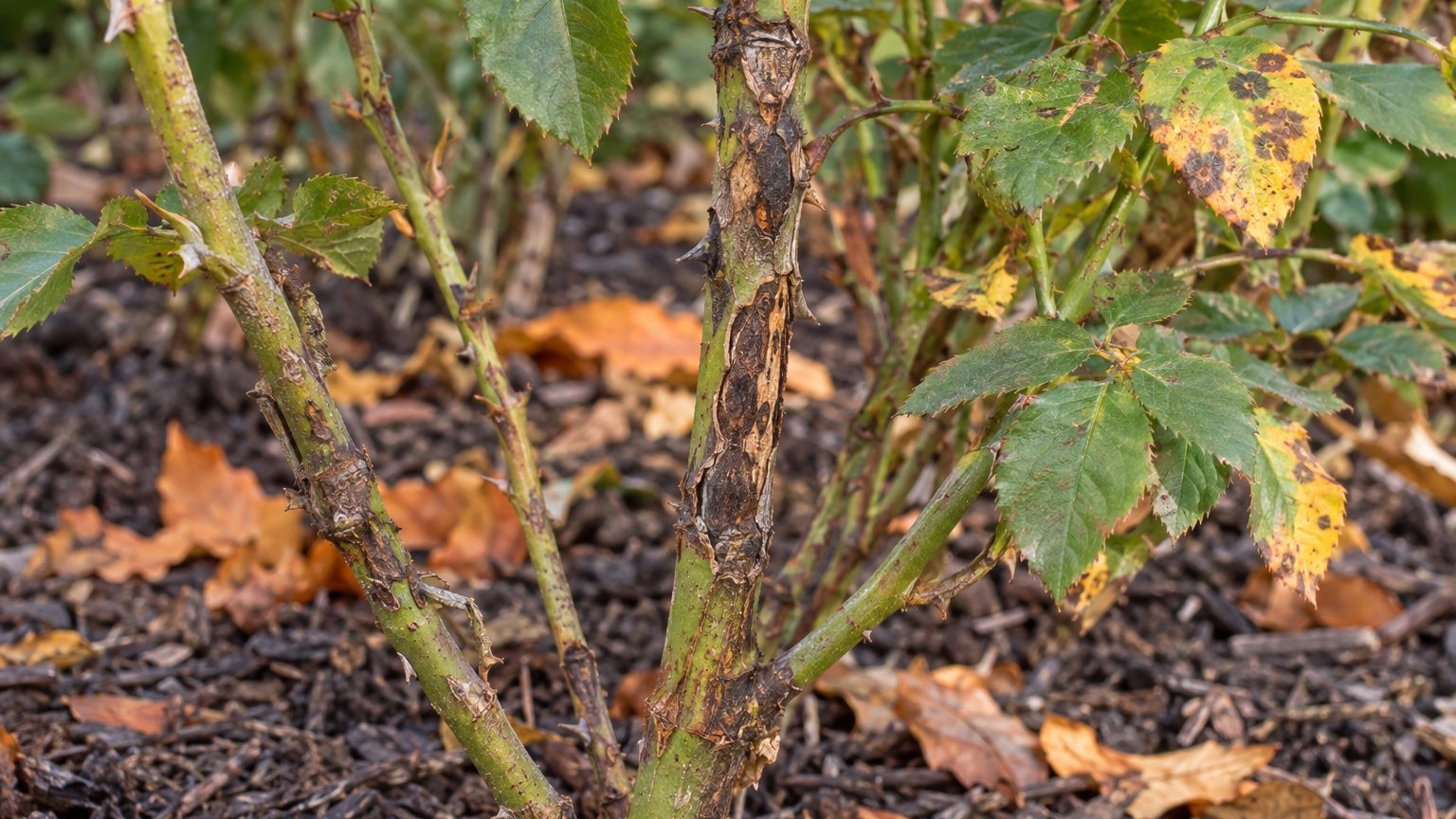
  • A single cane dies back while the rest of the plant looks healthy.
  • Light colored blotches or patches appear along the dead stem, often ringed with a reddish purple border.
  • Young cankers look slightly darker than the healthy tissue beside them and sit slightly sunken.
  • Some patches show flaky, loose or cracked surface tissue.
  • Tiny black bumps dot the dead area, and these are the fungus’s fruiting structures.

Color varies from light brown to dark purple, so go by the dead cane and the blotch together rather than by shade alone.

Stem Canker and Dieback or Something Else?

Several problems leave a rose with dead or spotted canes. Matching the spot to where it sits on the cane, and checking for the black dots, sorts most of them out.

A discolored or sunken area with black dots helps distinguish canker from other causes of cane dieback.

Looks like How to tell them apart
Winter injury Winter injury can wound a cane and allow canker to develop later, so look for a discolored or sunken area with black dots before calling it canker. Winter injury can also open the door for canker later.
Black spot Spots show up on the leaves, not on the cane, and the plant loses foliage rather than a single stem. A plant weakened by black spot can pick up canker afterward.

Powdery mildew, which coats young shoots and leaves in white film, can also leave a plant weak enough for canker to follow, though the mildew itself stays on the surface.

What Causes Stem Canker and Dieback, and Where It Is Worst

Several fungi cause it, among them Botryosphaeria, Leptosphaeria, Coniothyrium and Cryptosporella. They enter through wounds. In South Carolina, the wounds come from winter injury, improper pruning, wind, hail damage or flower cutting.

The disease follows stress. Roses weakened by black spot, poor nutrition or winter injury are the ones that get it, and cankers are more common on stressed plants in marginal sites or poorly maintained landscapes. No region is singled out, so it can turn up in any bed.

Left alone, a canker keeps growing until it circles the cane and kills it. It can also reach the crown at the base and spread to other canes, or kill the whole plant. Roses are susceptible to many stem canker fungi, so buying clean stock matters too: do not plant stock that already has cankers.

How to Treat Stem Canker and Dieback

Several kinds of canker exist, but you do not need to identify the fungus, since the treatment is the same for all of them: prune out the infected canes.

  1. Find the canker and trace the dead stretch, so that you know where healthy tissue begins.
  2. Disinfect your shears before each cut with 70 percent rubbing alcohol, or with household bleach mixed 1 part to 9 parts water, so that the fungus does not travel from cane to cane.
  3. Cut back to a strongly growing shoot or branch at least 2 to 3 inches below the infected portion, so that no diseased tissue stays behind.
  4. Make the cut immediately above a bud, so that the cane regrows cleanly instead of leaving a dying stub.
  5. Clean up all debris, including old mulch, and replace it with fresh mulch pulled back from the stems, so that spores are not left sitting at the base.

No fungicide controls canker, so pruning does the real work. Before using any spray, check that it is approved where you live and suitable for roses.

How to Prevent Stem Canker and Dieback Coming Back

Because the fungus needs a wound or a weakened plant, prevention means avoiding both across the year.

  • Check canes for cracks or frost damage, because winter injury leaves wounds where the fungus can enter.
  • When you prune, cut cleanly above a bud and disinfect the shears before every cut, since ragged pruning cuts invite infection.
  • Through the growing season, watch for black spot and powdery mildew and deal with them early, because a weakened rose is the easier target.
  • When you cut flowers, make clean cuts rather than tearing stems, since flower cutting is one way the fungus gets in.
  • Clear fallen debris and refresh the mulch, keeping it back from the stems.

If a bed holds 20 roses, they may be too crowded, and removing every other one may space them out for better air circulation.

Where This Comes From

This guidance reflects rose problems described in Minnesota, Maryland and South Carolina. Check local guidance for timing and treatments approved in your area.

Common Questions

Can a Rose Recover from Stem Canker?

The rose can recover when the infected canes are pruned out. Left in place, the canker can grow until it encircles the cane and kills it, and it can reach the crown.

Does Stem Canker Spread to Other Roses?

Cankers can spread to other canes on the same plant, and contaminated shears may carry the fungus between roses. Disinfecting the shears between cuts helps keep the fungus from moving along with you.

Is It Safe to Compost the Pruned Canes?

Remove the infected canes and all other debris from around the plant. Check local disposal guidance before adding infected canes to a compost pile.

Rose Rust on Roses: Signs, Treatment and Prevention

Rose Rust on Roses: Signs, Treatment and Prevention

Brush a rusty rose leaf and your fingers can come away dusted with orange. That powder is the spore mass of rose rust, a fungal disease that shows up on the lower leaves first and climbs the plant. Knowing what it looks like, what feeds it and when to clean up lets you keep it at a level the plant tolerates.

Rose Rust: What You See

Rose Rust on Roses: Signs, Treatment and Prevention

Turn leaves over, because the telling signs sit on the underside, while the top of the leaf gives only a hint.

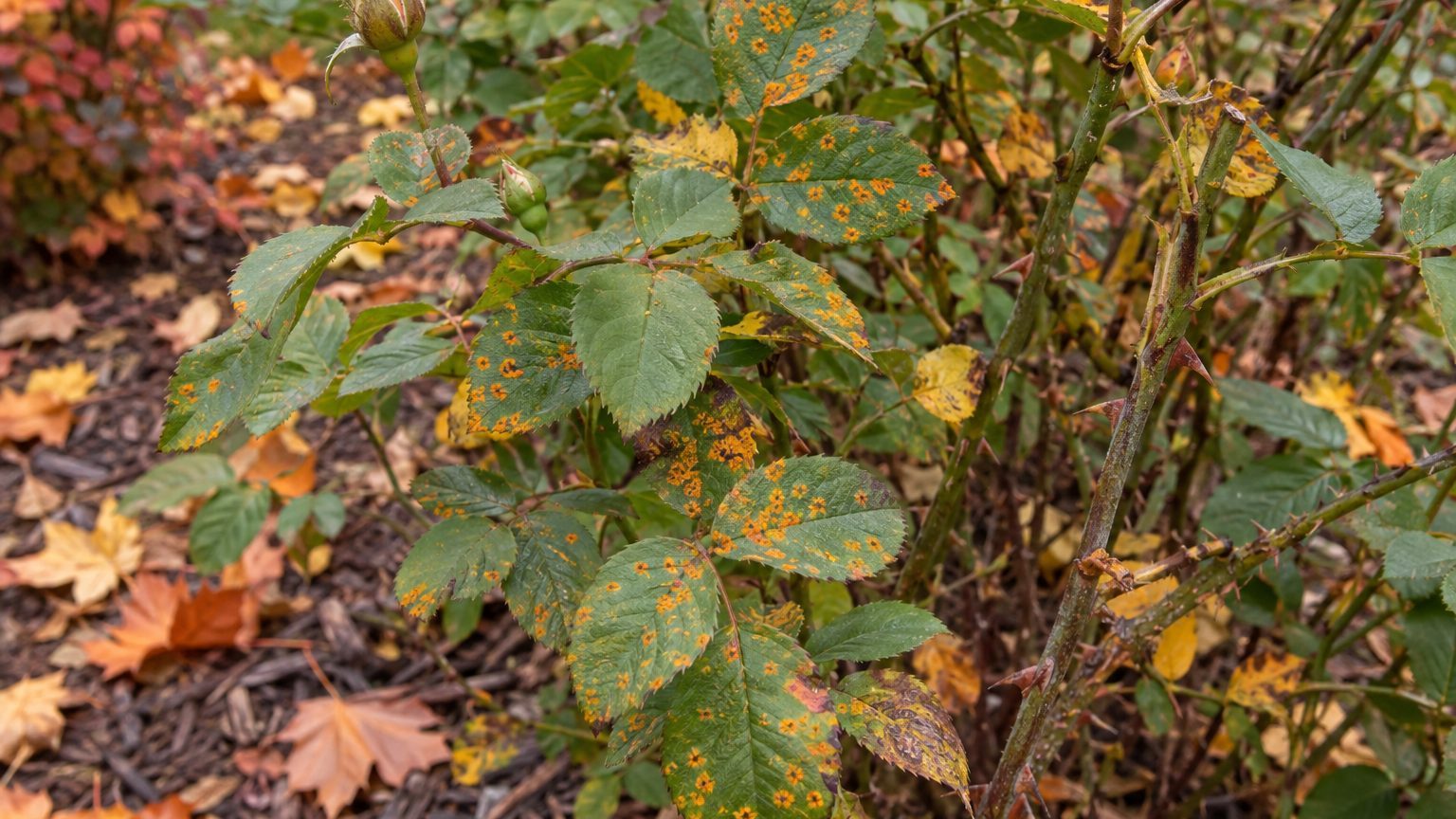
  • Small orange pustules full of powdery spores cover the undersides of leaves, usually starting on the lower ones and moving upward.
  • Yellow to reddish brown spots appear on the upper leaf surfaces, directly over the pustules below.
  • Pustules may also break out on the stems, as described for Maryland roses.
  • A severe case leaves orange dust on the leaves and on the ground beneath the plant.
  • In Maryland, the orange pustules darken late in summer as overwintering spores form, while in Pennsylvania black spores appear on the leaves in autumn.
  • Badly infected leaves on highly susceptible cultivars turn yellow or brown and drop.

Only roots and petals escape, so every other part of the bush can carry the fungus.

Rose Rust or Something Else?

Spotted, dropping leaves have more than one cause, and some of them call for a very different response. A diagnosis should combine the spot pattern with another clue, such as where the color sits on the leaf or how the stems grow.

Rose rosette disease is the one to rule out, because it reddens the plant in a way that can pass for rust at a glance.

Looks like How to tell them apart
Rose rosette disease: deep red color on the undersides of young leaves, then small, distorted, bright red leaves Stems grow vigorously in pink to magenta, leaf stalks shorten and the stem takes on a rosette look. No orange powder appears. Plants generally survive two to five years after the first symptoms.
Chrysanthemum rust: discolored spots on leaves that may drop early The spots are on chrysanthemum foliage, and the neighboring rose shows no orange pustules on its leaf undersides.

If new growth is red, crowded and rosetted instead of dusty orange underneath, treat it as a different disease. Before you decide what to do with the plant, have the problem identified.

What Causes Rose Rust, and Where It Is Worst

Rose rust comes from fungi in the genus Phragmidium, mainly Phragmidium mucronatum and Phragmidium tuberculatum, and these fungi infect roses only. The fungus runs through four spore stages. It arrives on infected roses you buy or on spores carried by the wind, and it can infect every type of rose, including Knockout cultivars.

Water is what lets an infection take hold, and cool, moist weather favors the fungus. It occurs throughout the United States, but the weather sets how bad it gets. Hot, dry summers limit it, yet it surfaces when conditions turn cool and wet.

The problem is chronic in cool coastal areas and can reach inland in wet years. Dark, thick-walled teliospores form in fall and wait out winter on fallen leaves. In California, some rusts also winter over on leaves that never drop from the plant.

How to Treat Rose Rust

Treatment centers on cleanup and careful watering.

  1. Check the undersides of the lower leaves first, so that you find the pustules before they climb the plant.
  2. Prune back severely affected canes, so that the heaviest source of spores leaves the bush.
  3. Stop overhead watering and wet only the soil, because water is needed for the fungus to infect new leaves.
  4. Pick up fallen leaves and dispose of them away from the bed, since the overwintering spores rest on them.
  5. A rose can tolerate a light infection without significant loss, but keep watching for heavier damage.

Fungicides are a separate decision. Which products are registered for roses differs by state, so your state extension service is the place to ask before you buy anything.

How to Prevent Rose Rust Coming Back

Rust returns on a seasonal cycle, so the prevention that works follows that cycle.

  • When you bring home new roses, inspect them closely, since infected plants are one way the disease arrives.
  • When rust is a problem, water at the base and keep the leaves dry, because wet foliage helps the fungus infect.
  • When pustules darken, prune out the most affected canes before the overwintering spores settle in.
  • Rake up fallen leaves, because dormant spores survive on them.
  • In California, collect leaves still hanging on the plants and those on the ground during winter.
  • When replacing a rose in a coastal location where rust is chronic, look for rust-resistant cultivars if they are available.

Removing fallen and lingering leaves clears away spores that can start another infection.

Where This Comes From

These notes draw on university extension and government plant disease publications written for states including California, Maryland, Pennsylvania, South Carolina and South Dakota. Timing and product rules differ by state, so confirm the details with your own state’s extension service.

Common Questions

Can Rose Rust Spread to Other Plants?

No. The fungi are specific to roses, so the disease moves from rose to rose, carried by wind. Chrysanthemums have their own rust, which looks similar but is a different disease.

Will Rose Rust Kill a Rose Bush?

Low levels of damage usually cost a plant little. Heavy infections cause leaves to yellow and fall, which weakens the bush.

Does Rose Rust Affect the Roots or Blooms?

It attacks every part of the plant except the roots and the petals. Leaves and stems carry most of the damage.

The almanac, state by state. Every date on this site comes from a state’s own frost facts and its extension service’s calendar — and says where it comes from.