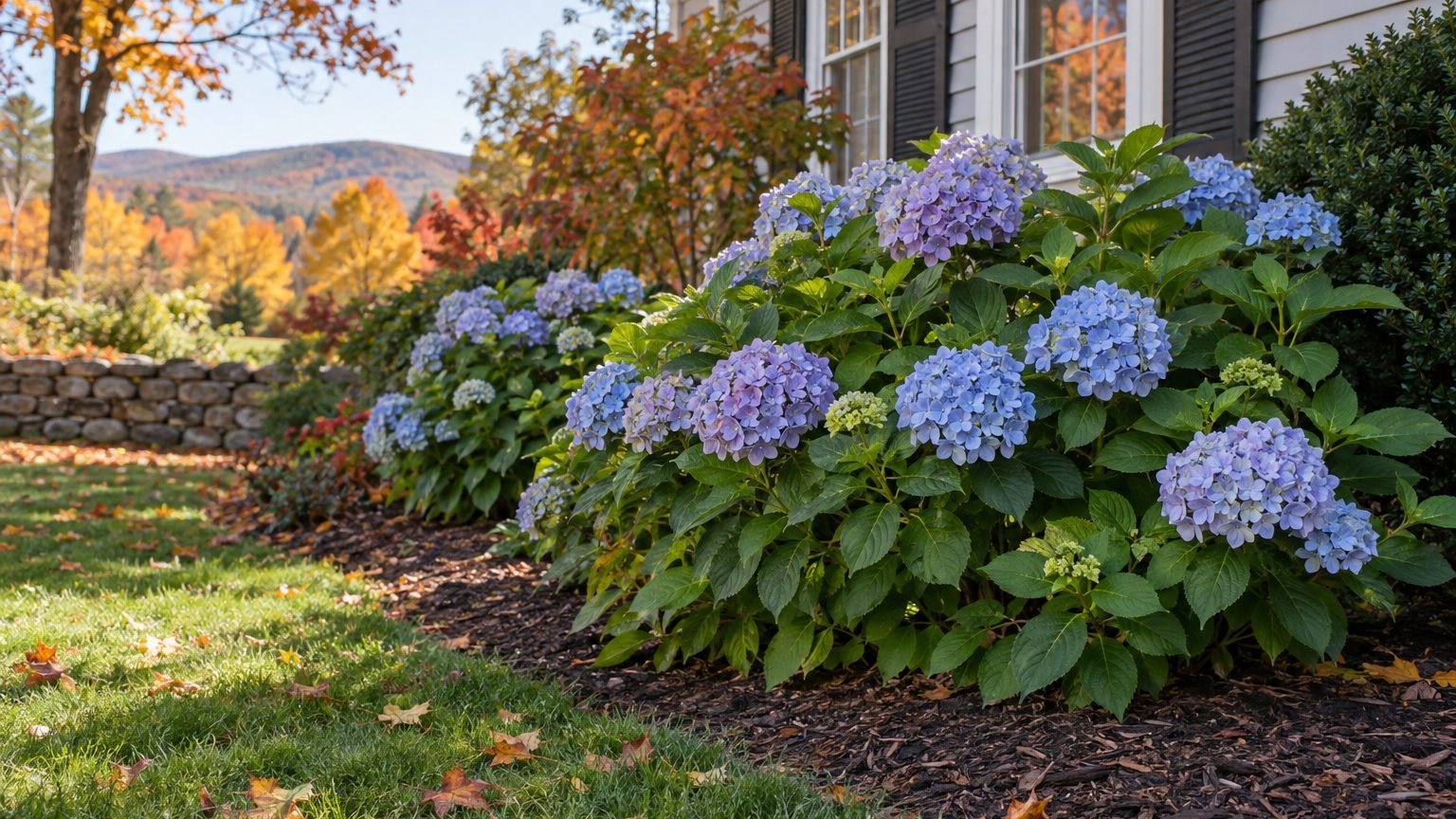
Hydrangeas grow across Vermont, but the state’s frost calendar decides which kind actually thrives where you live. Panicle and smooth types shrug off the cold here. Bigleaf hydrangeas gamble against a winter that can wipe out next year’s flower buds. Plant after the ground has warmed, prune according to wood type, and match the variety to your elevation, not the state average.
Hydrangeas Care Calendar for Vermont

The year turns on two dates measured at Burlington: NOAA NCEI 1991-2020 Climate Normals puts the last spring freeze between April 30 and May 10, and the first fall freeze between October 3 and October 13. That window runs shorter once you leave the lake for the Green Mountains or the Northeast Kingdom.
- Dormancy: the one safe window to move an established hydrangea, while roots stay undisturbed and no leaf has opened yet.
- Planting: wait until soil has actually warmed past the April 30 to May 10 freeze window before setting new plants out.
- First feeding: work a balanced fertilizer into the soil at planting, then again once new growth is a few inches tall.
- Pruning: cut panicle and smooth types back hard while still dormant, but leave bigleaf wood alone until its buds show green.
- Bud watch: check for flower buds through early summer, since a stray cold night can still nip them on exposed sites.
- Fall mulch: pile mulch over the root zone before the October 3 to 13 freeze window arrives.
- Winter mound: once the ground freezes hard, mound extra mulch over the crown of any bigleaf plant to buffer the worst of the cold.
Skip a step here and the calendar punishes you fast. A hydrangea planted after the soil has cooled, or left bare through a Vermont winter, rarely blooms the following June.
Vermont — the year and the numbers
- State
- Vermont
- USDA zones
- 3b-5b
- Last spring frost
- April 30 to May 10
- First fall frost
- October 3 to October 13
- Annual rain
- 38 in
- Lawn zone
- cool-season
- Source
- NOAA NCEI 1991-2020 Climate Normals, 32F freeze probabilities · Burlington
Best Hydrangeas for Vermont
USDA Plant Hardiness Zone Map puts Vermont at zone 3b to 5b, and that spread alone decides which hydrangea kind is worth the ground you’d give it. Panicle and smooth hydrangeas bloom on new wood, so a cold winter can’t erase flower buds that haven’t formed yet.
Bigleaf hydrangeas are the gamble here. Most set their buds on old wood, and a winter that pushes toward the colder end of that same zone range can kill those buds even while the shrub itself survives underground.
| Kind | Verdict here | Why |
|---|---|---|
| Panicle | Solid choice | Blooms on new wood, so winterkill doesn’t touch next year’s flowers |
| Smooth | Solid choice | Same new-wood habit, forgiving across the state’s full zone range |
| Bigleaf | Risky | Old-wood buds often fail at the colder end of zone 3b to 5b |
| Oakleaf | Borderline | Sits near the warm edge of what the range supports, best near the lake |
Climbing hydrangea and a handful of lesser-known kinds are on their own page, since the state-wide zone number doesn’t say much about how a vine handles a north-facing wall.
When to Plant, Prune and Feed Hydrangeas in Vermont
Three dates run most of the hydrangea year here, and all three trace back to the same freeze window. NOAA NCEI 1991-2020 Climate Normals sets that spring freeze between April 30 and May 10 at Burlington, and the rest of the calendar counts forward or backward from it.
Planting waits until the soil has actually warmed, not just the calendar page. Pruning splits by wood type, since a new-wood bloomer takes a hard cut while dormant, but an old-wood bloomer wants to wait until right after its flowers fade instead.
| Task | Window here | Counted from |
|---|---|---|
| Planting | A couple weeks after soil has warmed | The April 30 to May 10 freeze window |
| Pruning, new-wood types | Late winter into early spring, while dormant | Any time before that same freeze window |
| First feeding | At planting, in the weeks that follow the freeze | The same April 30 to May 10 window |
Bigleaf and oakleaf hydrangeas set next year’s buds on this year’s growth, so pruning them on the panicle schedule strips away flowers before they ever open. Their exact pruning window lives on the state’s dedicated calendar page.
Hydrangeas Problems in Vermont and What Causes Them
No flowers despite a healthy-looking shrub
This is almost always a bud problem, not a plant problem. Bigleaf hydrangeas set flower buds on old wood, and a winter reaching the colder end of the range the USDA Plant Hardiness Zone Map sets for Vermont, zone 3b to 5b, kills those buds while the shrub survives. Choosing a new-wood bloomer instead sidesteps this entirely.
Stems die back to the ground every winter
A shrub that returns from the roots but never gains height is usually planted at the cold edge of its range. Bigleaf wood above ground takes the brunt of that same zone spread. A heavy fall mulch over the crown buys some protection, and the state’s problems page walks through winter injury in more depth.
Late blooms cut short by an early freeze
The first fall freeze can land as early as October 3 at Burlington, catching any late, soft growth before it hardens off. Feeding into midsummer encourages exactly that kind of tender growth. Cutting off fertilizer earlier in the season gives new wood time to toughen up before that window opens.
Vermont North to South: How the Dates Shift
Vermont’s frost dates don’t apply evenly from one end of the state to the other. Burlington sits right on Lake Champlain, and that water keeps the reference numbers milder than much of the state actually sees.
- Champlain Valley (Burlington, the lake shore): the mildest corner of the state, and the closest match to the frost dates and zone range cited above.
- Green Mountains (the state’s spine, higher elevation): frost lingers later into spring and returns earlier in fall than the lakeshore numbers suggest.
- Northeast Kingdom (the far northeast): the coldest corner of Vermont, where the season shrinks the most and only tough new-wood hydrangeas really make sense.
Check the reference numbers against your own elevation and distance from open water, since a few miles inland can shift a safe planting date by weeks.
Vermont Extension Offices and County Contacts
The zone 3b to 5b range and the Burlington frost dates are a starting point, not a guarantee for your particular yard. University of Vermont Extension keeps county-level guidance worth checking before a bigleaf hydrangea goes in the ground.
- Your state page: the frost dates and the pruning window where you live.
- Which ones hold up here: a longer look at panicle, smooth, bigleaf and oakleaf side by side.
- University of Vermont Extension: county contacts for a soil test or a site-specific planting call.
Common questions
Can I grow bigleaf hydrangeas in Vermont?
Only in the mildest pockets, close to Lake Champlain, and even there expect some winters with no blooms since old-wood buds sit exposed to the state’s zone 3b to 5b lows.
When is it safe to plant a new hydrangea in Vermont?
Wait a couple weeks past your local last frost, using Burlington’s April 30 to May 10 window as a reference point and later still if you’re up in the mountains.
Do hydrangeas need winter protection in Vermont?
New-wood types like panicle and smooth usually don’t. Bigleaf and oakleaf benefit from a heavy mulch mound over the crown before the ground freezes hard.