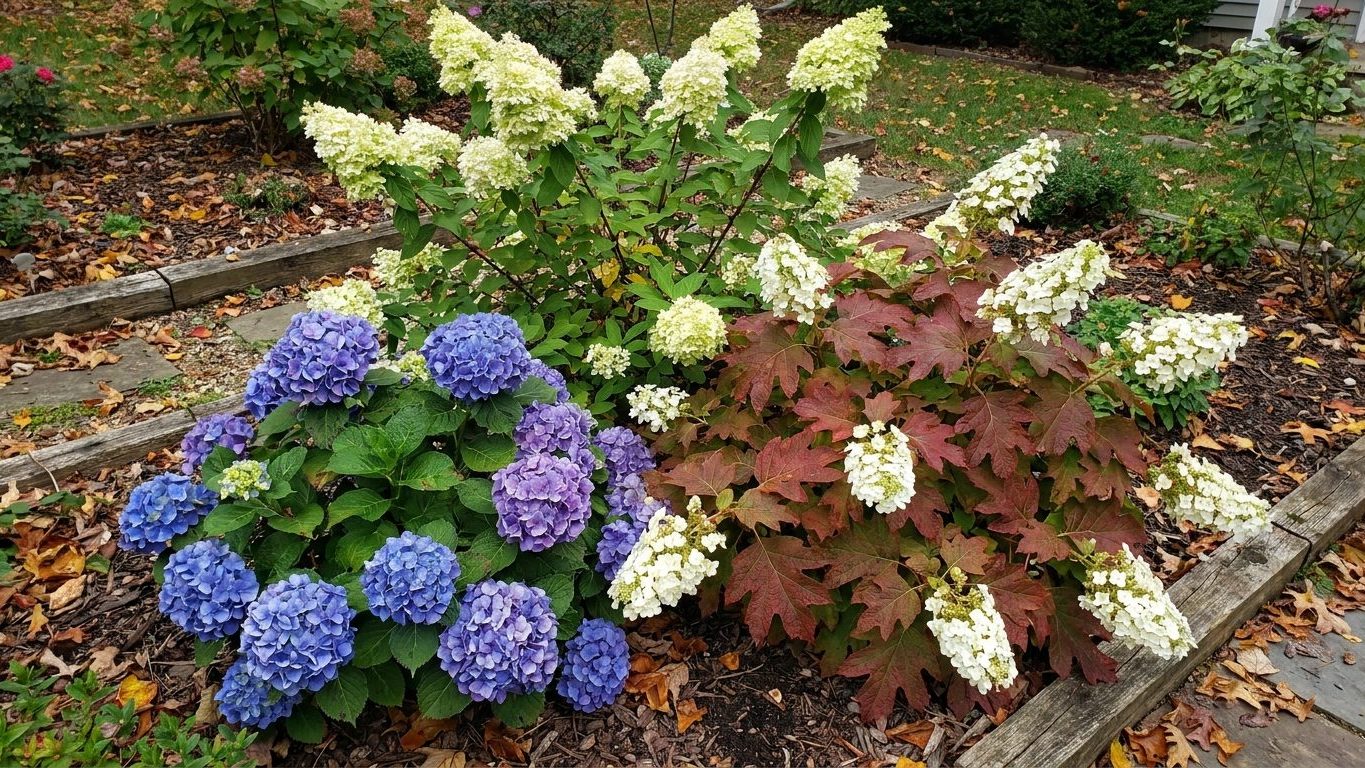
Panicle and smooth hydrangeas are the safe bets across Montana, built for winters that stay brutally cold and summers that arrive late. Bigleaf hydrangea, the type most people picture with its giant mophead blooms, struggles here because its flower buds rarely survive the state’s coldest nights, which is why it sits at the bottom of the list below.
Hydrangeas that grow well in Montana: The Short Answer
In Billings, the reference city for this guide, the USDA Plant Hardiness Zone Map puts the state at 3a to 6a, and Billings itself sits toward the milder end of that range. That single fact decides almost everything below: hydrangeas that bloom on new wood shrug off Montana winters, while those that bloom on old wood mostly don’t.
Hydrangea paniculata ‘Limelight’

Panicle hydrangea is the safest name on this list. It blooms on new wood, so a hard winter that kills stems to the ground still leaves a full bloom by August. Zone 3 hardiness means it shrugs off winters most other hydrangeas can’t survive.
Hydrangea paniculata ‘Little Lime’

A compact paniculata that behaves the same way as ‘Limelight’ in a Montana yard. It stays shorter, which matters where open wind can shred taller stems, and it still blooms reliably on new wood every summer.
Hydrangea arborescens ‘Annabelle’

Smooth hydrangea is native to a wide swath of the country and hardy enough for Montana’s coldest counties. It blooms on new wood too, so winterkill only delays the show, it never cancels it. Afternoon shade helps the big white heads hold up in dry summer wind.
Hydrangea arborescens ‘Incrediball’

Bred for stronger stems than older Annabelle types, which matters where wind is a bigger threat than cold. It carries the same new-wood blooming habit and the same cold tolerance, making it a solid second choice for exposed yards.
Climbing hydrangea (Hydrangea anomala subsp. petiolaris)

A step riskier than the shrubs above. It tolerates cold reasonably well but needs years to establish before it flowers, and a rough winter early in its life can set it back to nothing. It wants a sheltered wall, not an open yard.
Bigleaf hydrangea (Hydrangea macrophylla)

The riskiest name here. Bigleaf sets its flower buds on old wood the fall before, and Montana’s winter lows routinely kill those buds even when the plant itself survives. Expect a green shrub with few or no blooms most years without heavy winter protection.
Montana — the year and the numbers
- State
- Montana
- USDA zones
- 3a-6a
- Last spring frost
- April 29 to May 10
- First fall frost
- October 1 to October 14
- Annual rain
- 14 in
- Lawn zone
- transition-season
- Source
- NOAA NCEI 1991-2020 Climate Normals, 32F freeze probabilities · Billings
How to Work Out the Dates for Your Own Yard
The frost window decides almost every planting date, so work from it instead of a generic calendar.
- Find your last spring frost window: NOAA NCEI 1991-2020 Climate Normals puts Billings’ last spring freeze between April 29 and May 10, a range that shifts later the higher you climb into the mountains.
- Hold new plantings until that window closes: a hydrangea set into cold soil before May 10 often sits stalled for weeks, and a late freeze can burn new leaves back to bare wood.
- Line up with the site’s plant months: Montana’s plant window covers April, May, August, and September, so an early fall planting avoids both the late frost risk and the driest weeks of midsummer.
- Work out the fall cutoff: the first fall frost lands October 1 to October 14, leaving an August planting roughly two months to root before the ground locks up.
- Weigh your zone against the variety’s needs: paniculata and arborescens types hold their own at zone 3a, while bigleaf wants conditions closer to zone 6a, the mild edge of the state’s range.
- Watch your own yard’s microclimate: a spot against a south-facing wall can run warmer than the official window, while a low pocket that collects cold air can run colder.
Take ‘Limelight’ as the test case: it blooms on new wood, so a winter that kills every stem to the ground still leaves a full show by late summer.
Bigleaf hydrangea fails the same test. Its flower buds form on old wood the fall before, and Montana’s winter lows erase them most years no matter when it was planted.
Montana North to South: How the Dates Shift
Montana’s frost dates aren’t one line on a map, they shift with elevation, water, and how exposed a valley is to wind.
- Western valleys (Missoula, Kalispell, the Bitterroot): lake and river moisture softens the swings, letting the plant window open a little earlier than the rest of the state.
- South-central valleys (Bozeman, Livingston, the Yellowstone corridor): higher elevation cold pockets can push both frost dates later in spring and earlier in fall than the Billings reference numbers suggest.
- Eastern high plains (Miles City, Glendive, Sidney): open, treeless exposure means wind does more damage than cold alone, so shelter matters as much as the calendar date.
- Southern river valleys (Billings, the lower Yellowstone): this is the mildest ground in the state and the reference point for the dates used throughout this guide.
Wherever you garden, treat the state-wide dates as a starting point and adjust with what your own yard tells you.
Mistakes Montana Punishes
Montana’s cold and short season punish three specific habits harder than a milder climate would.
Planting bigleaf for old-wood blooms
Bigleaf hydrangea sets next year’s flowers on wood grown this year, and Montana’s winter lows kill those buds most years even when the shrub itself survives fine. Plant a paniculata or arborescens type instead, both bloom on new wood and shrug off the same cold.
Pruning bigleaf outside its window
The safe prune window for bigleaf hydrangea here is June and July. Cutting earlier removes wood that would have carried this year’s buds, and cutting later leaves fresh wounds exposed just as the first fall frost approaches in early October.
Skipping mulch before the ground freezes
Bare soil around the crown loses heat fast once the first fall frost lands, somewhere between October 1 and October 14 here. A few inches of mulch over the root zone before that window closes protects the crown more than wrapping the top growth ever will.
Montana Extension Offices and County Contacts
Montana’s zone range is a starting point, not a final answer, and county-level help fills in the rest.
- Your state page: the frost dates and prune window for where you actually live, not just the Billings reference numbers.
- What’s going wrong with your hydrangea: symptom-by-symptom fixes for the pests and problems Montana’s climate brings.
- Montana State University Extension: call your county office before you plant if your yard sits outside Billings’ milder valley.
Common questions
Can bigleaf hydrangea ever bloom reliably in Montana?
Only with heavy winter protection, since its flower buds form on old wood that Montana’s cold routinely kills. Gardeners who wrap the whole shrub in burlap and mulch heavily sometimes get blooms, but paniculata and arborescens types skip that work entirely.
Do hydrangeas need full sun in Montana?
Most do best with morning sun and afternoon shade here, since the state’s dry summer air and strong sun can scorch leaves faster than in a humid climate. A spot with a few hours of shade past midday holds moisture longer.
How long does a newly planted hydrangea need before winter?
Aim for at least six to eight weeks of root growth before the first fall frost, which lands October 1 to October 14 in Billings. That points toward the April, May, August, and September plant window rather than a midsummer planting.