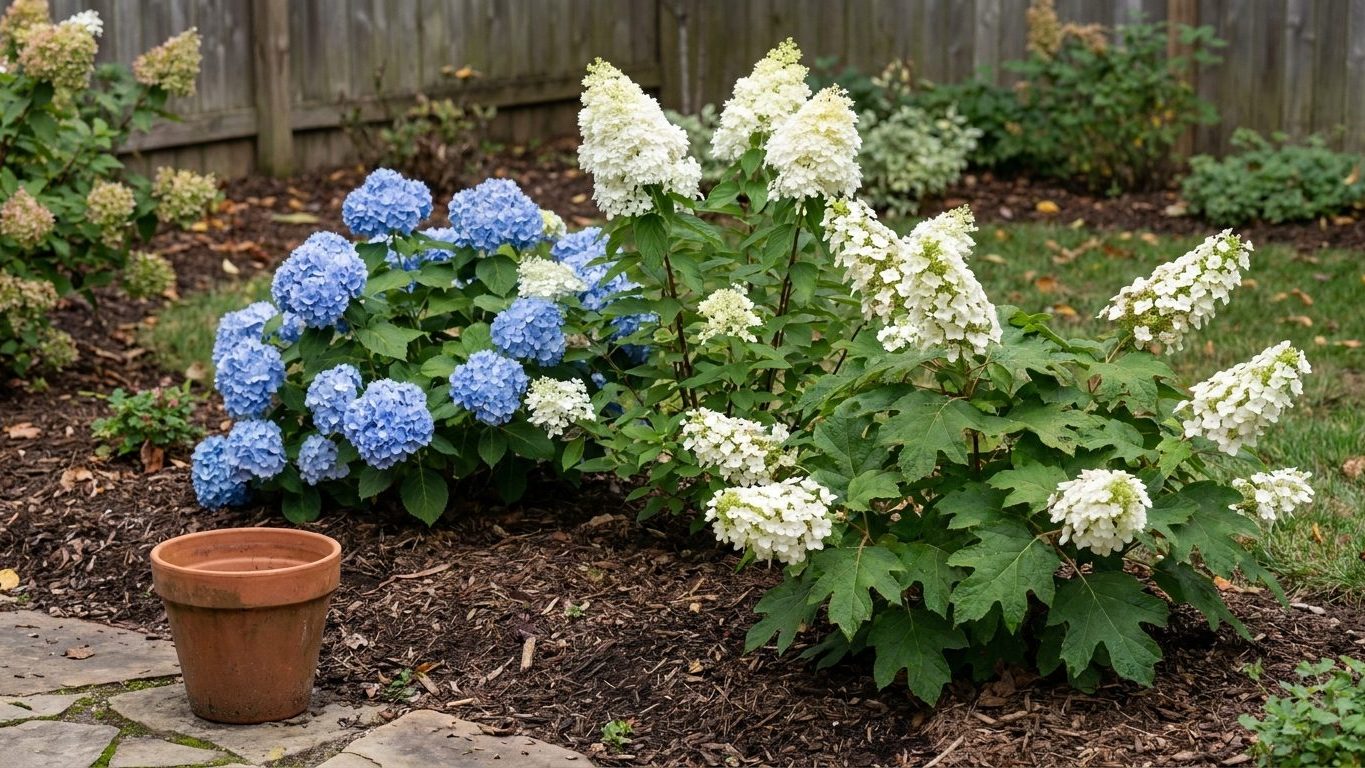
Panicle and smooth hydrangeas are the two safest bets for Idaho, since both flower on new wood and shrug off the hard freezes that come with USDA zones 3b to 7b. Boise’s frost-free stretch runs from late April to early October, plenty of time for a new-wood bloomer to set flowers. Bigleaf hydrangea, the variety most people picture, struggles almost everywhere except the mildest valley floors.
Hydrangeas that grow well in Idaho: The Short Answer
Idaho spans USDA zones 3b to 7b on the USDA Plant Hardiness Zone Map, and Boise sits near the mild end. A hydrangea’s bloom habit, new wood or old, matters more here than in milder states, since a spring freeze after bud break is common before Boise’s frost-free window opens.
Panicle hydrangea (Hydrangea paniculata)

Panicle hydrangea flowers on new wood, so a hard freeze that damages last year’s stems doesn’t cost a season of blooms. It tolerates cold across the state’s coldest zones, making it the safest choice from Boise’s benches up into the mountains. Full sun and dry summers, Idaho’s default weather, suit it well.
Smooth hydrangea (Hydrangea arborescens)

Smooth hydrangea also blooms on new wood, so a late frost doesn’t erase the flowers. It handles the same cold as panicle types and tolerates part shade better, useful where afternoon sun turns harsh on the Snake River Plain. Heavy blooms can flop the stems without some support.
Mountain hydrangea (Hydrangea serrata)

Mountain hydrangea is a smaller, tougher relative of bigleaf, with thinner stems that handle a whiplash spring better. It still sets most buds on old wood, so a freeze after growth starts can erase a year’s flowers. It fits Boise’s lower elevation but not the state’s colder pockets.
Oakleaf hydrangea (Hydrangea quercifolia)

Oakleaf brings fall color and peeling bark, a genuine four-season shrub, but its cold tolerance runs out around zone 5, excluding much of Idaho above the valley floors. Where it fits, heavy mulch and shelter from north wind help it through winter.
Climbing hydrangea (Hydrangea anomala subsp. petiolaris)

Climbing hydrangea needs several seasons just to establish before it starts flowering, and Idaho’s shorter frost-free window leaves less growing time than the vine wants. It can survive the cold in a sheltered spot but rarely rewards the wait with much bloom.
Bigleaf hydrangea (Hydrangea macrophylla)

Bigleaf is the variety most gardeners picture first, and the one Idaho punishes hardest. It sets flower buds on the previous year’s wood, and a spring freeze after bud break, common before Boise’s frost-free window fully opens, wipes out blooms even on a healthy shrub.
Idaho — the year and the numbers
- State
- Idaho
- USDA zones
- 3b-7b
- Last spring frost
- April 23 to May 7
- First fall frost
- October 7 to October 21
- Annual rain
- 12 in
- Lawn zone
- transition-season
- Source
- NOAA NCEI 1991-2020 Climate Normals, 32F freeze probabilities · Boise
How to Work Out the Dates for Your Own Yard
Finding out what will actually survive in your yard starts with two dates, since Idaho’s growing season is really the gap between them.
- Find your last spring frost: Boise’s window runs April 23 to May 7, the range NOAA NCEI 1991-2020 Climate Normals for station USW00024131 gives as the 30 to 70 percent freeze probability band.
- Find your first fall frost: Boise sees this between October 7 and October 21, setting the far end of the season.
- Subtract time for elevation: every few hundred feet above Boise’s valley floor pushes both dates inward and shortens the season further.
- Check your zone: Idaho spans 3b to 7b, so a shrub rated for zone 6 may die where you live even though it thrives in Boise.
- Match bloom habit to the gap: a new-wood bloomer only needs the frost-free stretch to flower, while an old-wood bloomer needs last year’s stems to survive winter intact too.
Run panicle hydrangea through that checklist and it passes every point, cold-tolerant, new-wood blooming, comfortable with a shorter frost-free window than Boise’s. Bigleaf fails the zone check almost everywhere above the valley floor, since its rating leaves it exposed across most of the state’s higher ground.
Idaho North to South: How the Dates Shift
Elevation, not latitude, does most of the work shifting these dates from one Idaho yard to the next.
- Treasure Valley (Boise, Nampa, Caldwell): the lowest, mildest ground in the state, closest to the April 23 to May 7 spring frost window and the longest stretch before fall frost returns.
- Magic Valley and the Snake River Plain (Twin Falls, Burley): similar low elevation but drier air, so daytime heat and overnight cooling both run harder.
- Panhandle (Coeur d’Alene, Sandpoint): nearby lakes soften the coldest nights somewhat, though the frost-free season still runs shorter than the Treasure Valley’s.
- Central and eastern mountains (Sun Valley, Stanley, Idaho Falls): the state’s coldest ground, where the growing season can close weeks earlier than Boise’s.
Whichever region matches your yard, treat Boise’s dates as the mild end of Idaho’s range and adjust colder from there.
Mistakes Idaho Punishes
Planting bigleaf and expecting old-wood blooms
Bigleaf hydrangea sets flower buds on the previous year’s wood, and a freeze after growth starts, common before Boise’s frost-free window closes, kills those buds even on a healthy shrub. Plant a new-wood bloomer like panicle or smooth instead, or accept foliage without flowers most years.
Pruning bigleaf outside its window
Cutting back stems any time other than June or July removes next year’s flower buds before they even form, since bigleaf sets buds on the growth made right after that cut. Prune only in that window, never during fall or spring cleanup.
Feeding on a random schedule
Fertilizing whenever a bag happens to be on sale pushes soft new growth right before a fall or spring freeze, and that tender wood is what cold kills first. Idaho’s fertilizing window falls in March, May, and July, timed to avoid pushing growth into frost. Skip a September feeding no matter how the shrub looks.
Idaho Extension Offices and County Contacts
Boise’s frost dates and zone number are a starting point, not the final word for your yard. University of Idaho Extension keeps county-level guidance that adjusts for local elevation and soil.
- Your state page: the frost dates and the pruning window where you live.
- Which ones hold up here: the full list of hydrangea varieties suited to Idaho’s zones, ranked from safest to riskiest.
- What goes wrong here: the pests and problems specific to Idaho’s hydrangeas, month by month.
Call your county extension office through University of Idaho Extension before planting anything rated below your local zone.
Common questions
Can bigleaf hydrangeas survive an Idaho winter?
Only in the mildest valley pockets near Boise, and even there a late spring freeze after bud break often erases the bloom for the year. Panicle and smooth hydrangeas handle the same cold with far less risk.
What is the best hydrangea for a cold Idaho yard?
Panicle hydrangea tolerates cold across the state’s coldest zones on the USDA Plant Hardiness Zone Map, covering most of Idaho’s mountain valleys, and it flowers reliably because it blooms on new wood every year.
Do hydrangeas need winter protection in Idaho?
New-wood bloomers like panicle and smooth rarely need it, since frozen stems just get replaced by spring growth. Old-wood types such as bigleaf benefit from a thick mulch layer and shelter from north wind, though protection only helps so much once a hard freeze hits open buds.