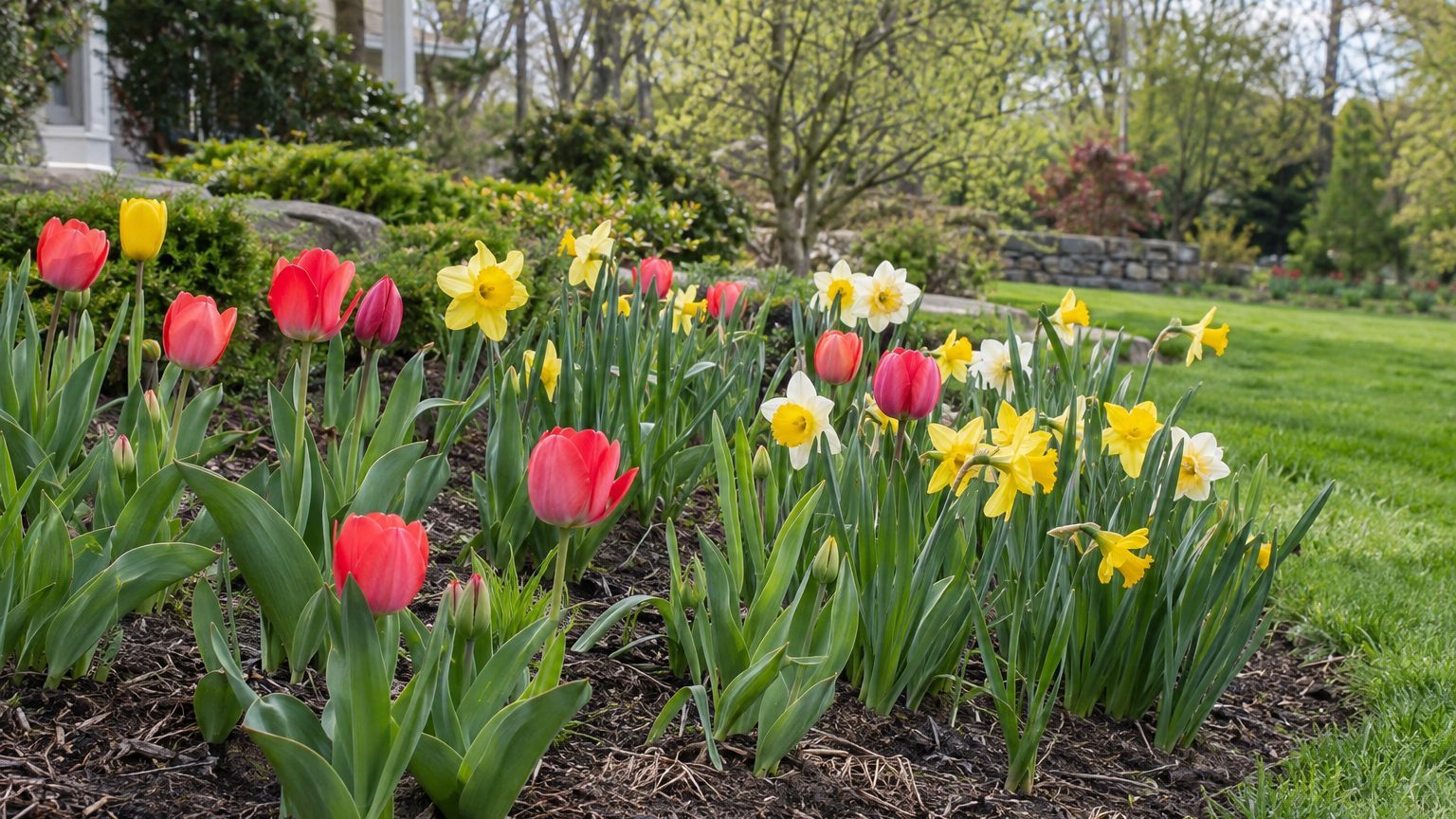
Green spears of daffodil and tulip leaves pushing through cold soil are one of the first signs of spring in a British Columbia yard. The flowers follow in the spring months, and the exact week depends on the variety and on how quickly your patch of the province warms.
When Do Tulips and Daffodils Bloom in British Columbia?

Tulips and daffodils bloom from March through May, following the warming of spring. British Columbia has no local bulb-timing guide of its own, so these months follow the nearest comparable climate. Confirm local timing with a garden centre, a garden society or a provincial gardening group.
| Bulb | When it blooms in British Columbia | What sets the timing |
|---|---|---|
| Daffodils | March to May | Spring warming, plus whether the variety opens early or late |
| Hybrid tulips | Late March to early May | Early, mid or late spring varieties |
| Tulips and daffodils overall | March to May | How fast the soil and air warm where you live |
Mixing early and late varieties stretches the show, and daffodils chosen this way can carry color into early summer. Crocus and alliums sit at opposite ends of the bulb season, with alliums finishing it. In Vancouver, which sits in Canadian hardiness zone 9a (a Canadian rating that does not match any USDA zone), the last spring frost falls on average March 18. Treat that as the middle of a range, since in one year out of two the frost arrives later.
British Columbia — the year and the numbers
- State
- British Columbia
- Hardiness zones
- 9a
- Last spring frost
- March 18
- First fall frost
- November 10
- Annual rain
- 47 in
- Lawn zone
- transition-season
- Source
- Environment and Climate Change Canada — Canadian Climate Normals 1981-2010, station VANCOUVER INT'L A · Vancouver
How to Tell Your Bulbs Are About to Bloom
Bulbs announce themselves well before the first petal opens, and a few plain signs tell you how close you are.
- Green tips breaking the soil mean roots and bulbs are awake, so mark where bulbs are planted before you dig anything nearby.
- Leaves that keep lengthening and thickening tell you a flower stalk is forming in the middle.
- A bud that rises out of the foliage on its stalk is close to opening, so this is the time to check for slugs on tender tulip and crocus growth.
- A bud showing color through its wrapping is days from opening, and a cold snap now will hold it back rather than harm it.
- Hybrid tulips open from late March to early May, so a bed planted with several types can have buds at different stages at once.
Cut stems for a vase just as the color shows, and leave the rest of the plant alone.
What to Do After Tulips and Daffodils Bloom in British Columbia
Snip off the faded flowers and leave everything else in place. The leaves are what recharge the bulb for next year, so they stay on the plant until they turn yellow and then brown. Do not cut them while they are green, and do not tie or braid them, since folded leaves collect less light.
Tulips are often short-lived in the garden, while daffodils last longer and are the more reliable perennial bulb. A few tulips, such as Darwin hybrids and Emperor tulips, are bred to return for several years, and species tulips, which are smaller, are hardy and well suited to naturalizing.
Once the foliage has browned, it lifts away with a gentle tug. Plant late-flowering annuals or perennials near the fading leaves so they cover the untidy stage and the bulbs stay undisturbed.
How Bloom Time Shifts Across British Columbia
The province is not one climate, so the months above stretch or tighten depending on where you garden.
- Vancouver and the Lower Mainland: the coast is mild, and spring warmth arrives here sooner than in colder districts, so blooms open toward the front of the window.
- The Okanagan: winters are colder inland, so bulbs go in a little earlier in fall to settle their roots. Bloom follows how quickly your own site warms in spring.
- Northern and upland districts: spring comes later than at Vancouver, so expect tulips and daffodils to open later and shift toward the end of the window.
A sheltered, south-facing wall near your house will open flowers ahead of an open, shaded corner of the same yard.
Where to Get Bulb Advice in British Columbia
British Columbia has no county extension offices, so local advice comes from the province and from people who garden nearby. Their guidance on soil, varieties and planting times reflects your own district rather than the province as a whole.
- British Columbia’s Ministry of Agriculture and Food has provincial gardening and agriculture information, and it is a good first stop before fall planting.
- A local garden centre can tell you which varieties suit your district, and it is worth a visit in early fall when bulbs are in stock.
- A garden society or master gardener group in your area can answer timing questions, and spring meetings are a good time to compare notes on bloom dates.
Common Questions
Can You Plant Tulip and Daffodil Bulbs in December?
Yes, as long as the ground can be dug. October and November are the usual planting months, with September and December as fallback months. In the colder interior, planting goes in by late September. A bulb still in the bag is better planted late than stored over the winter.
Do Deer and Voles Eat Tulips and Daffodils?
Voles, squirrels, rabbits and deer eat tulips and crocus, but they leave daffodils alone. Daffodil sap contains needle-sharp crystals that burn the mouth, which is why browsing animals avoid them. Crocuses resist deer but not slugs.
Do Tulips Need to Be Chilled Before Planting?
Most spring bulbs need about 12 to 16 weeks of cold to flower. Where winters are too mild to supply it, tulips and hyacinths are chilled in the refrigerator before planting. Alliums need the cold of winter to bloom.