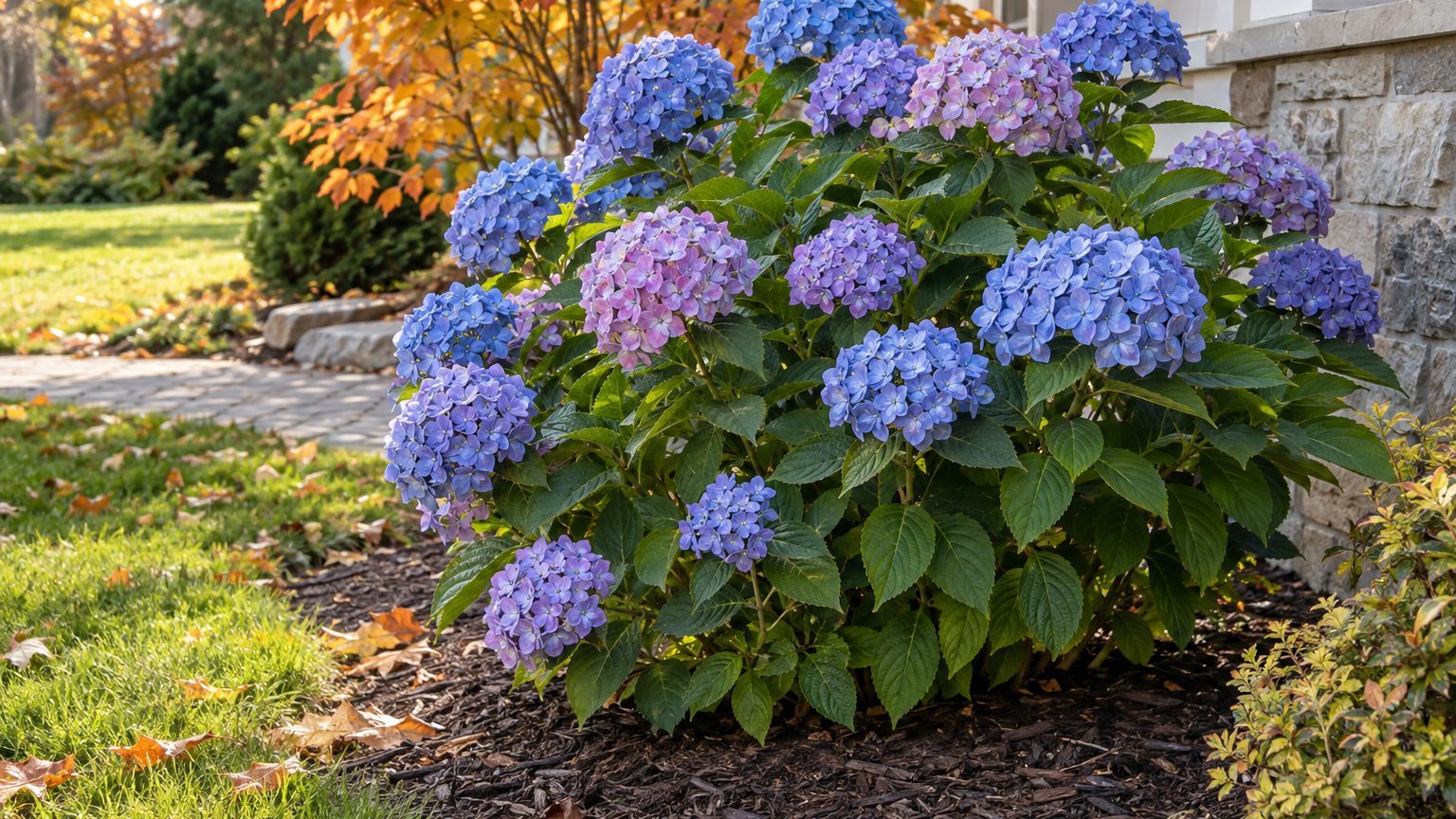
In Burlington, the safe planting windows for hydrangeas run April, May, August, and September, timed around a last spring frost of April 30 to May 10 and a first fall frost of October 3 to October 13. Bigleaf pruning waits until June or July, after bloom, never in fall.
When to prune hydrangeas in Vermont: The Short Answer
NOAA NCEI’s 1991-2020 Climate Normals put Burlington’s last spring frost at April 30 to May 10 and its first fall frost at October 3 to October 13, and the state’s hydrangea calendar builds outward from those two windows.
- January: the ground is frozen solid and nothing goes in the soil. Leave any mulch dome over the crown untouched.
- February: still dormant season here. Order stock now so it arrives ready for the April planting window.
- March: the first fertilize month of the year. Feed once new growth starts to swell, not before.
- April: the plant window opens, but frost risk lingers into early May. Hold containers by a wall until the ground truly warms.
- May: planting continues and it’s also a fertilize month. Wait until after May 10 in most yards before committing roots to open ground.
- June: the bigleaf pruning window opens right after the first flush of bloom. Cut spent flower heads back to the first healthy bud pair.
- July: pruning and fertilizing both continue. This is the last feeding of the season, so root growth slows before fall.
- August: a second plant window. Roots set now have real weeks to establish before the ground cools.
- September: the last safe planting month. Anything set in now needs mulch on standby for the frost that follows.
- October: the first fall frost lands October 3 to October 13. Stop planting and mulch anything new heavily.
- November: fully dormant. Check that mulch still covers the root zone after any hard rain.
- December: nothing to do outside. Use the quiet month to plan next spring’s plant list.
Every gesture on that list traces back to the same two dates. Miss the frost window in either direction and the plant pays for it, not the calendar.
Vermont — the year and the numbers
- State
- Vermont
- USDA zones
- 3b-5b
- Last spring frost
- April 30 to May 10
- First fall frost
- October 3 to October 13
- Annual rain
- 38 in
- Lawn zone
- cool-season
- Source
- NOAA NCEI 1991-2020 Climate Normals, 32F freeze probabilities · Burlington
How to Work Out the Dates for Your Own Yard
USDA’s Plant Hardiness Zone Map puts Vermont anywhere from 3b to 5b, and that range is the first thing to pin down before you count backward from frost.
- Find your zone: a yard at 3b behaves very differently from one at 5b, and it decides whether bigleaf hydrangea survives the winter at all here.
- Get your local frost window: compare your address to Burlington’s April 30 to May 10 spring frost and October 3 to October 13 fall frost, then adjust earlier for elevation.
- Pick a planting month: match your frost-free stretch to the state window of April, May, August, or September, favoring the month furthest from either frost date.
- Schedule pruning after bloom: bigleaf gets cut back in June or July only, once flowering has finished for the season.
- Align feeding to the calendar: fertilize in March, May, and July, and skip the March feed entirely if the ground is still frozen at your elevation.
- Recheck before the ground freezes: confirm mulch is down before your local first frost, not Burlington’s.
A shrub planted in the Champlain lowlands can go in the ground weeks before one in the Green Mountains reaches the same soil temperature, even though both sit inside the same statewide window.
Vermont North to South: How the Dates Shift
Elevation and the lake do more work here than latitude ever does.
- The Champlain Valley (Burlington, Vergennes, Middlebury): the mildest corner of the state, closest to the frost dates cited above.
- The Green Mountains (Stowe, Killington, Manchester): elevation pushes both frost dates inward, so the safe planting window shrinks from both ends.
- The Northeast Kingdom (St. Johnsbury, Newport, Island Pond): the shortest season in Vermont, where fall planting after early September carries real risk.
- Southern Vermont (Brattleboro, Bennington): lower elevation than the Kingdom softens both frost dates slightly, closer to the Champlain pattern.
None of these local shifts are figures NOAA breaks out by town, so treat Burlington’s dates as the reference point and adjust by feel from there.
Mistakes Vermont Punishes
No Blooms After a Hard Winter
Bigleaf sets its flower buds on old wood the summer before, and a Vermont winter at zone 3b or 4a can kill those buds outright even when the shrub survives. Choose reblooming types or a hardier species for this state.
Fall Pruning That Cuts Off Next Year’s Flowers
Cutting bigleaf back in September or October removes the very buds meant to bloom next summer. Prune only in June or July, right after flowering finishes.
Planting Too Close to October Frost
Roots set in late September have almost no time to establish before the first fall frost arrives October 3 to October 13. Push fall planting earlier in the window, or wait for spring instead.
Vermont Extension Offices and County Contacts
Vermont’s statewide dates are a starting point, and UVM Extension fills in what your specific soil and county actually need.
- Your state page: the frost dates and the pruning window where you live.
- Which ones hold up here: the varieties bred to survive a Vermont winter without dying back to the ground.
- What goes wrong here: the pests and problems this state’s growing conditions actually produce.
Common questions
Can I plant hydrangeas in Vermont in October?
No. The first fall frost lands October 3 to October 13, and roots planted that late have too little time to establish before the ground freezes.
Why didn’t my hydrangea bloom this year?
In most Vermont yards it’s winter bud damage on bigleaf types, not a planting or pruning mistake. A hard freeze at zone 3b or 4a can kill flower buds set the previous summer.
Is spring or fall better for planting hydrangeas here?
Spring, specifically April or May, gives the longest stretch of frost-free growing time before winter. Fall planting in August or September still works, but leaves less margin for error.