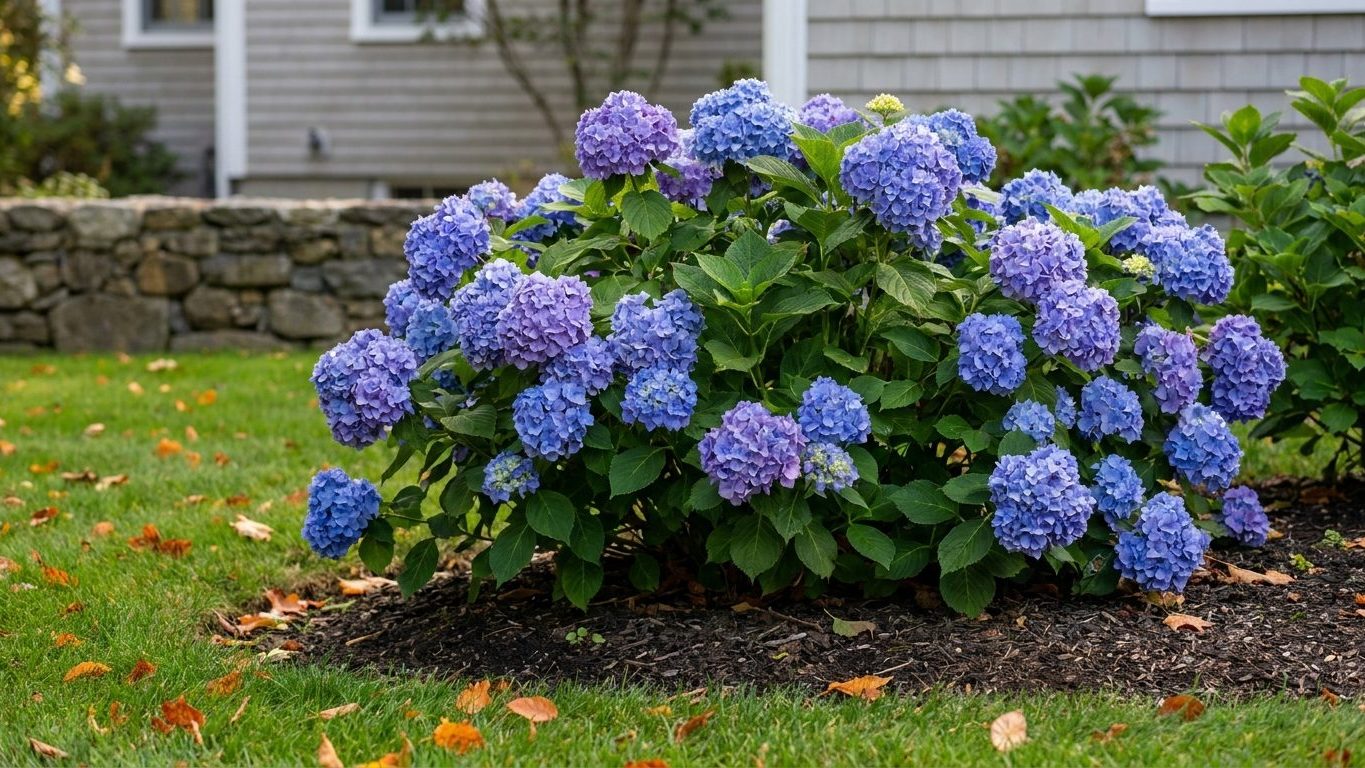
Massachusetts hydrangeas go into the ground twice a year: a short stretch in spring once frost risk clears, and a longer, gentler run in fall before the ground closes up. Boston anchors the state’s timing, though gardeners west of Worcester and up in the Berkshires work on a delayed clock. Get the window right and roots take hold before either summer heat or winter cold tests them.
When to prune hydrangeas in Massachusetts: The Short Answer
In Boston, NOAA NCEI 1991-2020 Climate Normals put the last spring frost between April 1 and April 8, and gardeners here plant hydrangeas once that window closes, typically the back half of April into May, then again in fall before the first frost between November 3 and November 14.
- March: Fertilize with a slow-release feed once the ground thaws, well ahead of the last frost window. Keep the winter mulch in place a while longer.
- April: Plant new hydrangeas once frost risk has passed, typically toward the back half of the month. This opens the first of the state’s two planting stretches.
- May: Keep planting, and fertilize a second round now that new growth is pushing hard. Soil has warmed enough for roots to take hold quickly.
- June: Prune bigleaf hydrangeas now, once the earliest bloom flush fades, since this opens the state’s two-month pruning window. Cut spent flower heads back to the first strong bud.
- July: Finish any bigleaf pruning before the window closes, and give a third and final fertilizer application. Anything cut later risks the buds already set for next year.
- August: Hold off on fertilizer and pruning both, and keep the soil evenly moist through the hottest stretch. New growth needs time to harden before fall.
- September: The second planting window opens, and cooler nights make this the gentler of the state’s two stretches for putting hydrangeas in the ground.
- October: Keep planting into the first half of the month, well ahead of the earliest fall frost date. Roots still have time to establish before soil cools further.
- November: Mulch heavily once leaves drop, since first frost lands somewhere in the state’s fall window depending on where you sit. This is protection, not pruning.
- December: Leave the shrub alone through dormancy, and resist any urge to prune bigleaf types now. Old wood is already carrying next year’s flower buds.
- January: Check for snow load bending branches, and brush off heavy, wet snow by hand. No feeding, no cutting, no planting this month.
- February: Plan next year’s spots and order stock, since the ground is still frozen for planting. This is a paperwork month, not a shovel month.
Every date here follows Boston’s frost record. Inland and up in elevation, both windows close and open later, so treat these months as a starting point rather than a fixed rule.
Massachusetts — the year and the numbers
- State
- Massachusetts
- USDA zones
- 5a-7b
- Last spring frost
- April 1 to April 8
- First fall frost
- November 3 to November 14
- Annual rain
- 44 in
- Lawn zone
- cool-season
- Source
- NOAA NCEI 1991-2020 Climate Normals, 32F freeze probabilities · Boston
How to Work Out the Dates for Your Own Yard
Boston’s frost record is a reference point, and the real dates for your yard depend on how far you sit from that station.
- Start from the frost window: NOAA NCEI 1991-2020 Climate Normals set Boston’s last spring frost at April 1 to April 8, and the first fall frost at November 3 to November 14.
- Push planting a week past the thaw: aim for the tail end of the spring window or later, since a hydrangea set in still-cold soil sits and sulks instead of rooting.
- Match your spot to the state’s plant months: April, May, September, and October are the four months the calendar keeps open, so anything outside those falls outside the safer range.
- Watch for your microclimate: a low spot that collects cold air, or a yard west of Worcester, runs on a clock roughly one to two weeks behind Boston’s.
- Save bigleaf pruning for June and July: cut outside that stretch and you risk the wood that is already holding next year’s buds.
None of this replaces a local check. A frost app or a call to your county office confirms whether this particular week is safe, since Boston’s numbers are an average, not a guarantee for every yard in the state.
Massachusetts North to South: How the Dates Shift
Massachusetts covers more climate variation than its size suggests, and four rough regions each nudge the calendar in their own direction.
- Greater Boston and the South Shore (Suffolk, Norfolk, Plymouth counties): the mildest ground in the state, closest to the frost dates above, and often the first spot where spring planting is safe.
- Cape Cod and the Islands (Barnstable, Dukes, Nantucket counties): surrounded by ocean, so both frosts arrive later than the mainland average, stretching the safe planting stretch on both ends.
- Central Massachusetts (Worcester County): sits inland and higher, so spring frost lingers past the state’s early dates and fall frost arrives sooner.
- The Berkshires and the Connecticut River Valley (Berkshire, Franklin, Hampshire counties): the coldest, highest ground in the state, running toward the harder end of the USDA hardiness range and demanding the latest spring planting of anywhere in Massachusetts.
None of these shift the calendar by more than a couple of weeks, but that couple of weeks decides whether a new hydrangea roots before summer heat or gets caught by one more frost.
Mistakes Massachusetts Punishes
No flowers on a healthy shrub

Cutting bigleaf hydrangeas outside June and July removes wood that has already set next year’s flower buds, since these varieties bloom on growth from the previous season. The fix is simple, prune only inside that two-month stretch, and if you missed it, wait until next year.
New growth burned by a late frost
New growth pushed by a warm early spring gets caught when frost slides as late as April 8 in Boston, and later still inland. Keep frost cloth or a bucket ready through early April, and don’t strip winter mulch until the window has closed.
Shrub planted and gone by winter
A hydrangea planted after October has too little time to root before Massachusetts winter sets in, and one planted in the dead of summer just bakes instead of establishing. Stick to April, May, September, and October, the four months the state’s calendar keeps open.
Massachusetts Extension Offices and County Contacts
Boston’s frost window is a starting point, not a rule. County offices and UMass Extension track local variation the state map cannot, from the Berkshires’ shorter season to Cape Cod’s later frost.
- Your state page: the frost dates and the pruning window where you live.
- Which hydrangeas hold up here: the varieties suited to Massachusetts winters.
- Call before you plant: county extension offices and UMass Extension confirm this year’s frost timing before you dig.
Common questions
Can I plant hydrangeas in Massachusetts in the fall?
Yes. The state’s planting window includes September and October, both well ahead of the first fall frost, which lands between November 3 and November 14 depending on where you are.
What USDA zone is Massachusetts for hydrangeas?
The USDA Plant Hardiness Zone Map puts Massachusetts across zones 5a to 7b, warmer near Boston and colder up in the Berkshires and higher elevations.
When should I stop fertilizing hydrangeas in Massachusetts?
The calendar keeps three fertilizing months open: March, May, and July. Stop after July so new growth has time to harden before fall frost arrives.