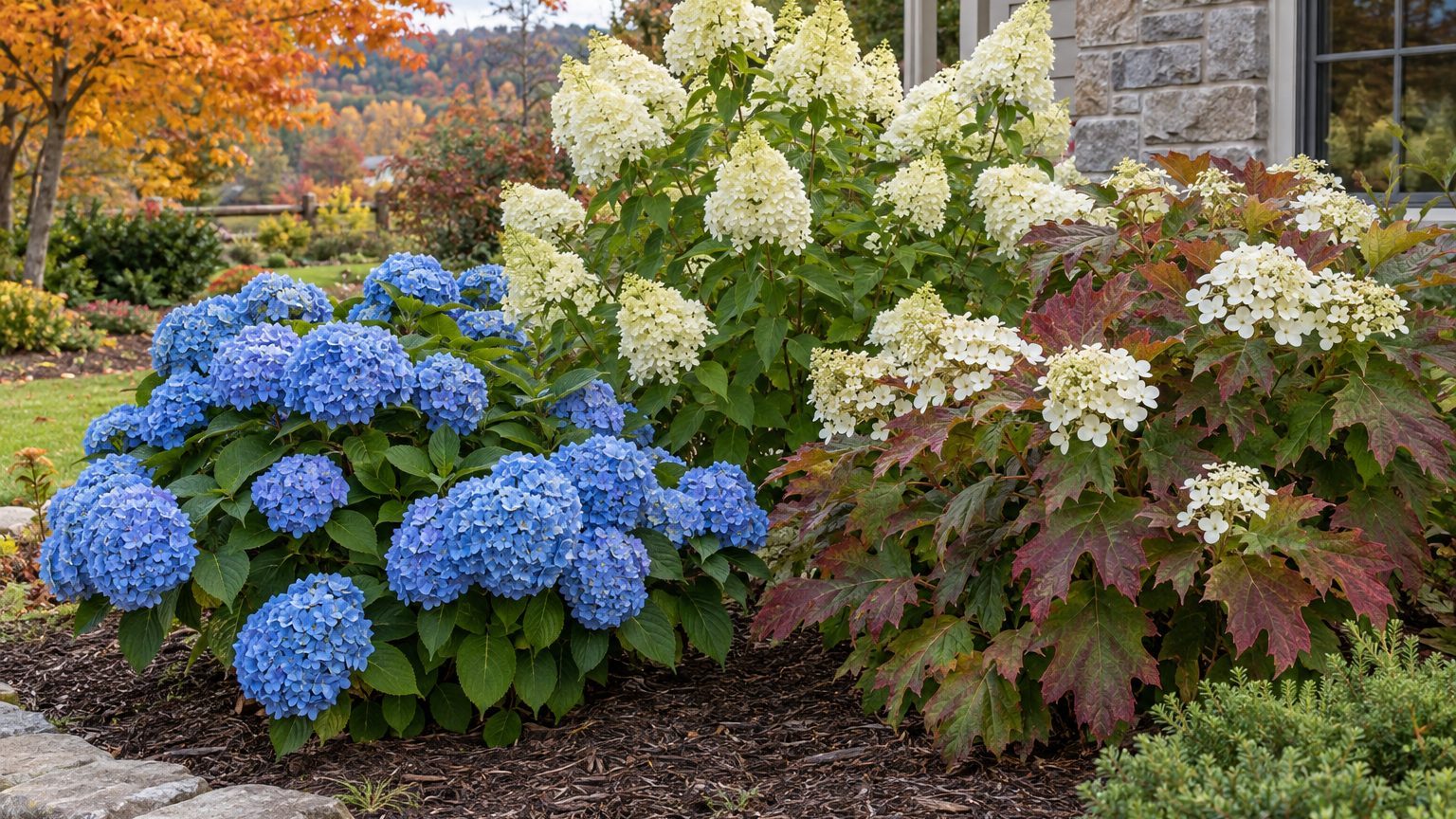
Panicle and smooth hydrangeas succeed almost anywhere in Pennsylvania, from the Alleghenies to Philadelphia. Bigleaf hydrangea is the pickier choice: its flower buds survive a typical winter only in the mildest end of the state’s USDA range, closest to Philadelphia. Oakleaf and climbing hydrangea sit in between, reliable in most yards but worth siting with care in the colder northern tier.
Hydrangeas that grow well in Pennsylvania: The Short Answer
The USDA Plant Hardiness Zone Map puts Pennsylvania at 5a to 7b, with Philadelphia sitting at the mild end and the northern tier and the Alleghenies running colder. That single range decides which hydrangea keeps its flower buds through winter and which one gets reduced to bare stems every spring.
Here are six names ranked from the one that forgives almost any yard to the one that only performs in the mildest pocket of the state.
Panicle hydrangea

Panicle hydrangea blooms on new wood, so a hard winter never touches next summer’s flowers. It tolerates full sun better than any other type here and shrugs off both the cold pockets of the Alleghenies and the muggy summers near Philadelphia. This is the safest name on the list for a first hydrangea in Pennsylvania.
Smooth hydrangea

Smooth hydrangea, the species behind ‘Annabelle’, is native to the eastern woodlands and treats a Pennsylvania winter as routine. It also flowers on new wood, so a late frost or a rough pruning cut rarely costs a season of blooms. A bit of afternoon shade suits it well in most yards here.
Climbing hydrangea

Climbing hydrangea is hardy across the entire state but slow, often taking several years to settle in before it climbs or flowers at all. Once established against a wall or a sturdy trellis, it shrugs off a Pennsylvania winter without any protection. Patience matters more than the zone number here.
Oakleaf hydrangea

Oakleaf hydrangea holds up across most of the state, with bold foliage that turns burgundy in fall. Its flower buds form the summer before, closer to the way bigleaf behaves, so a late cold snap in the northern tier can still nip them. A sheltered spot away from open winter wind helps.
Mountain hydrangea

Mountain hydrangea, sold under names like ‘Bluebird’, sets flower buds that are somewhat tougher than bigleaf but still exposed on old wood through the cold months. In the milder Philadelphia corner it blooms most years. Farther north or at higher elevation, a late freeze can strip the buds before they open.
Bigleaf hydrangea

Bigleaf hydrangea is the riskiest name on this list. Its flower buds form on old wood and sit exposed all winter, so anywhere colder than the mildest pocket near Philadelphia risks a shrub that leafs out but never blooms. Reblooming cultivars help some years, but a hard frost still wins others.
Pennsylvania — the year and the numbers
- State
- Pennsylvania
- USDA zones
- 5a-7b
- Last spring frost
- March 29 to April 6
- First fall frost
- November 5 to November 16
- Annual rain
- 44 in
- Lawn zone
- transition-season
- Source
- NOAA NCEI U.S. Climate Normals 1991-2020, 32F freeze probabilities · Philadelphia
How to Work Out the Dates for Your Own Yard
NOAA NCEI U.S. Climate Normals puts Philadelphia’s last spring frost between March 29 and April 6, and every planting or pruning date counts forward or backward from that single range.
- Find your local frost range first: Philadelphia typically clears frost by early April, but the northern tier and the Alleghenies run two to four weeks later, so adjust every date below to match.
- Wait for the plant window to open: March and April make up the state’s first planting stretch, timed to follow frost in the mildest yards before the ground warms further.
- Feed only in the listed fertilize months: March, May, and July match active root and leaf growth, so a shrub still bare in early spring simply waits for the next round.
- Prune bigleaf inside June and July only: cutting earlier removes old wood that is about to flower, and cutting later strips next year’s buds before they even set.
- Use the fall planting window with care: September and October give new roots time to grip soil before the first frost, November 5 to November 16 near Philadelphia.
- Recheck the whole sequence against your address: a yard in the Alleghenies follows the same order of steps, just shifted later by the weeks its frost dates run behind Philadelphia.
Panicle hydrangea shrugs off this entire calendar, since it can be planted in either window and pruned in early spring instead of the bigleaf-only months and still bloom on schedule.
Bigleaf hydrangea is less forgiving, since missing the June-to-July window by even a few weeks can erase a summer of flowers.
Pennsylvania North to South: How the Dates Shift
The frost dates and the hardiness range describe Philadelphia, the mildest reference point in the state, and every other pocket of Pennsylvania drifts from there in a known direction.
- Southeastern Pennsylvania (Philadelphia, the Delaware Valley, Lancaster County): the mildest ground in the state, closest to the top of the USDA range and first to clear frost each spring.
- The Alleghenies and central ridges (State College, the Laurel Highlands): elevation pushes both frost dates outward, so hydrangeas here go into the ground later and lose their leaves sooner in fall.
- The northern tier and the Poconos (Wayne County, the New York border): NOAA NCEI U.S. Climate Normals notes this ground runs two to four weeks later in spring than Philadelphia, the widest gap in the state.
- The Lake Erie shoreline (Erie County): the lake itself moderates both ends of the season, an unusually mild pocket for a northern latitude.
Match your yard to one of these bands before trusting a single statewide date, and use the Pennsylvania hydrangea guide for the frost and zone numbers themselves.
Mistakes Pennsylvania Punishes
Pruning bigleaf outside June and July
Cutting bigleaf hydrangea back in fall or early spring removes the old wood that was about to flower, since the state calendar lists only June and July for this cut. Wait until new leaves confirm which stems are alive, then prune inside that window. The month-by-month calendar page lays out every other cut.
Planting past the fall window
NOAA NCEI U.S. Climate Normals puts the first fall frost near Philadelphia between November 5 and November 16, and a hydrangea planted after October rarely has time to root before that date. Roots set too late often heave or dry out over winter. Stick to the March, April, September, or October planting months instead.
Treating the whole state as one zone
The USDA Plant Hardiness Zone Map spans 5a to 7b across Pennsylvania, so a bigleaf hydrangea that thrives in a Philadelphia yard can die back to the ground every year in the northern tier or the Alleghenies. Plant panicle or smooth hydrangea instead in the colder half of the state. The which-ones list above ranks every option by that same risk.
Pennsylvania Extension Offices and County Contacts
The statewide hardiness range is a starting point, not a verdict for your yard. Penn State Extension and your county’s extension office track local frost pockets, soil pH, and disease pressure that a state map can’t show.
- Penn State Extension: extension.psu.edu covers planting windows, pruning timing, and pest calls for every county in the state.
- Your county extension office: the local horticulture agent knows whether your yard runs closer to Philadelphia’s mild end or the northern tier’s colder one.
Call before you plant if your address sits in a frost pocket the county map does not already show.
Common questions
Can bigleaf hydrangea survive a Pennsylvania winter?
It can in the mildest pocket of the state, near Philadelphia, where the USDA Plant Hardiness Zone Map tops out at 7b. Farther north or at higher elevation, in the 5a to 6a part of that same range, its old-wood flower buds often die back and the shrub blooms poorly or not at all.
When should I prune hydrangeas in Pennsylvania?
Bigleaf hydrangea has a narrow window, June and July only, on the state calendar. Panicle and smooth hydrangea bloom on new wood, so they tolerate a cut outside that window far better, though the state calendar does not list a separate month for them.
What is the best month to plant hydrangeas in Pennsylvania?
The state calendar lists two planting stretches, March and April in spring and September and October in fall. Either works, but fall planting near the first frost, November 5 to November 16 around Philadelphia, needs enough lead time for roots to settle before the cold arrives.