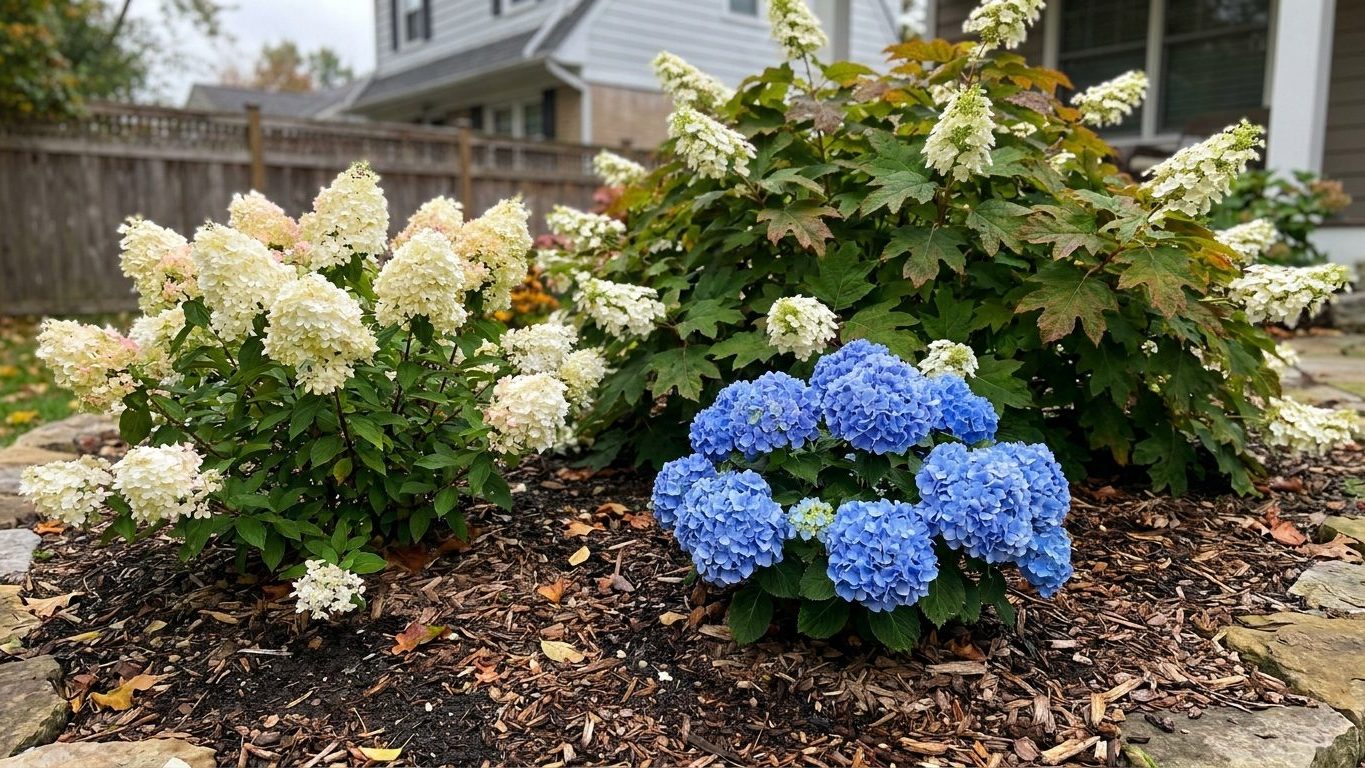
Panicle and smooth hydrangeas are the safest bets across New Jersey, hardy through the state’s 6a to 7b range, while bigleaf types can work near the coast but risk losing flower buds during colder inland winters.
Hydrangeas that grow well in New Jersey: The Short Answer
The USDA Plant Hardiness Zone Map puts New Jersey at 6a to 7b, with Newark sitting near the milder edge of that range. That single number decides which hydrangea species shrug off a Garden State winter and which ones gamble their flower buds on a mild December.
Panicle hydrangea

Hydrangea paniculata is the safest choice anywhere in New Jersey, from the Highlands to Cape May. It blooms on new wood, so a hard freeze never touches the flower buds, and it tolerates both 6a winters and 7b summers without complaint.
Smooth hydrangea

Hydrangea arborescens, the native species behind ‘Annabelle’, handles the state’s full hardiness range without protection. It also blooms on new wood, so a late frost that nips the stems still leaves a full flush of blooms by midsummer.
Oakleaf hydrangea

Hydrangea quercifolia brings fall color that panicle and smooth types skip entirely. It holds up fine through New Jersey winters, though a site with reliable afternoon shade keeps the leaf edges from scorching in a hot South Jersey August.
Climbing hydrangea

Hydrangea petiolaris survives the cold without trouble but takes its time. Expect three or four seasons before it climbs and flowers, so it suits patient gardeners more than the coldest pockets of the state.
Mountain hydrangea

Hydrangea serrata sits between smooth and bigleaf types in toughness. Its flower buds handle a typical New Jersey winter better than bigleaf, but a late cold snap after a warm February can still erase a season of blooms.
Bigleaf hydrangea

Hydrangea macrophylla is the riskiest name on this list. It blooms on old wood, so the state’s 6a stretch can freeze out next year’s flowers even when the shrub itself survives, leaving healthy green leaves and no blooms at all.
New Jersey — the year and the numbers
- State
- New Jersey
- USDA zones
- 6a-7b
- Last spring frost
- March 29 to April 6
- First fall frost
- November 4 to November 16
- Annual rain
- 47 in
- Lawn zone
- transition-season
- Source
- NOAA NCEI U.S. Climate Normals 1991-2020, 32F freeze probabilities · Newark
How to Work Out the Dates for Your Own Yard
Working out your own planting window starts with the same frost data used for the state figure, then adjusts for what sits around your yard. NOAA NCEI U.S. Climate Normals puts the Newark station’s last spring frost between March 29 and April 6, and gardens away from the airport’s pavement typically see frost linger a week or two longer.
- Find your last spring frost: start from the March 29 to April 6 window and add a week if you garden inland or at elevation.
- Note your first fall frost: the November 4 to November 16 window marks when new growth needs to have already hardened off.
- Match the planting months to your site: New Jersey’s plant window runs March, April, September, and October, so pick the half of that window furthest from your local frost date.
- Time pruning to bloom type: bigleaf and mountain hydrangeas get pruned in June or July, right after their old-wood buds finish flowering, never in spring.
- Fertilize on the March, May, July schedule: skip a fall feeding, since new growth pushed late won’t harden before frost.
Panicle hydrangea passes this test in almost any county because its new-wood blooms don’t care when the last frost lands. Bigleaf hydrangea fails it more often, since a bud set in October can be gone by March, no matter how carefully the calendar was followed.
New Jersey North to South: How the Dates Shift
Altitude and distance from the ocean shift these dates more than latitude does inside a state this narrow.
- The Skylands and Northwest (Sussex, Warren, Morris counties): frost arrives earliest and lingers latest here, so bigleaf and mountain hydrangeas lose more flower buds than the state average suggests.
- Central New Jersey (Middlesex, Somerset, Mercer counties): closer to the Newark reference figures, with the frost window holding up reasonably well away from river valleys.
- The Shore (Monmouth, Ocean, Atlantic counties): the Atlantic keeps both frost dates milder, which is why bigleaf hydrangeas do best in yards within a few miles of the coast.
- South Jersey and the Pine Barrens (Cumberland, Cape May, Burlington counties): sandy soil warms fast in spring but drains hydrangea beds dry by August, so watering matters more than the frost date itself.
Check the state guide’s frost map for the county closest to your own before trusting any single date.
Mistakes New Jersey Punishes
Pruning bigleaf hydrangea in spring
Cutting back old wood in March removes the buds that were about to bloom. New Jersey’s bigleaf and mountain types set flowers the previous summer, so the only safe pruning window is June or July, right after the shrub finishes flowering.
Planting bigleaf in an exposed spot
An open yard in the Skylands or Northwest lets winter wind strip moisture from flower buds that a coastal yard never loses. Choosing panicle or smooth hydrangea for exposed sites, and saving bigleaf for a sheltered corner, avoids the blank spring most homeowners blame on the weather.
Fertilizing after July
A late feeding pushes soft new growth that has no time to harden before the fall frost window arrives. Sticking to the March, May, July schedule keeps growth timed to the season instead of racing the first freeze.
New Jersey Extension Offices and County Contacts
The state’s 6a to 7b range is a starting point, not a guarantee for your yard. Rutgers Cooperative Extension and your county office narrow that down to what actually survives your soil and slope.
- Your state page: the frost dates and the pruning window for where you live in New Jersey.
- Which ones hold up here: the full ranking of hydrangea varieties by how they handle a Garden State winter.
- Rutgers New Jersey Agricultural Experiment Station: njaes.rutgers.edu connects to the county office nearest your zip code for a soil test before you plant.
Common questions
Do hydrangeas need full sun or shade in New Jersey?
Most varieties do best with morning sun and afternoon shade across the state, since summer heat in the 7b pockets of South Jersey can scorch leaves by early afternoon. Panicle hydrangea tolerates more sun than the others, while oakleaf and bigleaf prefer the shadier end of that range.
Why did my hydrangea not bloom this year?
A bigleaf or mountain hydrangea that stays green but skips flowers almost always lost its buds to a winter cold snap or a spring pruning cut. Switching to a new-wood bloomer like panicle or smooth hydrangea removes that risk entirely.
Can I grow bigleaf hydrangea near the Jersey Shore?
Coastal yards in Monmouth, Ocean, and Atlantic counties see milder winter lows than inland New Jersey, which is exactly where bigleaf hydrangea has the best odds of blooming reliably. Move even a few miles inland and the same variety becomes a gamble.