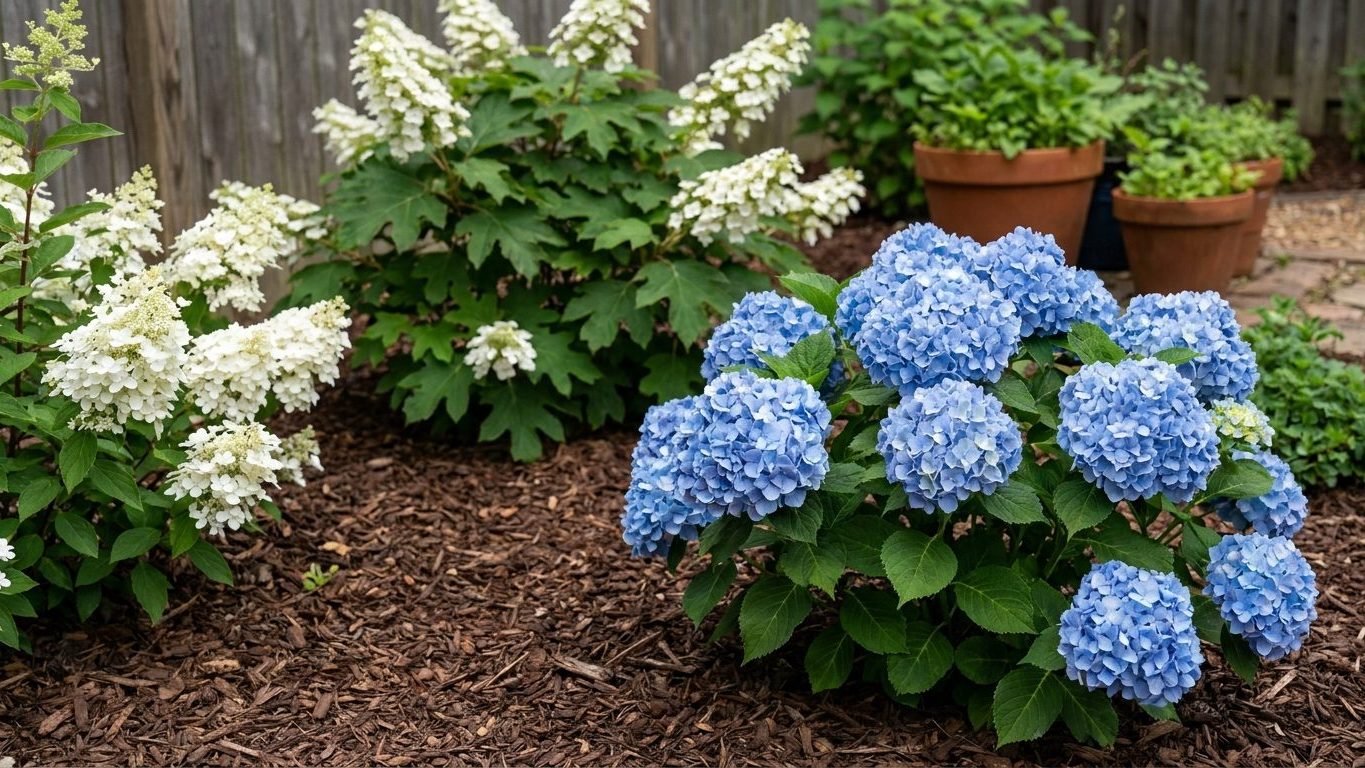
Hydrangeas that grow well in Maryland are the ones bred to bloom on new wood, since old-wood bloomers gamble against a late spring freeze. Near Baltimore, where the USDA rates the state’s hardiness zone at 5b to 8a, panicle and smooth hydrangeas top that list for reliability, with oakleaf close behind, and bigleaf or mountain types best kept to sheltered spots statewide.
Hydrangeas that grow well in Maryland: The Short Answer
Panicle hydrangea

Panicle hydrangea (Hydrangea paniculata) tops this list because it blooms on new wood, so a late freeze in Baltimore, rated 5b to 8a on the USDA Plant Hardiness Zone Map, never touches the flower buds. It also shrugs off summer heat on the Eastern Shore, making it the closest thing to a guaranteed bloomer statewide.
Smooth hydrangea

Hydrangea arborescens, the native behind ‘Annabelle’, blooms on new wood too, so even a hard cutback in late winter still leaves a full show by July. It tolerates the clay soils common across central Maryland and takes shade better than paniculata.
Oakleaf hydrangea

Hydrangea quercifolia is native to the Southeast and hardy through zone 5, so it holds its buds through a typical Maryland winter. It blooms on old wood, which means a very late freeze can still nip an early flush, but its fall color earns it a near-safe spot on this list.
Mountain hydrangea

Hydrangea serrata sets slightly hardier flower buds than its bigleaf cousin and tolerates part shade well. In the state’s colder pockets those buds can still freeze back in a harsh winter, so treat it as a good bet close to Baltimore and a gamble further west.
Bigleaf hydrangea

Hydrangea macrophylla is the classic mophead, but it sets most of its buds on old wood, and a late freeze after a warm spell can wipe out a season of color. A sheltered east-facing wall stays the safer placement statewide.
Climbing hydrangea

Hydrangea anomala subsp. petiolaris survives Maryland winters without complaint, but it can take three years or more to establish and flower, and it needs a sturdy structure to climb. Patience is the real requirement, which makes it the riskiest choice only in terms of reward per year waited.
Maryland — the year and the numbers
- State
- Maryland
- USDA zones
- 5b-8a
- Last spring frost
- April 3 to April 16
- First fall frost
- October 26 to November 5
- Annual rain
- 45 in
- Lawn zone
- transition-season
- Source
- NOAA NCEI 1991-2020 Climate Normals, 32F freeze probabilities · Baltimore
How to Work Out the Dates for Your Own Yard
Working out when to plant or prune in your own yard starts with the two dates that bracket your growing season, not with a generic calendar month.
- Find your frost window: NOAA NCEI 1991-2020 Climate Normals puts the last spring freeze near Baltimore at April 3 to April 16, and the first fall freeze at October 26 to November 5.
- Push planting into the state’s planting months: set new hydrangeas out in April, May, August, or September, once the spring freeze window has passed and before the fall one opens.
- Time bigleaf pruning to new growth: wait until you see leaves emerging in June or July before cutting bigleaf hydrangea back, since cutting earlier risks removing live wood that still held a flower bud.
- Match the variety to your microclimate: a panicle hydrangea planted against a shaded wall will still bloom because it flowers on new wood, while a bigleaf hydrangea in that same spot may lose its buds to a freeze that never touches the paniculata.
- Feed on the state’s fertilizing months: apply fertilizer in March, May, or July rather than guessing, since those months line up with root growth ahead of bud set.
Once you know your own frost window, the rest of the calendar is just counting weeks backward or forward from those two dates, plant by plant.
Maryland North to South: How the Dates Shift
The frost window and hardiness range above describe an average for the whole state, and Maryland’s geography stretches that average in both directions.
- Western Maryland (Garrett, Allegany counties): mountain elevation pushes both the last spring freeze and the first fall freeze weeks later than the rest of the state, so panicle or smooth hydrangea are the steadier bet over bigleaf.
- Central Maryland (Baltimore, Howard, Montgomery counties): this is the reference zone for the dates above, with a moderate frost window and the mildest of the state’s inland hardiness ratings.
- Eastern Shore (Talbot, Dorchester, Worcester counties): Chesapeake Bay and Atlantic influence keep both frosts milder, letting bigleaf hydrangea hold its old-wood buds through more winters than it would inland.
- Southern Maryland (Calvert, St. Mary’s, Charles counties): tidal water moderates temperature swings in a similar way, extending the safe planting season at both ends.
Check the state guide for the frost dates and hardiness zone closest to your own county before committing a bigleaf hydrangea to an exposed spot.
Mistakes Maryland Punishes
Pruning bigleaf hydrangea too early
Cutting back bigleaf hydrangea in March removes wood that already holds next summer’s flower buds, since this species blooms mostly on old wood. Wait until new leaves show in June or July, the state’s pruning window, and remove only dead stems before then.
Planting in full afternoon sun
A hydrangea set on a west-facing bed with no afternoon shade wilts by midsummer even with regular water, especially on the Eastern Shore’s sandy soils. Choose morning sun with afternoon shade, or plant a heat-tolerant panicle hydrangea instead.
Skipping the fall watering before frost
A hydrangea that goes into the October frost window dry loses more roots to winter desiccation than one planted well hydrated. Give a deep soak in early October, ahead of the first fall freeze near Baltimore, then let the ground do the rest.
Maryland Extension Offices and County Contacts
The zone range above is a starting point, and your county’s University of Maryland Extension office turns it into a local answer for soil, pests, and planting dates.
- Your state page: the frost dates and the pruning window for wherever you live in Maryland.
- Which ones hold up here: county-by-county notes on bigleaf versus panicle hydrangea survival.
- University of Maryland Extension: extension.umd.edu connects you to your county’s master gardener program and soil testing.
Common questions
What hydrangea blooms most reliably in Maryland?
Panicle and smooth hydrangeas bloom most reliably across the state because they set their flower buds on new wood each spring, so a late freeze that would ruin a bigleaf hydrangea’s old-wood buds never touches them.
Can I grow bigleaf hydrangea in western Maryland?
Bigleaf hydrangea can survive in Garrett or Allegany county, but the colder pocket there raises the odds of losing a season’s flower buds to a late freeze, so a sheltered spot against a building matters more there than near Baltimore.
When should I fertilize hydrangeas in Maryland?
The state’s fertilizing months are March, May, and July, timed to support root growth and bud development ahead of each bloom cycle rather than pushing late-season growth that winter can catch off guard.