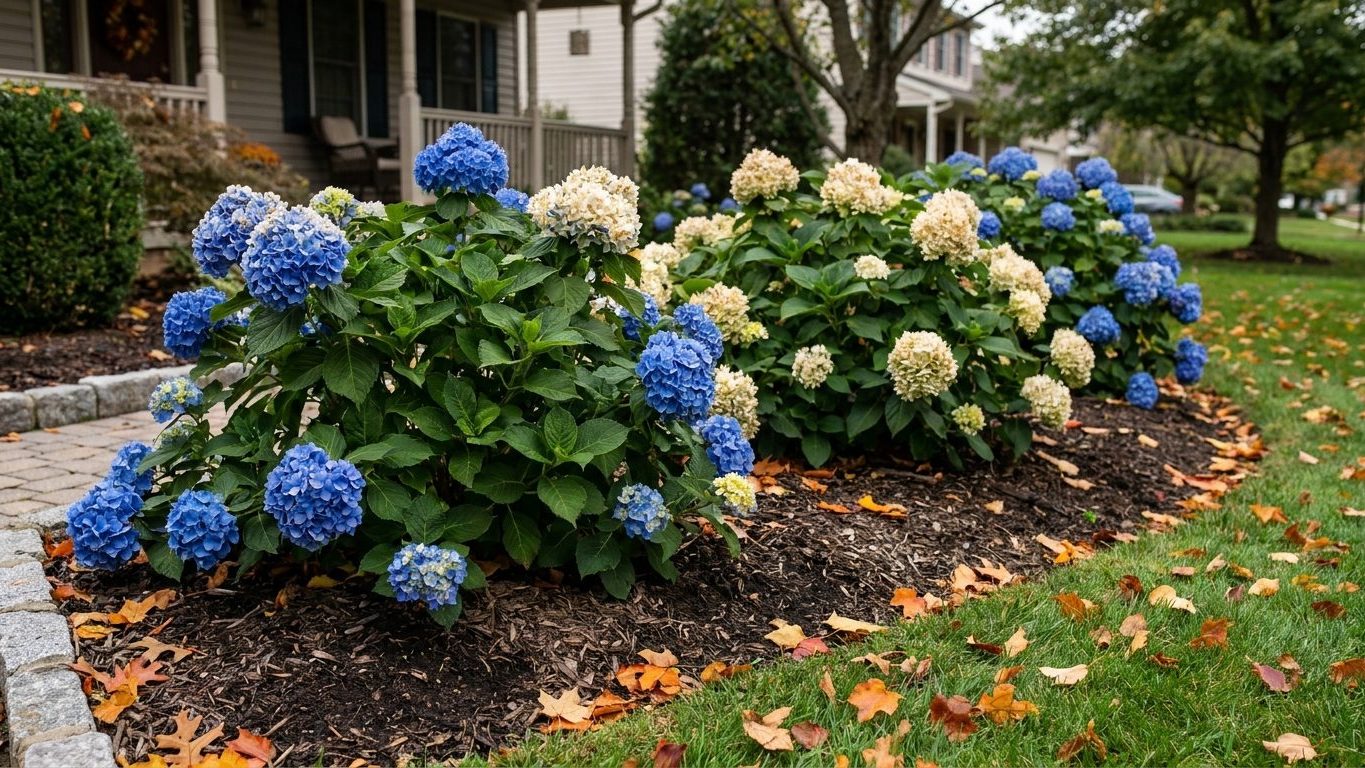
Plant hydrangeas in Pennsylvania during two windows: spring, from March through April, once the ground has thawed past the last frost, and early fall, September through October, while soil still holds summer warmth. Philadelphia sits at the mild edge of the state’s range. Gardeners north of the Alleghenies wait longer on both ends. Prune bigleaf varieties in June or July, right after their flowers fade.
When to prune hydrangeas in Pennsylvania: The Short Answer
NOAA NCEI U.S. Climate Normals 1991-2020 puts Philadelphia’s last spring frost between March 29 and April 6, and everything below tracks the year against that line, plus the fall frost that follows between November 5 and November 16.
- January: hydrangeas sit dormant, weeks before that last spring frost date arrives. Leave the stems alone and skip any feeding.
- February: frost risk stays high across the whole state. Hold off on planting, pruning, or fertilizing.
- March: the state’s earliest planting window opens, and it’s the first of three fertilizing months this year. Feed shrubs only once the ground has fully thawed.
- April: the planting window continues through the month. Wait until nighttime lows stop dropping below freezing before setting new roots.
- May: this is a fertilizing month, not a planting one. Feed shrubs already showing a full flush of new leaves.
- June: the pruning window for bigleaf hydrangeas opens, right after the first flowers fade. Cut spent blooms back to the first healthy pair of buds.
- July: pruning for bigleaf closes out and fertilizing reopens. Feed lightly, then stop until fall so new growth has time to harden.
- August: nothing is scheduled on the calendar. Focus on watering deeply twice a week through the hottest stretch.
- September: the fall planting window opens. Roots set now still have weeks before the first fall frost arrives.
- October: the last planting month of the year. Get shrubs into the ground early in the month, not late.
- November: the first fall frost lands across most of the state this month. Mulch heavily at the base once the ground starts to cool.
- December: dormancy sets in with nothing left on the calendar. Check mulch depth after any hard freeze-thaw cycle.
None of these dates are fixed points. They’re the middle of a range, and a shrub planted a week early or late rarely notices as long as the soil has thawed and drains well.
Pennsylvania — the year and the numbers
- State
- Pennsylvania
- USDA zones
- 5a-7b
- Last spring frost
- March 29 to April 6
- First fall frost
- November 5 to November 16
- Annual rain
- 44 in
- Lawn zone
- transition-season
- Source
- NOAA NCEI U.S. Climate Normals 1991-2020, 32F freeze probabilities · Philadelphia
How to Work Out the Dates for Your Own Yard
The state figures above are anchored to Philadelphia, and your own yard can run one to four weeks off that line depending on elevation and how close you sit to a lake or a ridge in the Alleghenies.
- Find your zone: the USDA Plant Hardiness Zone Map 2023 places Pennsylvania between zone 5a and 7b, built on the average annual extreme minimum temperature, so a shrub rated for zone 6 is a safer bet than one rated for zone 7 anywhere outside Philadelphia.
- Count back from the last frost: subtract two to three weeks from the March 29 to April 6 window to find when soil has usually thawed enough to dig, landing most of the state in mid to late March.
- Count forward from the first fall frost: work backward six weeks from the November 5 to November 16 window to get a safe fall planting cutoff, roughly the third week of September.
- Match the gesture to the calendar months: plant only in March, April, September, or October, fertilize in March, May, or July, and prune bigleaf hydrangeas only in June or July.
- Check your own microclimate: a south-facing wall or a low spot that pools cold air can shift these dates by a week or more in either direction.
None of this replaces reading the ground itself. Soil still frozen an inch down isn’t ready, no matter what the calendar says.
Pennsylvania North to South: How the Dates Shift
The state is not one climate, and a date that works in one county can arrive weeks off in another.
- The Southeast (Philadelphia, Delaware County, Chester County): the mildest corner of the state, closest to the frost window named above, with the widest planting margin on both ends.
- The Allegheny Plateau and the northern tier (Bradford County, Potter County, Tioga County): frost lingers longer than in Philadelphia, so every date on the calendar shifts later.
- Lake Erie’s shoreline (Erie County): the lake itself delays spring frost and pushes back fall frost compared with inland spots at the same latitude.
- The Alleghenies and the Laurel Highlands (Somerset County, Fayette County): elevation adds its own delay on top of the northern shift, often the last part of the state to clear frost in spring.
For the numbers that apply to a single county, the state-level guide is the place to check before setting a date.
Mistakes Pennsylvania Punishes
Pruning bigleaf hydrangeas in fall
Cutting back bigleaf stems in September or October removes buds already set for next summer, since bigleaf blooms on old wood. The calendar reserves pruning for June and July, right after the flowers fade. Wait for that window and next year’s blooms follow.
Planting too late in fall
A shrub set into the ground in November has only days before the first frost lands, not the weeks of root growth it needs. The planting calendar closes in October for a reason. Move fall planting earlier if the ground still works.
Feeding right before frost
Fertilizing in fall pushes soft new growth that a hard freeze then kills outright. The calendar keeps feeding to March, May, and July, months when new growth has time to harden before cold returns. Skip the fertilizer bag once autumn arrives.
Pennsylvania Extension Offices and County Contacts
USDA NIFA’s Land-Grant University Extension directory lists Penn State Extension as the state’s service, and a county office fills in what the statewide range can’t, since soil and shade vary block by block.
- Your state page: the frost dates and the pruning window where you live.
- Which ones hold up here: the bigleaf, panicle, and smooth varieties suited to Pennsylvania’s range of zones.
- Penn State Extension: county-by-county advice for questions specific to one yard.
Common questions
Can I plant hydrangeas in Pennsylvania in summer?
The planting calendar covers March, April, September, and October only. Summer heat stresses new roots before they’ve had a chance to establish, so July and August are for watering, not digging.
Do all Pennsylvania hydrangeas need winter protection?
It depends on where you garden inside the 5a to 7b range. A shrub rated for the colder end of that range needs less help than one rated for the warmer end planted in the northern tier.
When exactly should I prune bigleaf hydrangeas?
June and July, right after the first flush of blooms fades. Pruning outside that window risks cutting off buds already set for next year’s flowers.