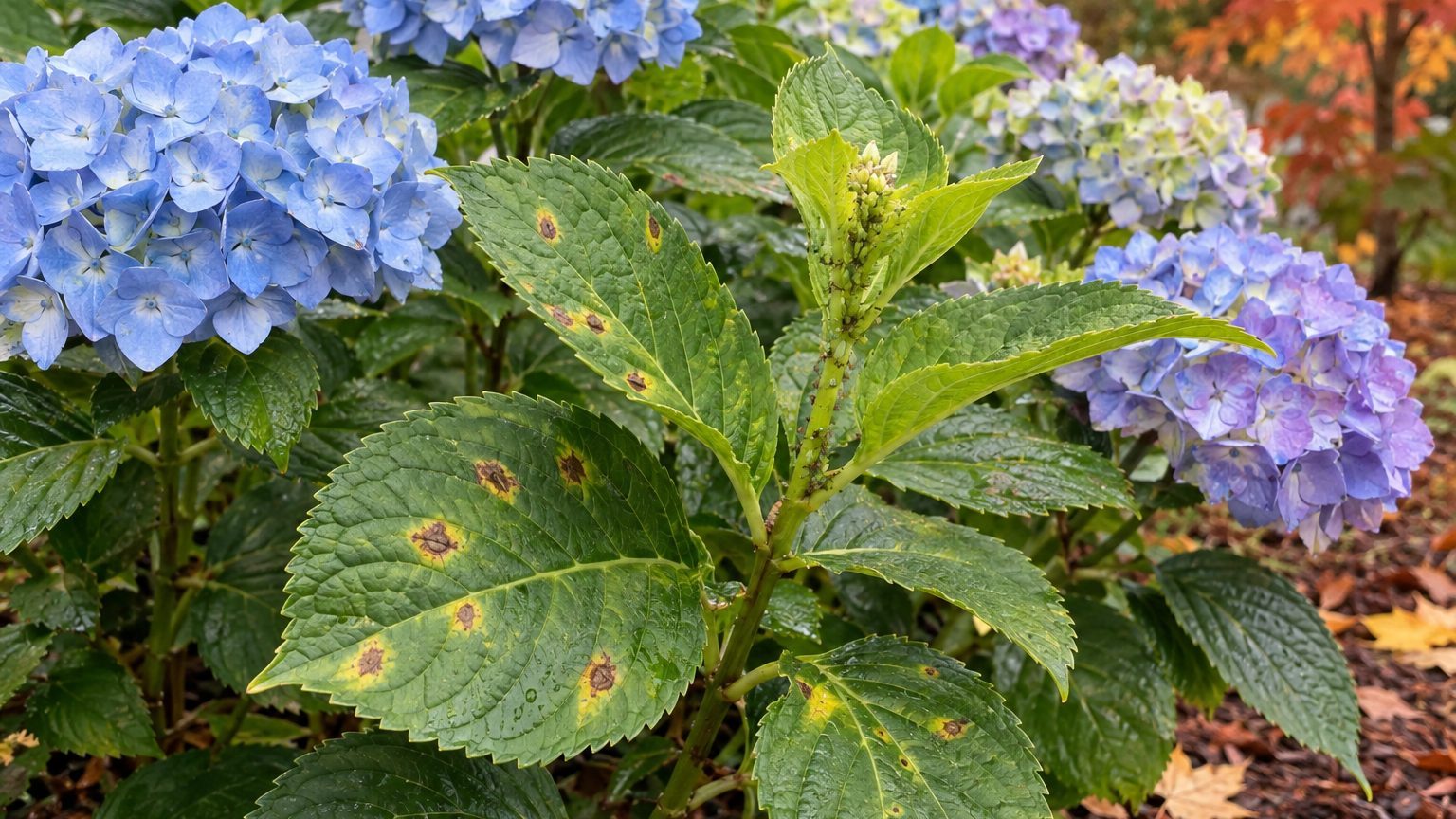
New Hampshire hydrangeas fight cold more than insects. In Concord, USDA hardiness zone 3b to 6a and a frost window that closes in late April decide whether bigleaf types even flower, while aphids, four-lined plant bug, powdery mildew, and two leaf diseases fill out the rest of the season’s trouble list, each one landing at its own point in the year rather than all at once.
Hydrangea pests and diseases New Hampshire: The Short Answer
NOAA NCEI’s climate normals put Concord’s last spring frost between April 16 and April 27, close enough to bud swell that cold, not insects, causes most flowerless bigleaf hydrangeas in New Hampshire. The state’s zone range, 3b to 6a, then decides which winter problems turn into summer ones for the rest of the season.
Bud blast after a late frost

A frost that lands inside that window blackens swelling flower buds and can erase the whole season’s bloom. Wait until the window closes before pulling off winter protection, and check the state calendar page for the exact week where you garden.
Sticky curled new growth
Aphids cluster on tender shoots as soon as new growth pushes out, right in the April and May planting window. Leaves curl, stems get tacky with honeydew, and sooty mold follows. A strong hose spray every few days knocks the colony down without reaching for a spray bottle.
Pinholes and stippled young leaves
Four-lined plant bug punches small round holes in young leaves in early summer, usually before the June and July pruning window opens on bigleaf types. The damage looks worse than it is and rarely needs treatment. Pruning during that window cleans the shrub up anyway.
White dust across the leaf surface
Powdery mildew shows as a gray-white film on leaf tops during humid July stretches, especially where shrubs sit close together. Airflow matters more than any fungicide: space plants, skip evening overhead watering, and let the July fertilizing round feed roots instead of wet foliage.
Brown spots ringed in purple

Cercospora leaf spot follows the same humid weeks as mildew, marking lower leaves with small brown spots edged in purple before they yellow and drop. It rarely kills a healthy shrub. Rake and remove fallen leaves each fall so spores do not overwinter in the bed.
Fuzzy gray mold on spent blooms

Botrytis blight coats faded flower clusters with a fuzzy gray mold during extended wet spells in mid-summer, sometimes spreading onto stems. Cutting spent blooms promptly and improving airflow between shrubs stops it from traveling into next year’s buds.
Blackened canes after a hard winter
New Hampshire’s zone 3b to 6a range means some winters kill canes back to the snow line, especially on bigleaf types that bloom on old wood. Scratch the bark in spring, cut back to living tissue, and lean on panicle or smooth types if this happens most years.
New Hampshire — the year and the numbers
- State
- New Hampshire
- USDA zones
- 3b-6a
- Last spring frost
- April 16 to April 27
- First fall frost
- October 13 to October 26
- Annual rain
- 40 in
- Lawn zone
- cool-season
- Source
- NOAA NCEI U.S. Climate Normals 1991-2020, 32F freeze probabilities · Manchester
How to Work Out the Dates for Your Own Yard
Concord’s numbers are a starting point, not a rule for your own yard, so work backward from the frost window instead of a fixed calendar date.
- Find your last spring frost: NOAA NCEI’s climate normals put Concord’s window between April 16 and April 27, and gardens off the valley floor should add a week or two to that.
- Hold winter protection through that window: pulling burlap or mulch off before the window closes exposes swelling flower buds to the exact frost that kills them.
- Watch new growth for aphids: they show up within two to three weeks of the first flush, overlapping the April and May planting window on the calendar.
- Pair pest checks with the June and July pruning window: that is when bigleaf gets cut back anyway, so a look for four-lined plant bug damage costs nothing extra.
- Count back from first fall frost: Concord’s range runs October 13 to October 26, and fallen, spotted leaves need raking before that window closes the season.
- Check where your yard sits on the zone map: the state runs anywhere from 3b to 6a, and a shrub that survives winter in the south may not near the notches.
None of this replaces watching your own shrub. A warm pocket against a south-facing wall runs a week or two ahead of an open yard, and a low spot that collects cold air runs behind it.
New Hampshire North to South: How the Dates Shift
Concord sits in the middle of the state’s range, and the same pest and disease timeline shifts by a couple of weeks in either direction depending on where you garden.
- The Seacoast (Portsmouth, Dover, Exeter): the mildest ground in the state, with the shortest frost season and the longest stretch of humid air that favors powdery mildew and leaf spot.
- The Merrimack Valley (Concord, Manchester, Nashua): the reference climate, tracking the frost window and zone range described above.
- The Lakes Region and hill towns (Laconia, New London, Peterborough): cold air pools in the valleys overnight, pushing bud blast risk later into spring and cane dieback further into the growing season.
- The North Country and White Mountains (Berlin, Lancaster, Franconia): the shortest growing season in the state, where winter dieback is the default outcome for bigleaf types rather than an exception.
Whichever pocket of the state you garden in, the state hydrangea page sets the frost and zone figures your county starts from.
Mistakes New Hampshire Punishes
Pruning bigleaf too early
Cutting bigleaf hydrangea back in April or May removes the same old wood that survived winter and would have flowered. Wait for the June and July pruning window on the calendar, cut just above the first live bud, and check the by-variety page before planting the next one.
Skipping winter protection on exposed sites
Leaving bigleaf hydrangea bare through a New Hampshire winter in an open, windy spot invites full cane dieback, not just bud loss. Mound mulch over the crown before the ground freezes, and hold the wrap until Concord’s frost window closes in late April.
Watering leaves late in the day
Sprinkling leaves late in the day keeps them damp overnight through humid summer stretches, which is exactly what powdery mildew and leaf spot need to spread. Water at the base in the morning instead, and pair it with the July fertilizing round already on the calendar.
New Hampshire Extension Offices and County Contacts
Concord’s frost window and zone range are only a starting point. USDA NIFA’s Land-Grant University Extension directory lists UNH Extension as the county-by-county contact for the pest pressure, soil, and exposure specific to your address.
- UNH Extension: extension.unh.edu connects to county offices and current advisories for common hydrangea problems.
- Your state page: the frost dates and zone range for New Hampshire in one place.
- Which ones hold up here: the variety-by-variety page for choosing a hydrangea built for this climate.
Common questions
Do I need to spray hydrangeas in New Hampshire every year?
No. Most New Hampshire yards see aphids and an occasional leaf spot outbreak, and both clear up with a hose spray and better airflow rather than a scheduled fungicide program.
Why did my hydrangea leaf out fine but never flower?
Bigleaf hydrangea blooms on old wood, and a late frost inside Concord’s April 16 to April 27 window, or a hard winter within the state’s 3b to 6a range, kills those buds before summer even starts.
Is winter dieback the same as a disease?
No. It is cold injury, not an infection, though a shrub weakened by dieback is more likely to pick up powdery mildew or leaf spot once the wound tissue is exposed to a humid summer.