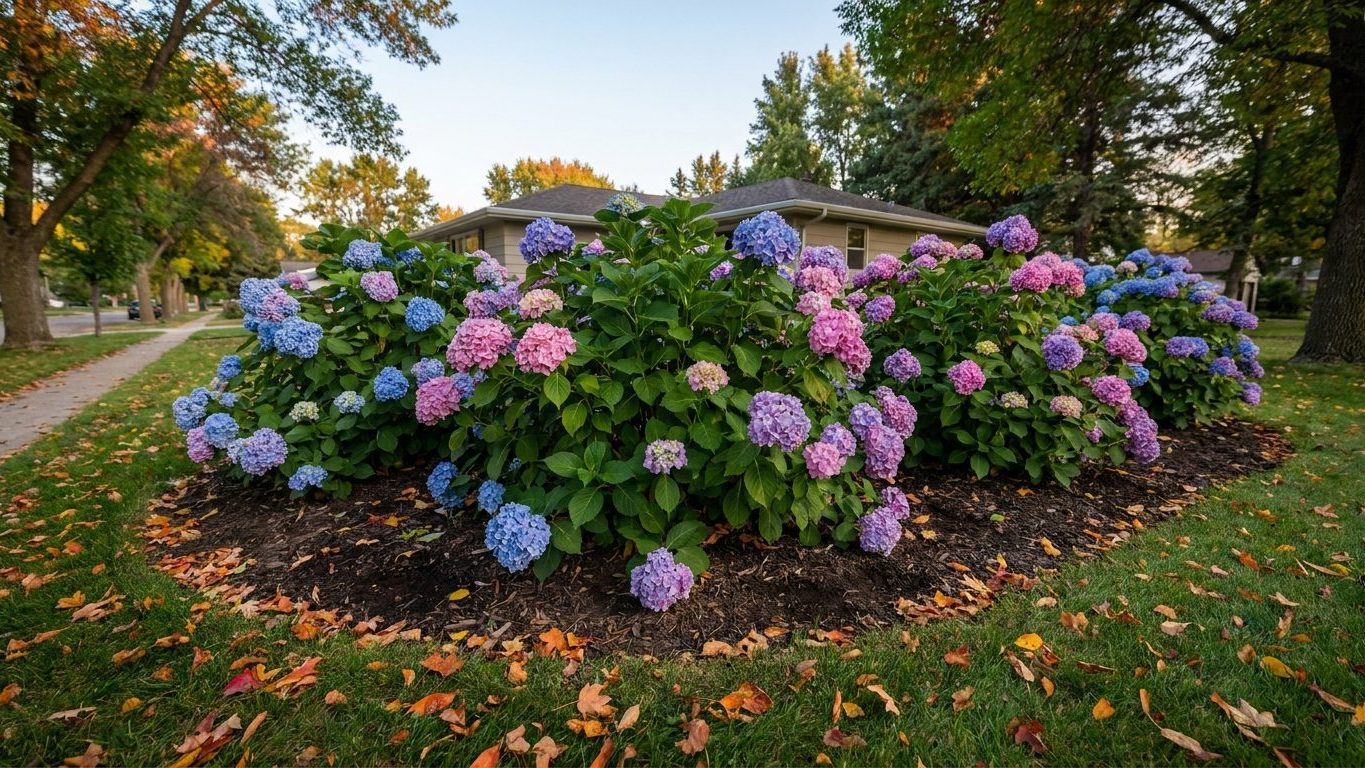
North Dakota’s hydrangea trouble is driven mostly by cold rather than by insects or disease pressure moving in from warmer states. In Fargo, the reference city for the state’s climate data, winter bud blast costs more blooms than aphids, powdery mildew, leaf spot, botrytis, and iron chlorosis put together, and the state’s USDA hardiness range explains why.
Hydrangea pests and diseases North Dakota: The Short Answer
Six problems account for nearly every hydrangea complaint in this state, and they tend to show up in roughly the same order every year, starting with cold damage as the snow melts and ending with fungal trouble as the first fall frost closes in.
Winter bud blast and dieback
A false spring thaw followed by a hard refreeze kills flower buds before they open. USDA Plant Hardiness Zone Map puts the state at zone 3a to 4b, cold enough that this is the top complaint here. Prune dead wood back to green tissue once new leaves appear, and check our guide to which varieties hold up here.
Aphids on new growth
Sticky leaves and curled tips in May and June point to aphids feeding on tender new shoots. A strong spray of water knocks most of them off, and insecticidal soap handles a heavier cluster. New transplants set out during the May through August planting window tend to draw the biggest colonies, so check those first.
Powdery mildew
A white, flour-like coating on leaves shows up during humid stretches in July and August. It rarely kills the shrub but weakens next year’s buds. Space plants for airflow, water the soil instead of the leaves, and pull off the worst leaves rather than spraying a fungicide on a small patch.
Cercospora leaf spot
Small purple-brown spots that spread into ragged patches on lower leaves appear from late July into September, usually after a run of wet weather. Rake up and discard fallen leaves each fall rather than composting them, since the fungus overwinters there. Thinning crowded stems lets the foliage dry faster after rain.
Botrytis blight
Gray, fuzzy mold on flower clusters and soft stems shows up in cool, damp weather as the season turns, often right around the September 25 to October 5 fall frost window. Cut out and trash the affected blooms, and avoid overhead watering once nights turn cool. Good spacing matters more here than any spray.
Iron chlorosis

Yellow leaves with dark green veins point to alkaline, high-pH soil locking up iron, common in North Dakota’s clay and prairie soils. A soil test tells you where you stand before you add anything. Sulfur or a chelated iron feed timed to the May and July fertilizing months corrects it over a season or two.
North Dakota — the year and the numbers
- State
- North Dakota
- USDA zones
- 3a-4b
- Last spring frost
- May 4 to May 15
- First fall frost
- September 25 to October 5
- Annual rain
- 24 in
- Lawn zone
- cool-season
- Source
- NOAA NCEI U.S. Climate Normals 1991-2020, 32F freeze probabilities · Fargo
How to Work Out the Dates for Your Own Yard
The fastest way to time your own pest and disease checks is to work backward from your yard’s own frost dates rather than the airport’s numbers.
- Start from the Fargo frost window: NOAA NCEI U.S. Climate Normals 1991-2020 puts the last spring freeze there at May 4 to May 15, and the first fall freeze at September 25 to October 5.
- Add one to two weeks for a rural or suburban lot: gardens outside town typically see frost linger later in spring and arrive earlier in fall than the airport station shows.
- Set your bud-blast check for right after your last frost: this is when winter dieback finally becomes visible against fresh new growth.
- Set your aphid check for four to six weeks later: new growth stays soft enough to attract them through the whole May through August planting window.
- Set your mildew and leaf spot check for the humid stretch of July and August: both fungal problems tend to show up together during that run.
- Set a final leaf and stem check about two weeks before your first fall frost: botrytis moves in fast once nights turn cool and damp.
Write these dates on a kitchen calendar instead of trusting memory, since a two-week miss on any one of them is often the difference between a quick fix and a lost stem.
North Dakota North to South: How the Dates Shift
North Dakota’s own geography moves these dates around more than most gardeners expect, even inside a single state.
- The Red River Valley in the east (around Fargo and Grand Forks, near the Minnesota border): flatter, slightly more humid air keeps both frost dates a bit later than farther west, which stretches the mildew and leaf spot window a touch longer.
- The central plains (around Bismarck and Jamestown): frost timing tracks close to the statewide range with the least variation, so the checklist above applies almost as written.
- The western Badlands and higher ground (around Dickinson and Williston, closer to the Montana border): higher elevation and drier air tend to push the last spring frost and the first fall frost both a little earlier.
Whichever part of the state you garden in, treat Fargo’s numbers as a starting point and confirm your own county’s pattern before you commit to a date.
Mistakes North Dakota Punishes
Watering overhead in the evening
Wet leaves overnight are exactly what powdery mildew and botrytis need to spread through a bed. Switch to a soaker hose or water early in the morning instead, so foliage dries before nightfall. This one change cuts fungal complaints more than any spray program.
Pruning too early in spring
Cutting back stems before you can tell live wood from dead removes buds that were only dormant, not dead, especially in a range as cold as 3a to 4b. Wait until leaves show, then prune bigleaf types during the June and July window, and remove only what’s clearly brown.
Skipping the fall cleanup
Leaving fallen leaves and spent blooms in the bed over winter lets leaf spot and botrytis spores overwinter right where next year’s growth will emerge. Rake and discard that debris before the ground freezes, ideally ahead of the fall frost window, rather than composting it in place.
North Dakota Extension Offices and County Contacts
Fargo’s frost dates are a starting point, not a guarantee for your yard. NDSU Extension and your county office track local pest reports and soil conditions in more detail than any state-wide figure can.
- Your state page: the frost dates and the pruning window where you live.
- Which ones hold up here: the varieties bred to handle a 3a to 4b winter.
- NDSU Extension: county-by-county contacts and current pest alerts for your area.
Common questions
What is the most common hydrangea disease in North Dakota?
Winter bud blast, from freeze-thaw swings rather than a true disease, damages more blooms than any fungus does. Among the fungal problems, powdery mildew and Cercospora leaf spot show up most often during humid summer stretches.
When should I start checking for hydrangea pests in North Dakota?
Start once new leaves emerge after your last frost, since that’s when both winter dieback and the first aphids become visible. In Fargo, that window falls between May 4 and May 15 most years.
Can hydrangeas survive North Dakota winters without disease problems?
Yes, if the variety matches the state’s 3a to 4b range and gets morning sun with afternoon shade. Cold injury causes far more trouble here than any pest or fungus arriving on its own.