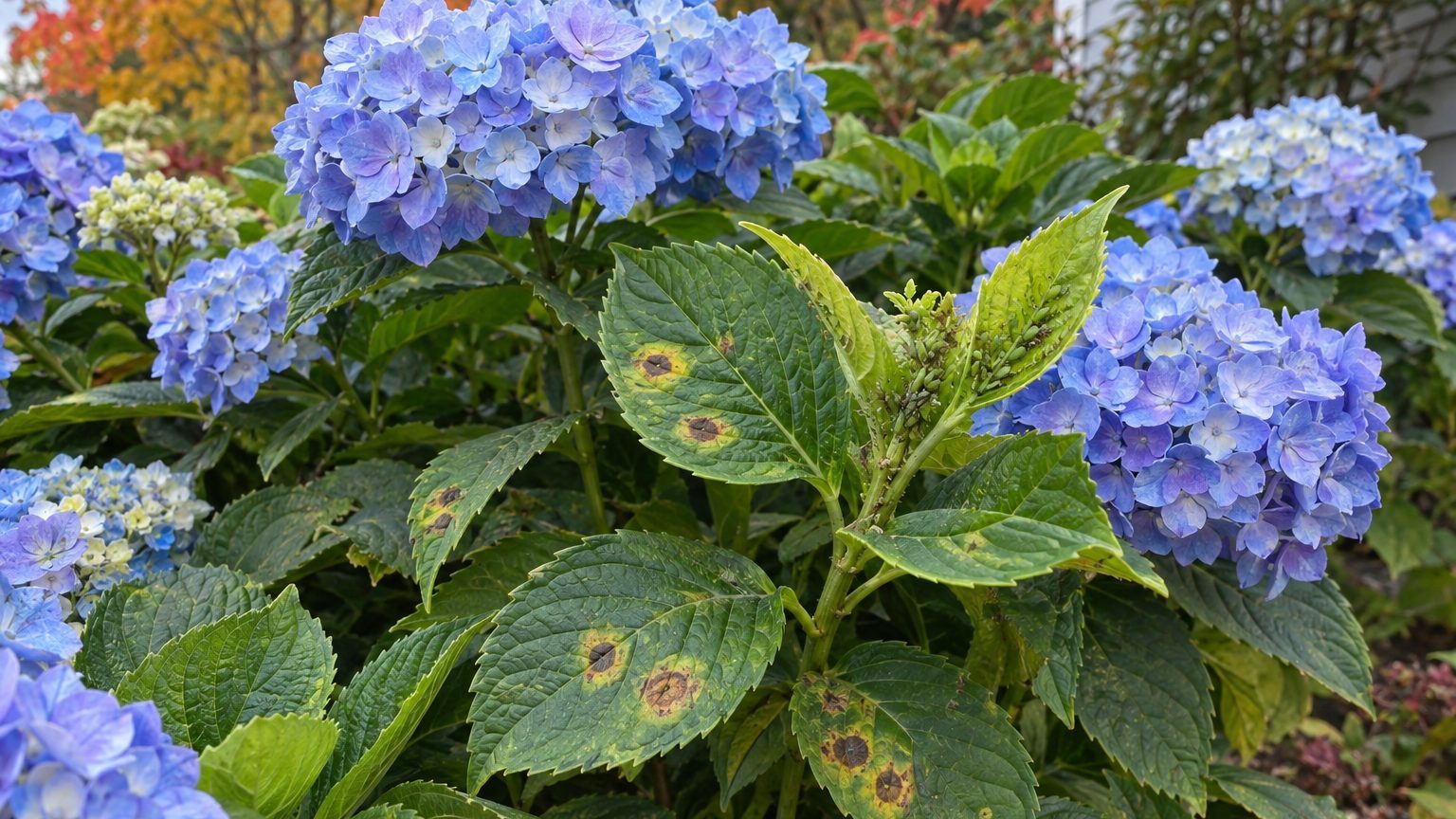
Iowa hydrangeas deal with more cold damage than bugs most years, but a short list of insects and fungal problems still show up on schedule every growing season. Frost-nipped buds open the year, aphids and plant bugs follow in early summer, powdery mildew and gray mold arrive with humid weather, and deer close out the season once leaves drop.
Hydrangea pests and diseases Iowa: The Short Answer
The short answer: in Des Moines, Iowa’s reference city for hardiness data, the USDA Plant Hardiness Zone Map puts the state at 4b to 6a, and that cold is the real driver behind most hydrangea trouble here, not insects. Late frost kills flower buds before pests ever show up, then aphids, plant bugs, powdery mildew, and gray mold follow through the growing season, with deer rounding out the list once the leaves drop.
Frost-nipped flower buds
A warm stretch in early April coaxes buds open, then the last spring frost, arriving anywhere from April 12 to April 24 in Des Moines, burns them black overnight. Leave dead wood alone until new growth confirms which stems survived, and check the Iowa hydrangea calendar before cutting anything back in spring.
Aphids clustering on new growth
Small green or black insects cluster on tender shoot tips and the undersides of young leaves, curling them and leaving a sticky residue that draws ants. A strong water spray knocks most colonies off within a week, and insecticidal soap handles the rest without hurting bees working the blooms.
Four-lined plant bug damage
This yellow-and-black striped insect punches small round holes that turn brown and papery within days, usually on upper leaves in late spring. Damage looks worse than it is, since the plant grows past it. Trim affected leaves for appearance and skip broad-spectrum sprays that also kill its natural predators.
Powdery mildew on leaves
A white, flour-like coating spreads across leaf surfaces during humid, still summer air, most often where shrubs sit too close together. Space new plants for airflow, water the soil rather than the foliage, and remove badly coated leaves so spores stop spreading to the next flush.
Botrytis blight on flowers and stems

Gray, fuzzy mold appears on flower petals and soft stem tissue after extended wet weather, turning blooms to mush. Deadhead spent flowers promptly, clear fallen petals from the base of the shrub, and avoid overhead watering late in the day when leaves stay wet overnight.
Deer browsing on stems and buds

Ragged, torn stem tips and stripped leaf clusters show up overnight once natural browse thins out in fall, and deer will strip a young shrub to bare wood by winter. Fencing or repellent applied before the first fall frost, October 14 to October 25, protects next year’s flower buds.
Iowa — the year and the numbers
- State
- Iowa
- USDA zones
- 4b-6a
- Last spring frost
- April 12 to April 24
- First fall frost
- October 14 to October 25
- Annual rain
- 37 in
- Lawn zone
- cool-season
- Source
- NOAA NCEI 1991-2020 Climate Normals, 32F freeze probabilities · Des Moines
How to Work Out the Dates for Your Own Yard
Matching a symptom to the right cause starts with the calendar, since NOAA NCEI Climate Normals put Des Moines’ last spring frost between April 12 and April 24, well before most insects or fungus get moving.
- Check the date first: symptoms that appear before the last spring frost window point to cold damage, not pests, since insects and fungus both need warmth to get moving.
- Look for pattern, not just damage: uniform leaf holes scattered across the whole shrub suggest an insect feeding steadily, while blackened, mushy tissue clustered right after a rain points toward fungus instead.
- Note the weather from the past week: powdery white coating and gray mold both need humidity, so a stretch of still, damp air makes fungus the likelier explanation over insects.
- Inspect at two times of day: four-lined plant bugs and aphids feed differently depending on temperature, so checking at dawn and again at midday catches insects that vanish once the sun climbs high.
- Confirm against the calendar windows: if the damage shows up outside the prune bigleaf window of June and July, hold off cutting back, since removing tissue too early stresses the shrub and hides the real cause.
- Watch the fall frost date too: the window of October 14 to October 25 marks when deer browsing turns serious as natural food dries up, so fencing goes up before then, not after.
None of this replaces a close look with a hand lens, but narrowing by date and weather cuts most of the guesswork before you reach for a spray bottle.
Iowa North to South: How the Dates Shift
Frost dates and fungus pressure shift together as you move across the map, and Iowa sits in the middle of that range rather than at either extreme.
- Upper Midwest and the northern Plains (Minnesota, Wisconsin, North Dakota): a shorter growing season and harder winter cold push hardiness lower and the safe planting window later, making mophead hydrangeas riskier than they are in Iowa.
- The Corn Belt (Iowa, Illinois, Nebraska): moderate humidity and swinging spring temperatures create the frost-then-fungus pattern described above, with cold doing more damage than pests most years.
- The Mid-South and lower Midwest (Missouri, Kentucky, southern Indiana): milder winters stretch the pest season longer, and powdery mildew and gray mold show up earlier and stick around longer than they do here.
- The Deep South and Gulf Coast (Georgia, Louisiana, Texas): heat and humidity dominate over cold, and fungal disease pressure runs nearly year-round instead of concentrating into a few humid summer weeks.
None of that changes what actually happens in a Des Moines backyard, so the Iowa state page stays the working reference for the exact windows.
Mistakes Iowa Punishes
Pruning before new growth appears
Cutting back stems in early spring, before new buds reveal which wood survived winter, loses a season of blooms on old-wood varieties. Wait until the prune bigleaf window of June and July, when live growth is obvious, and check the calendar page before cutting.
Watering the leaves in the evening
Overhead watering in the evening leaves foliage wet through the cool night, exactly the condition powdery mildew and gray mold need to spread across a bed. Switch to soaking the soil in the morning instead, and both fungal problems mostly stop showing up by midseason.
Skipping deer fencing until damage appears
Waiting until stems already look chewed to fence or spray means next year’s flower buds are gone, since deer return to the same plants once they find them. Protect shrubs before the first fall frost, October 14 to October 25, not after damage starts.
Iowa Extension Offices and County Contacts
The zone and frost numbers above make a solid starting point, but a county office adjusts for local soil, snow cover, and microclimate that no statewide map captures.
- Your state page: the frost dates and the pruning window where you live, gathered in one place for Iowa.
- Which ones hold up here: a list of hydrangea varieties matched to Iowa’s zone range, from safest to riskiest.
- Iowa State University Extension and Outreach: county-level contacts for a diagnosis specific to your yard’s soil and exposure.
Common questions
Do I need to spray hydrangeas every year in Iowa?
Most years, no. Cold damage from the last spring frost causes more trouble here than any insect or fungus, and a healthy shrub with good spacing and morning watering often gets through the season without a single application.
Is powdery mildew going to kill my hydrangea?
Rarely on its own. It weakens the plant and looks unsightly, but a shrub usually pushes through it and blooms again the next year once airflow and watering habits improve.
How do I stop frost from ruining next year’s flowers?
Hold off on pruning until the prune bigleaf window of June and July, when it is clear which wood survived winter, and avoid cutting back anything in early spring just because it looks bare.