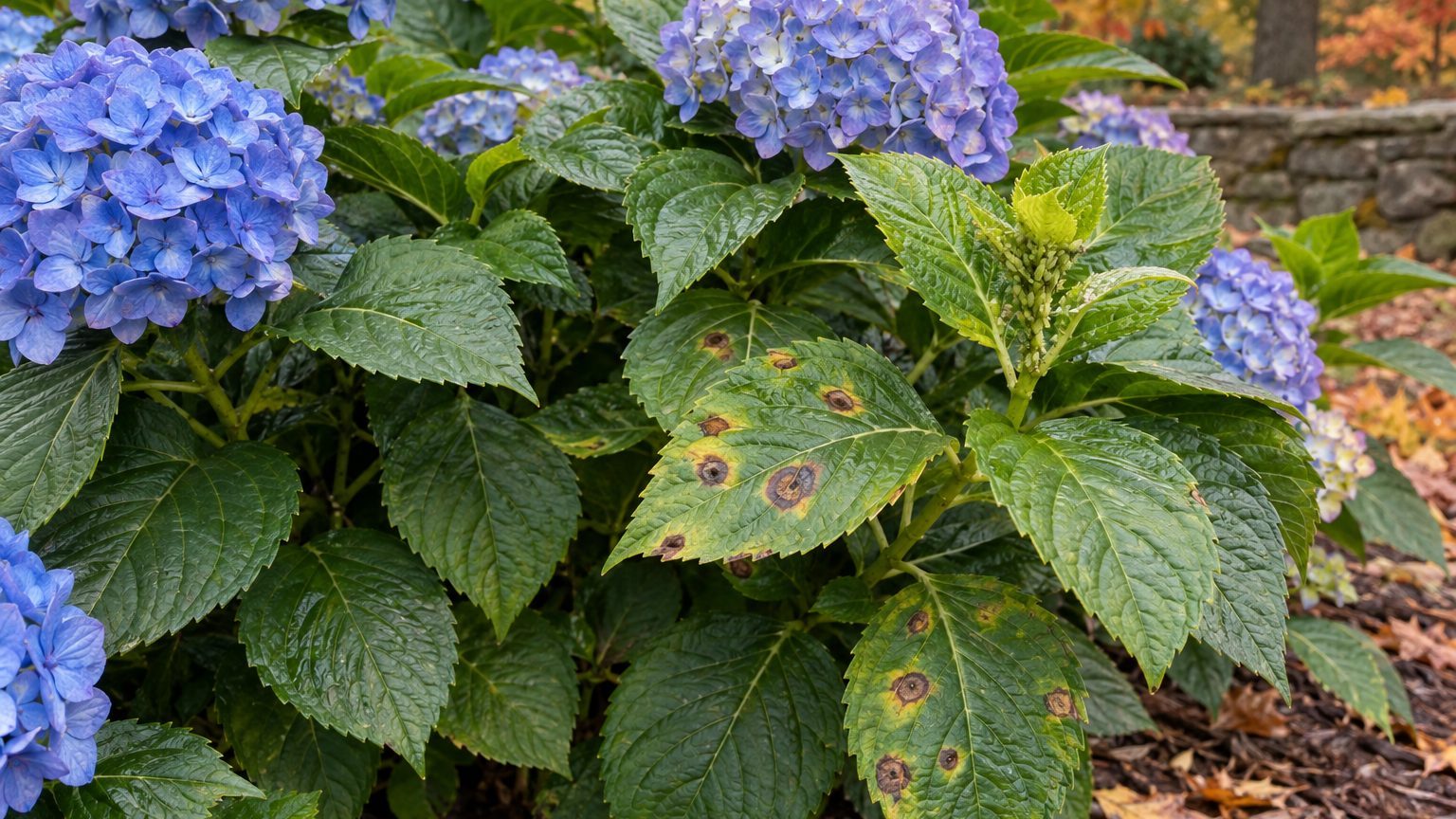
Most hydrangea trouble in Wisconsin follows the weather rather than showing up at random. Leaf-chewers, sap-feeders and fungal spots each take their turn between spring thaw and hard freeze, and how healthy the shrub is going in decides how much damage sticks. Reading the symptom, and the moment it appears, beats memorizing a list of culprits.
Hydrangea pests and diseases Wisconsin: The Short Answer
NOAA NCEI 1991-2020 Climate Normals puts Milwaukee’s last spring freeze at April 16 to April 29 and its first fall freeze at October 17 to October 29. Every problem below plays out between those two windows, so the leaf in your hand says more than the date.
Chewed leaves with ragged holes

Leaf-feeding insects often start on new growth in late spring. Check leaf undersides at dusk, then knock what you find into soapy water. Skip broad-spectrum sprays, which also kill the beneficial insects that keep numbers down. The Hydrangeas That Grow Well in Wisconsin page covers which types suit the cold.
Sticky leaves and curled tips
Sap-sucking insects leave a sugary film and distorted new growth on tender shoots. A hard spray from the hose knocks most of them off. Repeat every few days until the tips stay clean, and keep feeding inside the windows on the When to Plant and Prune Hydrangeas in Wisconsin page.
Brown or purple spots on leaves
Fungal leaf spots spread when foliage stays wet. Water at the base in the morning, never overhead at night, and pick off spotted leaves as you see them. Bag them rather than composting. Give shrubs room so air moves through, and read Hydrangeas in Wisconsin for siting.
White powder on leaf surfaces
A powdery coating points to a fungus that favors humid nights and stagnant air. Thin crowded stems for airflow and remove the worst leaves. On bigleaf, do the thinning in June or July so you do not cut next year’s flower buds.
Wilting despite moist soil
Wet, poorly drained soil starves roots of air and mimics drought. Push a finger into the soil before you water again, and hold off if it feels soggy. If wilting continues, bring a stem sample and photos to your county extension office for a proper diagnosis.
Wisconsin — the year and the numbers
- State
- Wisconsin
- USDA zones
- 3b-6a
- Last spring frost
- April 16 to April 29
- First fall frost
- October 17 to October 29
- Annual rain
- 35 in
- Lawn zone
- cool-season
- Source
- NOAA NCEI 1991-2020 Climate Normals, 32F freeze probabilities · Milwaukee
How to Work Out the Dates for Your Own Yard
NOAA NCEI 1991-2020 Climate Normals puts Milwaukee’s last spring freeze at April 16 to April 29, and every date below counts from that range, never from a single day.
- Add two weeks to the last spring freeze: April 16 to April 29 plus 14 days gives April 30 to May 13, the range for your first weekly walk around the shrubs, looking for chewed edges and sticky tips.
- Check the month before you plant or prune: planting falls in April, May, August or September, and bigleaf pruning waits for June and July, so a new transplant or a fresh cut never lands in the wrong window.
- Subtract three weeks from the first fall freeze: October 17 to October 29 minus 21 days gives September 26 to October 8, the range for pulling spotted leaves and noting what struck this year.
- Write down symptom, location and week: chewed edges, a sticky film, spots that begin on lower leaves, or a whole shrub wilting in moist soil each point to a different problem, and the week tells you how fast it moves.
- Take the notes to your extension office: if two weeks of entries do not settle it, a stem sample and dated photos give staff something real to work from.
Those ranges belong to Milwaukee. A yard near Madison or in the Northwoods runs on a different clock, and the next section shows which way it shifts.
Wisconsin North to South: How the Dates Shift
Wisconsin is long enough that a lakeshore schedule does not travel well, and the lake, more than latitude, sets the pace.
- Lake Michigan shore (Milwaukee, Racine, Sheboygan): the lake delays the first fall freeze, so leaves stay on longer and late-season leaf problems get extra weeks to develop.
- Inland southern Wisconsin (Madison, Janesville, Beloit): the first freeze typically arrives in early October, so the leafy season ends sooner and fall cleanup moves earlier.
- Central Wisconsin (Wausau, Stevens Point, Wisconsin Rapids): cooler nights push spring scouting later and end the season ahead of the south.
- The North (Rhinelander, Hayward, Superior): the first freeze comes far earlier, so the window for pests and diseases is shortest here, and cold hardiness matters more than any spray.
For the statewide picture of zones and frost, start with Hydrangeas in Wisconsin.
Mistakes Wisconsin Punishes
Three habits cost Wisconsin gardeners more than the pests themselves.
Watering from above at night
Cool nights keep wet leaves wet until morning, which is exactly what fungal spots and powdery coatings need. Water at the soil line in the morning instead, and let the foliage dry in the sun. The month-by-month care schedule sits on the When to Plant and Prune Hydrangeas in Wisconsin page.
Planting in the July heat
A shrub with a small root system and no reserves is the easiest target for insects and disease. Plant in April or May, or in August or September, and mulch after planting. Pick types built for the cold from Hydrangeas That Grow Well in Wisconsin.
Feeding outside the window
Fertilize in March, May and July. A late feeding pushes soft new growth that chewing and sap-feeding insects favor and that the first fall freeze then burns. If a shrub looks weak in August, check drainage and watering before you reach for the fertilizer.
Wisconsin Extension Offices and County Contacts
The frost windows here are for Milwaukee, and they are a starting point. Your county extension office and the Wisconsin extension service at extension.wisc.edu know local conditions and are the place to take a sample. Bring a stem and photos.
- Hydrangeas in Wisconsin: the frost dates and the zone picture for the whole state.
- Hydrangeas That Grow Well in Wisconsin: which types handle the cold before pests ever come into play.
- When to Plant and Prune Hydrangeas in Wisconsin: the planting, feeding and pruning months, so open it before you pick up pruners or a shovel.
Common questions
Is a spotted leaf always a disease?
No. Sun scorch, drought and insect feeding leave marks that look alike. Note where the damage sits: one sunny side points to scorch, lower leaves after wet weather point to fungus. Photograph it weekly and compare.
Should I spray at the first sign of trouble?
Start with mild fixes: a hose rinse, hand-picking, pulling spotted leaves. Save sprays for a problem your extension office has identified. The wrong product kills beneficial insects and does nothing for a watering or drainage issue.
When can I cut back a diseased bigleaf?
Bigleaf pruning belongs to June and July. Pull individual spotted leaves whenever you see them, but hold structural cuts for that window so you keep next year’s flower buds.