In Boise, the shrubs that struggle rarely lose a fight to an exotic invader. They lose it to timing: a late freeze catching open buds, dry heat scorching the west side of a leaf, or a stem pruned in the wrong month. Idaho’s USDA hardiness zone runs 3b to 7b, so what hits a shrub in the Panhandle looks nothing like what hits one in the Treasure Valley.
Hydrangea pests and diseases Idaho: The Short Answer
Boise’s shrubs face six recurring problems across the growing season, from bud blast right after the frost window closes to dieback once the first fall freeze lands. Each leaves a different signature on the leaf, bud, or stem, and catching it early keeps a bigleaf hydrangea blooming instead of just hanging on.
Bud blast after a late frost

A freeze after growth starts blackens flower buds before they ever open. NOAA NCEI 1991-2020 Climate Normals puts Boise’s last spring frost at April 23 to May 7, so buds pushing out ahead of that window carry the risk. Cover the shrub on cold nights and check the calendar page for safer timing.
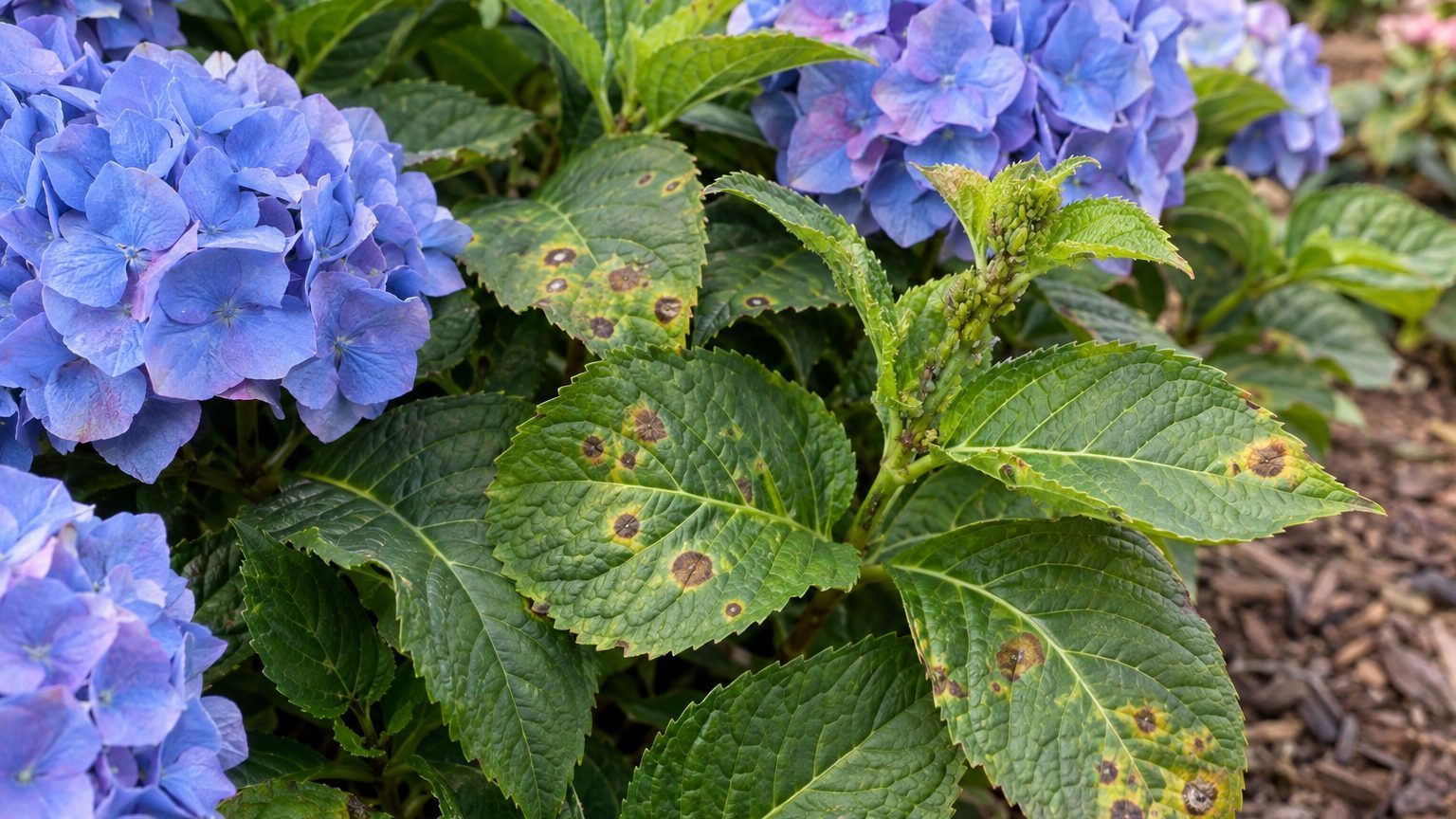
Aphids clustering on new growth
Aphids gather on soft new shoots right after the frost window closes, curling the leaf tips and leaving a sticky film behind. A strong morning spray of water knocks the colony back without chemicals. Fresh growth after a fertilizing round draws them in fastest, so check those shoots closely.
Leaves scorched on the sunny side
Idaho’s dry air and strong afternoon sun scorch the side of the leaf facing west, turning it brown and papery while the shaded side stays green. Move a stressed shrub to filtered light or add afternoon shade, and plant new stock during the cooler April, May, August, or September planting months.
Powdery mildew on the leaf surface

A gray-white coating on top of the leaf follows a run of warm days and cool, damp nights, and it spreads fastest where sprinklers wet the foliage after dark. Water the soil at the base in the morning instead, and space plants apart for airflow between them.
Spider mites stippling the foliage

Fine yellow speckling on top of the leaf, with faint webbing underneath, shows up during the driest stretch of summer, when mites multiply fastest. A forceful hose rinse under the leaves every few days breaks their cycle before it spreads to the rest of the shrub.
Winter dieback on the stem tips

Stems that blacken from the tip downward trace back to the first fall frost, which arrives October 7 to October 21 here. Stop fertilizing after July, per the calendar above, so growth hardens off before that window and skips the dieback.
Idaho — the year and the numbers
- State
- Idaho
- USDA zones
- 3b-7b
- Last spring frost
- April 23 to May 7
- First fall frost
- October 7 to October 21
- Annual rain
- 12 in
- Lawn zone
- transition-season
- Source
- NOAA NCEI 1991-2020 Climate Normals, 32F freeze probabilities · Boise
How to Work Out the Dates for Your Own Yard
Matching a symptom to its real cause starts with the calendar, not with the bug or the fungus itself.
- Mark the date the damage appeared: if it showed up before May 7, NOAA NCEI 1991-2020 Climate Normals gives that as Boise’s late end for the last frost, so a freeze is the likely cause, not a pest.
- Check what part is hit: blackened flower buds point straight to frost, while stippled or curling leaves point instead to mites or aphids.
- Line it up with the fertilize months: damage clustering right after March, May, or July often follows a feeding round that drew aphids to the soft new growth it produced.
- Watch the moisture pattern: a gray coating after warm days and wet nights signals powdery mildew, while stippling in the driest week of summer signals mites instead.
- Compare it to the prune window: dieback on stems cut outside June or July often means the wood was already stressed, not diseased.
- Note the zone you actually garden in: the USDA Plant Hardiness Zone Map puts the state at 3b to 7b, so a shrub thriving in Boise’s zone may struggle in a colder pocket nearby.
Once the date, the plant part, and the moisture pattern line up, you’re not guessing anymore. You’re matching a known Idaho pattern to your own yard.
Idaho North to South: How the Dates Shift
Elevation and lake effect move these dates around more than latitude does inside Idaho’s own borders.
- Treasure Valley and the Snake River Plain (Boise, Nampa, Caldwell): the warmest end of the state’s range.
- The Panhandle and northern lakes (Coeur d’Alene, Sandpoint, Priest Lake): the big lakes soften the coldest snaps, but the growing season still opens later than Boise’s.
- Eastern high valleys and mountain towns (Idaho Falls, Rexburg, Driggs): elevation pushes these spots toward the coldest end of the zone range, with a shorter stretch between frosts.
- The Magic Valley and south-central plateau (Twin Falls, Burley): elevation close to Boise’s, but more open to wind, adding stress on top of similar frost timing.
The Idaho hydrangea guide breaks these differences down further, but the short version holds everywhere: the problems above start later, and end earlier, the higher you climb.
Mistakes Idaho Punishes
Fertilizing past July
Idaho’s calendar allows fertilizing in March, May, and July only, and pushing a late feed in August forces soft growth that the October 7 to 21 frost window kills outright. Stop after July and let the shrub harden instead.
Pruning bigleaf outside June or July
Bigleaf hydrangeas set next year’s flower buds on old wood soon after bloom, so cutting stems outside the June to July window removes buds that would have opened the following spring. Prune only in that stretch.
Watering overhead in the evening
Wetting the leaves late in the day keeps them damp overnight in Idaho’s cool evenings, the exact condition that invites powdery mildew. Water the soil at the base in the morning instead.
Idaho Extension Offices and County Contacts
The zone range and frost windows above come from statewide averages, so the shrub in your own yard still needs a local check. University of Idaho Extension and your county office track pest and disease pressure block by block.
- University of Idaho Extension: the statewide directory for pest alerts and county contacts.
- Your county extension office: local staff who know whether mites or mildew are running heavy this season nearby.
- The Idaho hydrangea guide: the full frost calendar and pruning window for your part of the state.
Common questions
Do hydrangeas need fungicide spray in Idaho every year?
Most Boise-area shrubs never need it. Powdery mildew shows up only after a run of warm days and damp nights, usually from overhead watering, so switching to soil-level watering in the morning prevents most cases before a spray is ever needed.
Why did my hydrangea leaves turn brown only on one side?
That’s leaf scorch, not disease. The side facing west takes the full brunt of Idaho’s dry afternoon sun and wind, while the shaded side stays green. Afternoon shade or a filtered spot solves it without any product.
Can I treat spider mites without chemicals?
Yes, and it’s usually the first thing worth trying. A forceful rinse under the leaves every few days during the driest week of summer breaks their reproduction cycle, since mites thrive on dust and dry, still air more than on the plant itself.