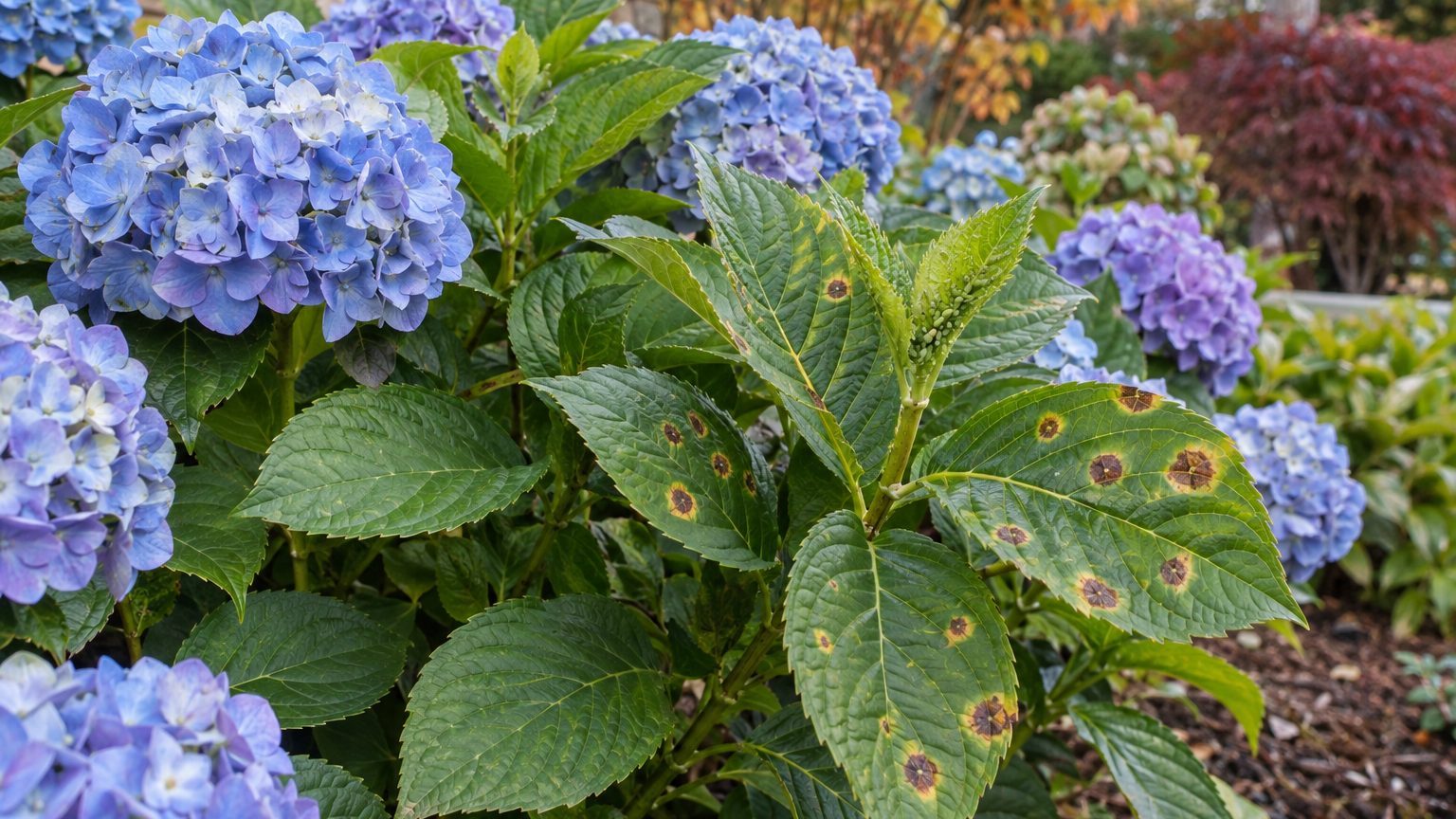
Wet, mild, and shaded much of the year, western Washington gives hydrangeas a longer disease season than most of the country, not a longer pest season. In Seattle, four fungal problems do more damage than any insect: powdery mildew, botrytis blight, leaf spot, and root rot. Aphids and slugs show up too, but rarely kill a shrub the way soggy clay does.
Hydrangea pests and diseases Washington: The Short Answer
NOAA NCEI 1991-2020 Climate Normals for station USW00024233 puts Seattle’s last spring frost at February 27 to March 18 and the first fall frost at November 13 to November 30, which leaves a long, damp growing season that fungal disease uses far better than insects do.
Aphids on new growth
Small green or black clusters gather on the soft tips as spring growth flushes, curling leaves and leaving a sticky residue behind. A strong hose spray every few days usually clears a light case, and it rarely needs anything stronger on an established shrub.
Cercospora leaf spot
Purple-brown spots with tan centers appear on lower, older leaves first, usually after a stretch of wet weather in late spring. Remove and bag the spotted leaves rather than composting them, and water the soil, not the foliage, going forward.
Powdery mildew
A gray-white dusting settles over leaf tops during humid summer stretches, especially on shrubs crowded against a fence or wall with no airflow. Thinning out crowded stems and spacing new plantings wider solves more of this than any spray does.
Botrytis blight
Cool, damp weather turns flower petals and soft stems brown and mushy almost overnight, often right around bloom. Cutting out the affected stems during the June to July prune window for bigleaf hydrangea keeps it from spreading into next year’s buds.
Slugs and snails

Ragged holes chewed through leaf edges, plus a silvery slime trail at dusk, point straight to slugs rather than any insect. Damp mulch near the crown is their favorite address, so pulling mulch back a few inches from the stems helps.
Root rot

A shrub that wilts even after rain, with leaves yellowing from the bottom up, usually sits in clay that never drains. Improving drainage before one of the fall or spring planting windows matters more here than anything applied after the fact.
Deer browsing
Stems chewed clean at an angle, not shredded, and entire flower heads missing overnight signal deer, not insects. Fencing or repellent applied before the dormant season keeps next year’s buds from disappearing along with this year’s blooms.
Washington — the year and the numbers
- State
- Washington
- USDA zones
- 4a-9a
- Last spring frost
- February 27 to March 18
- First fall frost
- November 13 to November 30
- Annual rain
- 39 in
- Lawn zone
- transition-season
- Source
- NOAA NCEI 1991-2020 Climate Normals, 32F freeze probabilities · Seattle
How to Work Out the Dates for Your Own Yard
Diagnosing what is actually wrong on a Washington hydrangea starts with the calendar, not the leaf.
- Match the symptom to the season: spotting that shows up before the June to July prune window points to leaf spot, while browning right at bloom points to botrytis instead.
- Check the fertilize windows first: with fertilizing set for March, May, and July, feeding a shrub mid-outbreak pushes soft new growth that mildew moves into fastest.
- Test drainage before the planting windows: February, March, September, and October are the planting months here, and a spot that puddles for hours after rain during any of them is a future root rot site.
- Prune only inside the June to July window: cutting bigleaf hydrangea outside that range removes next year’s flower buds, which can look like disease damage but isn’t.
- Bring a sample before spraying: a cut stem or a spotted leaf tells a county office more in five minutes than a description over the phone ever will.
Run through those five checks in order and most Washington hydrangea problems sort themselves into fungal, pest, or drainage before you’ve bought a single product.
Washington North to South: How the Dates Shift
USDA Plant Hardiness Zone Map puts Washington anywhere from 4a to 9a, and where a yard falls inside that range decides which of these problems actually shows up.
- Puget Sound lowlands (Seattle, Tacoma, Bellingham): mild and wet nearly year round, this is where fungal pressure runs highest.
- Cascade foothills and mountain valleys: shorter, drier summers cut back on mildew and blight but raise the odds of winter stem dieback.
- Eastern Washington (Spokane, Yakima, the Tri-Cities): high desert air keeps most fungal disease away, trading it for spider mites and leaf scorch.
- Olympic Peninsula and outer coast: the wettest corner of the state carries the longest fungal disease season of anywhere in Washington.
Whichever pocket a yard sits in, the state calendar page adjusts these same windows to the mild edge or the dry edge of that range.
Mistakes Washington Punishes
Watering the foliage at night
Overhead watering in the evening leaves leaves wet through the cool night hours, which is exactly the setup powdery mildew and botrytis need. Switching to morning watering at the soil line, not the leaves, cuts that risk without changing how often a shrub gets water.
Skipping fall garden cleanup
Fallen leaves and spent flower heads left under the shrub overwinter fungal spores in the mild Puget Sound climate that never gets cold enough to kill them off. Raking and bagging that debris before the dormant season breaks the cycle for next spring.
Planting too deep in heavy clay
Setting the root ball below grade in Washington’s common clay soils traps water right where the roots need air, which is how root rot starts. Planting slightly high, with the top of the root ball at or above grade, during one of the planting windows avoids the problem entirely.
Washington Extension Offices and County Contacts
The frost and calendar figures above are a starting point, not a diagnosis. County offices and WSU Extension carry the rest.
- Your county WSU Extension office: soil testing and on the ground diagnosis specific to your ZIP code.
- WSU Extension: statewide factsheets on identifying hydrangea disease before it spreads.
- Master Gardener plant clinics: free sample diagnosis during the growing season, no appointment needed at most locations.
Bring a cut stem or a spotted leaf to that first visit, not just a phone photo.
Common questions
Do Washington hydrangeas need fungicide every year?
Not automatically. Spacing plants for airflow and watering at the soil line prevent most of the fungal problems common here before any spray is needed.
What’s eating holes in my hydrangea leaves in Seattle?
Ragged edges with a slime trail nearby point to slugs and snails rather than an insect, especially in damp mulch close to the stems.
Can I compost blighted hydrangea leaves?
Bag and discard spotted or blighted leaves instead. Home compost piles rarely reach a temperature high enough to kill off the spores that cause leaf spot and botrytis.