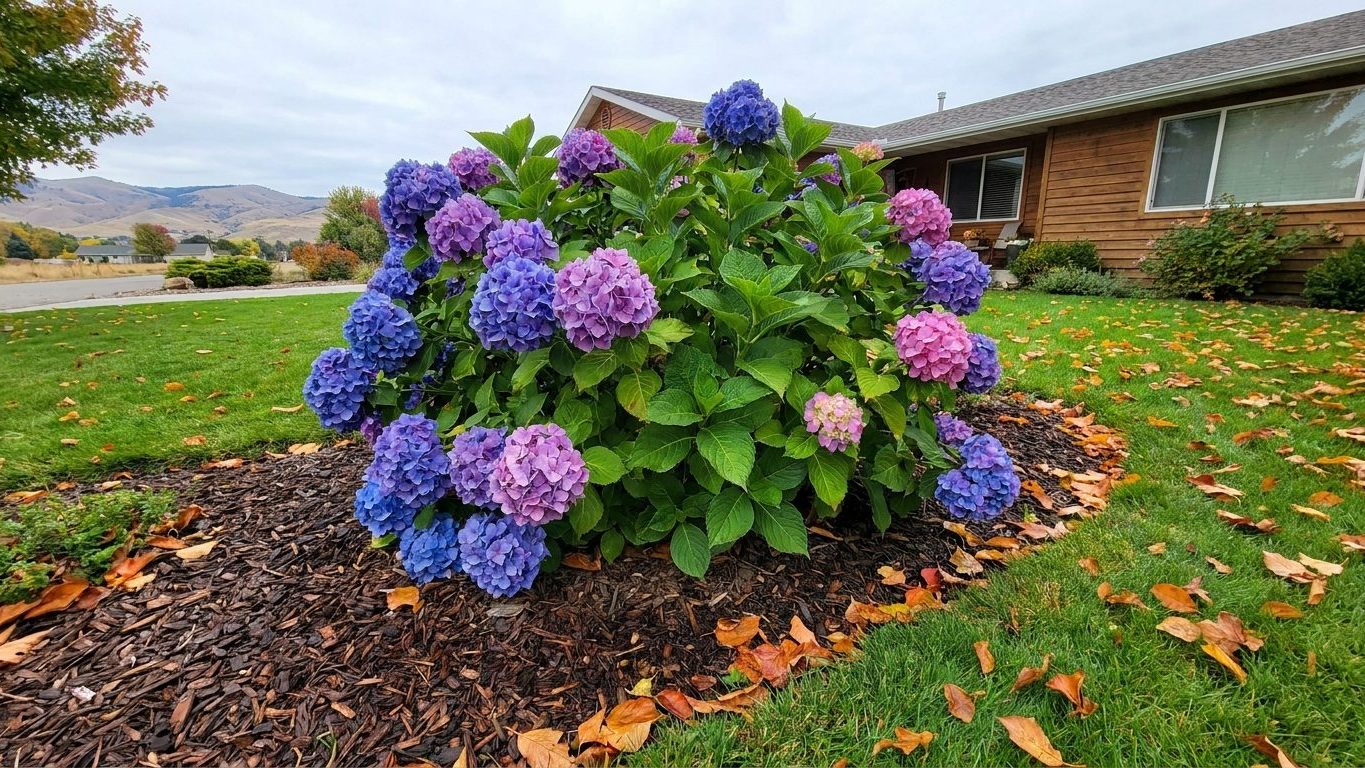
Boise’s frost calendar sets the pace: plant hydrangeas within the state’s April, May, August, or September windows, keeping the earliest tries on the late side until the last spring frost clears. Prune bigleaf types in June or July, right after bloom. Higher ground and northern valleys push every one of these dates later and shorten the season considerably.
When to prune hydrangeas in Idaho: The Short Answer
NOAA NCEI 1991-2020 Climate Normals puts Boise’s last spring frost between April 23 and May 7, and the first fall frost between October 7 and October 21.
- January: dormant hydrangeas need nothing but a wind check and mulch thick enough to outlast the coldest nights. Nothing else happens above ground yet.
- February: still too early to dig anywhere in the state. Use the quiet weeks to plan where a new shrub will go once the ground softens.
- March: the first fertilize window opens for shrubs already in the ground. Frost is still close, so hold planting until the calendar and the soil agree.
- April: the first plant window of the year, though Boise’s frost risk runs into early May. Treat this month as early planting in sheltered spots only.
- May: a plant and fertilize window overlap here, and once the last frost passes, most of the valley clears for the season’s main planting push.
- June: the first prune-bigleaf window opens as spent blooms fade and next year’s buds start forming on the current season’s wood.
- July: both the prune-bigleaf and fertilize windows stay open, useful for shaping shrubs that pushed hard growth in early summer heat.
- August: the plant window reopens, a good stretch for containers that missed the spring rush, as long as watering keeps pace with the heat.
- September: the last plant window of the year closes here, giving roots a few weeks to settle before the ground starts cooling.
- October: the first fall frost arrives, landing anywhere from October 7 to October 21, so mulch should already be down before the ground freezes.
- November: the yard settles into dormancy. Mulch does the real work now while the shrub above ground stays quiet.
- December: a planning month only, since colder counties see nothing resembling gardening weather until well into spring.
That twelve-month rhythm holds for the Boise valley itself. Areas at higher elevation or farther north compress this into a shorter, later season, covered further down.
Idaho — the year and the numbers
- State
- Idaho
- USDA zones
- 3b-7b
- Last spring frost
- April 23 to May 7
- First fall frost
- October 7 to October 21
- Annual rain
- 12 in
- Lawn zone
- transition-season
- Source
- NOAA NCEI 1991-2020 Climate Normals, 32F freeze probabilities · Boise
How to Work Out the Dates for Your Own Yard
NOAA NCEI 1991-2020 Climate Normals puts the last spring frost at Boise’s reference station between April 23 and May 7, and that single window is the starting point for figuring dates anywhere else in the state.
- Find your local frost window: compare your county to Boise’s spread, since higher ground and northern valleys push the safe planting date later than the reference station shows.
- Test soil drainage before you dig: fill a small hole with water and time how fast it drains, since irrigation-district soils and mountain clay behave very differently from valley loam.
- Match containers to the plant windows: use April, May, August, or September, and lean toward whichever end of each window sits furthest from your local frost dates.
- Wait for real growth before pruning bigleaf: inside June or July, cut only stems still bare after nearby shrubs have leafed out, a sign of true winterkill rather than late dormancy.
- Track the first fall frost for mulch timing: Boise’s average falls between October 7 and October 21, and colder counties need mulch down well ahead of their own local date.
None of these steps require guesswork once the local frost pattern is known. The ranges above describe the Boise valley only, and the next section covers how far those numbers shift once you leave the valley floor.
Idaho North to South: How the Dates Shift
USDA Plant Hardiness Zone Map places Idaho anywhere from zone 3b to zone 7b, and that spread is the real reason a hydrangea that thrives near Boise can fail two counties over.
- The Snake River plain and Boise’s valley floor (Ada, Canyon, Twin Falls counties): the lowest, warmest ground in the state, closest to the frost window already described above.
- The northern panhandle and the Lake Coeur d’Alene basin (Kootenai, Bonner counties): lake effect softens the coldest nights, but the growing season still opens later than in the Boise valley.
- Central and eastern mountain valleys (Blaine, Custer, Teton counties): elevation pulls both frost dates further apart, a shorter window that opens later in spring and shuts earlier in fall.
Check the state guide for the zone and frost window that match your own county before setting any date.
Mistakes Idaho Punishes
Planting before the ground actually warms
Ground temperature lags behind the calendar, and setting a shrub into cold, wet valley soil before the frost window closes stresses roots that haven’t started growing. Wait for the plant windows in April, May, August, or September, leaning later above the valley floor.
Pruning bigleaf outside June and July
Bigleaf hydrangeas set next year’s buds on the current season’s wood soon after bloom, so cutting back in spring or late fall removes flowers before they open. Keep pruning inside the June and July window and skip the shears if the plant already looks thin.
Leaving mulch off before the first freeze
Roots planted in late summer haven’t had a full season before NOAA NCEI 1991-2020 Climate Normals’ first fall frost window for Boise, October 7 to October 21, and bare soil around a young shrub freezes harder without cover. Lay mulch down before that window closes.
Idaho Extension Offices and County Contacts
Boise’s frost dates are a starting point, not a countywide guarantee, and University of Idaho Extension keeps county-level advice adjusted for local elevation and soil.
- University of Idaho Extension: county offices with local soil and frost advice for your exact address.
- Which Hydrangea Varieties Hold Up in Idaho: variety-by-variety picks ordered from safest to riskiest for this state.
- What Goes Wrong with Hydrangeas in Idaho: the state’s specific pests and problems, in the order they show up each season.
Common questions
Can I plant hydrangeas in Idaho in the fall?
Yes, September is one of the state’s plant windows. Aim for the earlier half of the month around Boise, since the first fall frost can arrive as soon as October 7.
Do hydrangeas survive Idaho winters without protection?
It depends on where you garden. Idaho spans USDA zone 3b to 7b, so a shrub that overwinters fine near Boise may need mulch or a sheltered spot in colder mountain counties.
When should I stop fertilizing hydrangeas in Idaho?
July is the last fertilize window on the state’s calendar. Feeding after that risks pushing tender new growth into a fall that can turn cold as early as October 7.