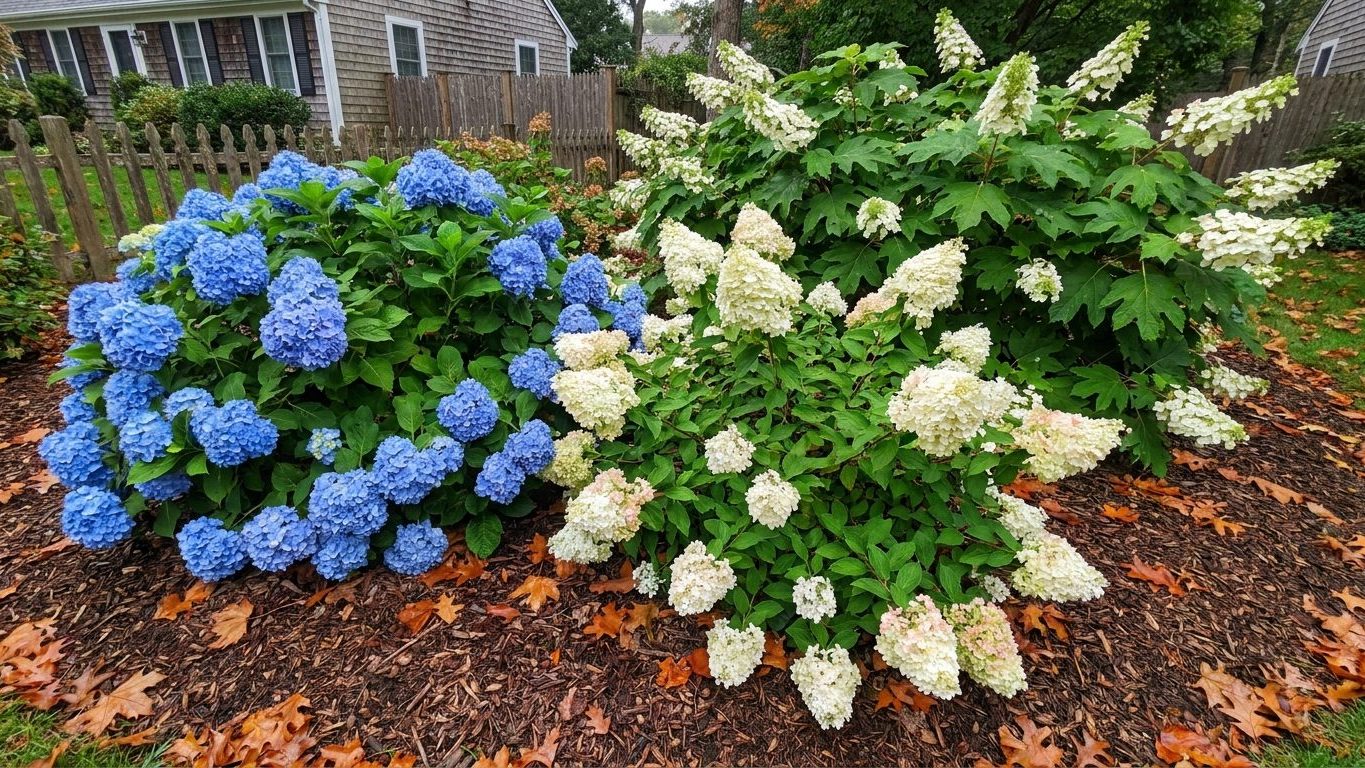
Panicle and oakleaf hydrangeas hold up best across Florida, tolerating full sun and long summers with little fuss. Bigleaf hydrangea, the blue or pink pom-pom type most people picture, works too, but only with afternoon shade, steady water, and a spot outside the state’s harder freeze pockets.
Hydrangeas that grow well in Florida: The Short Answer
The USDA Plant Hardiness Zone Map puts the whole state at 8b-11b, a spread that runs from cool nights near Jacksonville, the reference city for this state’s climate data, down to frost-free Miami. Jacksonville’s last spring frost falls February 16 to March 7, and its first fall frost lands November 26 to December 13.
That swing decides which hydrangea species can handle both ends of the state, since a plant that shrugs off a Panhandle freeze can still scorch in a Miami August, and the reverse holds too.
Panicle hydrangea (Hydrangea paniculata)

This is the safest choice statewide because it blooms on new wood, so a late freeze near Jacksonville cannot wipe out the coming season’s flowers. It also shrugs off long, humid summers that stress other types, and it tolerates full sun even where oakleaf and bigleaf need afternoon shade to survive.
Oakleaf hydrangea (Hydrangea quercifolia)

Native to the Southeast, this species already grows wild in parts of north Florida, so it arrived pre-adapted to the region’s heat and humidity. Its thick, textured leaves handle a few hours of direct sun without scorching, and it delivers fall color that few other hydrangeas offer this far south.
Smooth hydrangea (Hydrangea arborescens)

‘Annabelle’ and its relatives handle Florida’s rebound freezes reasonably well because, like paniculata, they flower on new wood each year. They prefer more shade and moisture than panicle types, though, and gardeners in the southern half of the state often see smaller blooms once midsummer heat peaks.
Reblooming bigleaf hydrangea (‘Endless Summer’ types)

These cultivars flower on both old and new wood, which buys some insurance against a Jacksonville-area freeze that damages buds before they open. They still need afternoon shade and steady moisture from the spring planting window through summer, or their leaves wilt by early afternoon most days.
Bigleaf hydrangea (Hydrangea macrophylla)

The classic blue or pink pom-pom shrub blooms mostly on old wood, so a hard freeze during Jacksonville’s frost window can strip an entire season’s flowers before they open. It also fades fastest in full Florida sun, which makes it a plant for morning light and afternoon shade only.
Mountain hydrangea (Hydrangea serrata)

This is the riskiest pick south of the Panhandle, since it is bred for cooler summers than most of Florida delivers. Prolonged heat tends to stall growth and bloom production even with shade and irrigation, and it rarely rewards the extra care it demands here.
Whichever of these six you choose, match it to the microclimate on your own lot, since afternoon shade or a coastal breeze can move a variety from the risky end of this list to the safe end.
Florida — the year and the numbers
- State
- Florida
- USDA zones
- 8b-11b
- Last spring frost
- February 16 to March 7
- First fall frost
- November 26 to December 13
- Annual rain
- 53 in
- Lawn zone
- warm-season
- Source
- NOAA NCEI 1991-2020 Climate Normals, 32F freeze probabilities · Jacksonville
How to Work Out the Dates for Your Own Yard
Work out your own planting and pruning dates by counting backward from Jacksonville’s frost window instead of a fixed date, since NOAA NCEI 1991-2020 Climate Normals puts the last spring frost there between February 16 and March 7.
The same math works whether you are counting toward spring planting or backward from the first fall frost, since both edges of the growing season chase the same set of dates.
- Start counting from the last frost date: with the window at February 16 to March 7, treat early February plantings as needing frost cloth on standby.
- Match planting to the state’s plant months: this state’s calendar lists February, March, September, and October as the times to plant, which gives new roots weeks to establish before summer heat or a winter cold snap arrives.
- Hold bigleaf pruning to early summer: prune only in June or July, after spring bloom finishes and before next year’s buds start forming on old wood.
- Feed on the three scheduled months: fertilize in March, May, and July only, and skip any fall feeding that would push soft new growth toward the November 26 to December 13 frost window, since that growth freezes first.
- Check whether your pick blooms on new wood: panicle and smooth hydrangeas recover from a late frost near the February window and still flower through summer without stalling.
- Watch bigleaf for the opposite risk: because its buds form on old wood the year before, a freeze inside that same window can erase a season’s flowers even though the shrub survives.
Once you know which window applies to your address, the arithmetic is simple: count back from the frost date, not forward from a nursery tag, and you stop pruning off flowers before they even show up.
A gardener near the coast might push the plant date slightly later, since a marine breeze delays the ground’s last cold snap, but the order of the six steps above still holds.
Florida North to South: How the Dates Shift
Florida’s frost math changes fast between the Panhandle and the Keys, and that shift decides which hydrangea species even make sense in a given yard. Latitude is not the only variable, since coastal breezes and inland heat pockets nudge these dates too, even within a single county.
- The Panhandle and North Florida (Jacksonville, Tallahassee, Gainesville): frost still arrives most winters, so panicle, oakleaf, and smooth hydrangeas that bloom on new wood recover faster than bigleaf types that lose next year’s buds to a hard freeze.
- Central Florida (Orlando, Tampa, the Lakeland ridge): freezes turn rare and shallow here, so summer heat becomes the bigger threat and afternoon shade matters more than any frost cloth.
- South Florida and the coasts (Miami, the Keys, the barrier islands): the growing calendar effectively inverts, with cooler months carrying the main bloom and summer heat and humidity doing the damage cold does further north.
Whichever part of the state you garden in, check your own region’s frost history and hardiness zone before you plant a hydrangea suited to a different part of the state, since a Panhandle recommendation and a Miami one rarely match.
Mistakes Florida Punishes
Three habits imported from cooler states get punished fastest in a Florida yard, and each one has a simple fix.
Planting bigleaf hydrangea in full afternoon sun
Florida’s summer sun scorches bigleaf leaves fast, even with regular watering, because the plant evolved for cooler, shadier native ranges than this state offers. Give it morning sun and afternoon shade instead, ideally on the east or north side of the house, and check the planting window before you dig.
Pruning after July
Cutting back bigleaf hydrangea past the June to July window removes the very buds it already set for next year, since those buds form on old wood months in advance. Prune only inside that window, and save any later trimming for panicle or smooth types instead.
Feeding on a fall schedule
Fertilizing outside the state’s scheduled months pushes tender new growth right into the November 26 to December 13 frost window, and that soft growth is what freezes first. Stick to the March, May, and July feedings, and let the plant harden off before fall arrives.
Florida Extension Offices and County Contacts
The state-level hardiness zone and frost window here are a starting point, not a final answer. Your county extension office adjusts for local soil, salt spray, and microclimate that no statewide number can capture.
- Your state page: the Jacksonville frost dates and the June to July pruning window in one place.
- Which ones hold up here: the six varieties above, ranked from safest to riskiest for Florida yards.
- UF/IFAS Solutions for Your Life: find your county’s extension office for soil tests and salt-tolerant variety advice.
Call before you plant if you’re within a few miles of the coast, since salt spray changes which hydrangea survives faster than frost does.
Common questions
Can hydrangeas survive Florida summers without heavy shade?
Panicle and oakleaf types manage in full sun statewide, but bigleaf hydrangea needs afternoon shade south of the Jacksonville reference zone, or its leaves wilt by midafternoon most summer days.
Do hydrangeas need winter protection in Florida?
North Florida sees an actual frost window, November 26 to December 13 into February 16 to March 7, so a young shrub benefits from mulch and frost cloth during those weeks. Central and south Florida rarely need it.
Which hydrangea blooms the most reliably in a Florida yard?
Panicle hydrangea blooms on new wood every year regardless of what winter does, which makes it the most consistent bloomer from the Panhandle to the coast.