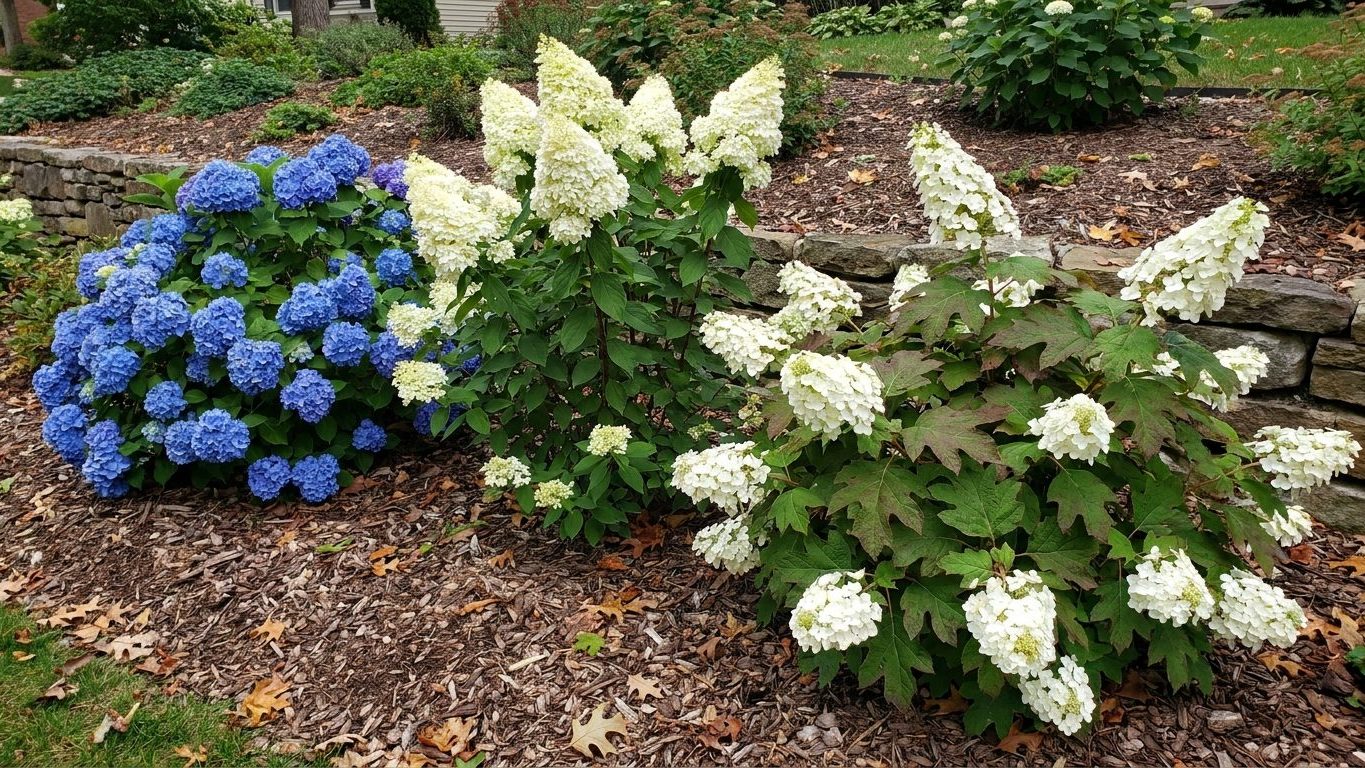
Six hydrangea species handle Georgia’s clay, heat, and humidity well enough to bloom reliably, though not equally. Oakleaf and panicle lead the pack, while the classic mophead bigleaf hydrangea needs a specific pruning calendar to flower here at all. The right pick depends less on looks than on how each species handles Georgia’s frost timing and long summer heat, covered variety by variety below.
Hydrangeas that grow well in Georgia: The Short Answer
Oakleaf and panicle hydrangeas hold up best from the Georgia mountains down to the coastal plain, while bigleaf hydrangea only blooms reliably if its pruning matches the state calendar.
Atlanta’s growing season sits inside Georgia’s 6a to 9b span on the USDA Plant Hardiness Zone Map, and a spring frost window of March 11 to March 29 is the number that decides whether an old-wood bloomer opens its flowers or not.
Oakleaf Hydrangea

This one is native to the woods of Georgia and the wider Southeast, so it already knows the heat, the clay, and the humidity. It tolerates part sun better than any other hydrangea on this list and rarely loses flower buds to a late frost. It’s the safest pick for a first Georgia planting.
Panicle Hydrangea

Panicle types bloom on new wood, so a cold snap after the frost window doesn’t wipe out the season’s flowers the way it can with older-wood bloomers. It handles full sun and Georgia’s July heat better than most hydrangeas on this list. Plant it in the spring planting window and it settles in fast.
Smooth Hydrangea

Another Southeast native, smooth hydrangea (the type behind ‘Annabelle’) dies back hard in winter but rebuilds and flowers the same year, which sidesteps bud damage from a late frost entirely. It wants part shade and steady moisture, both easy to give in a shaded Georgia yard.
Bigleaf Hydrangea

This is the classic mophead or lacecap look, but it blooms on old wood, so buds set the previous summer can get nipped by a late frost. Prune it only in the state’s June or July window, right after bloom, never in fall.
Mountain Hydrangea

Closely related to bigleaf and sometimes sold beside it, mountain hydrangea sets slightly hardier flower buds but still leans on old wood for its show. It does better in the cooler pockets of north Georgia than in the deep heat of the coastal plain.
Climbing Hydrangea

This is the riskiest of the six here, since it prefers cooler summers than Georgia usually delivers and can take a couple of years to establish before it flowers at all. Reserve it for a shaded, north-facing wall with steady moisture.
Georgia — the year and the numbers
- State
- Georgia
- USDA zones
- 6a-9b
- Last spring frost
- March 11 to March 29
- First fall frost
- November 13 to December 1
- Annual rain
- 50 in
- Lawn zone
- transition-season
- Source
- NOAA NCEI 1991-2020 Climate Normals, 32F freeze probabilities · Atlanta
How to Work Out the Dates for Your Own Yard
Matching a hydrangea to your yard is less about a single date and more about counting backward from the frost window that actually applies where you live.
- Check your last frost window first: NOAA NCEI 1991-2020 Climate Normals puts Georgia’s spring freeze risk at March 11 to March 29 near Atlanta, and any old-wood bloomer needs its buds to survive past that stretch.
- Match the species to your sun exposure: oakleaf and panicle hydrangea take full sun through a Georgia summer, while smooth and climbing hydrangea need afternoon shade to avoid scorch by July.
- Plant inside the real planting months: set new hydrangeas out in March, April, September, or October, never in the thick of summer heat.
- Give a first bloom cycle before judging: a bigleaf hydrangea that skips flowers its first spring may just need one more season to build old wood, not a replacement.
- Track how it handles the fall window: first frost arrives November 13 to December 1, and a plant still holding healthy leaves into that stretch is well suited to your particular spot.
Oakleaf hydrangea survives both ends of that window without help, since it evolved in these same woods and sets next year’s buds early.
Climbing hydrangea struggles at both ends, leafing out late in spring and often losing steam well before the fall window closes.
Georgia North to South: How the Dates Shift
Georgia’s frost dates and hardiness numbers hold true at the Atlanta station used for this guide, but the state runs from mountain ridges to tidal marsh, and that distance shifts both ends of the growing season.
- North Georgia and the mountains (the Blue Ridge and Chattahoochee National Forest area): frost arrives here well before it reaches Atlanta, which favors oakleaf and mountain hydrangea over species that need a long hot stretch to set buds.
- The Piedmont and Atlanta metro (the reference area for this guide): the state’s 6a to 9b range and the frost windows named above apply most directly here.
- The coastal plain and the coast (Savannah and the barrier islands): winters run milder and the season stretches longer, giving bigleaf and climbing hydrangea their best shot at holding onto old-wood buds through winter.
Check the Georgia state guide for the frost dates and pruning window that apply closest to where you actually garden.
Mistakes Georgia Punishes
Pruning bigleaf in fall or winter
Bigleaf hydrangea sets its flower buds on old wood well before summer ends, so a fall cleanup or a winter shape-up removes next year’s blooms before they open. The state’s pruning window for bigleaf sits in June and July, right after the flowers fade, never later.
Planting during peak summer heat
Setting a new hydrangea into Georgia clay during the hottest stretch of summer asks the roots to establish while the plant also fights heat stress, and many don’t make it. Plant in March, April, September, or October instead, when the ground is workable and the heat has eased.
Treating full sun the same everywhere
A nursery tag reading full sun assumes a cooler climate than south Georgia delivers, and bigleaf or climbing hydrangea scorch fast under an unbroken coastal plain afternoon. Give them morning sun and afternoon shade, and lean on oakleaf or panicle where shade isn’t an option.
Georgia Extension Offices and County Contacts
The numbers above are a starting point, but a county extension agent knows your soil test and your particular microclimate better than any state map. The University of Georgia Cooperative Extension, at extension.uga.edu, is the place to start.
- Your state page: the frost dates and the pruning window where you live.
- What goes wrong here: the sibling page covering pests and problems specific to Georgia hydrangeas.
Call the county office before the next planting window opens in September or October, and bring a soil sample.
Common Questions
Do hydrangeas bloom the first year in Georgia?
Most new hydrangeas, especially bigleaf and mountain types, spend their first season building roots rather than flowers. Planted in the March or April window, expect a fuller bloom the following spring once old wood has had a season to set buds.
Can hydrangeas survive a Georgia winter without protection?
Oakleaf, panicle, and smooth hydrangea handle the state’s fall frost window of November 13 to December 1 without any covering. Bigleaf and mountain hydrangea benefit from a layer of mulch over the root zone in the colder stretch of north Georgia.
Why didn’t my hydrangea flower this year?
A skipped bloom season usually traces back to a fall or winter pruning cut that removed the old wood carrying next year’s buds, or a late frost inside the March window that damaged buds already forming. Check the pruning calendar before assuming the plant is unhealthy.