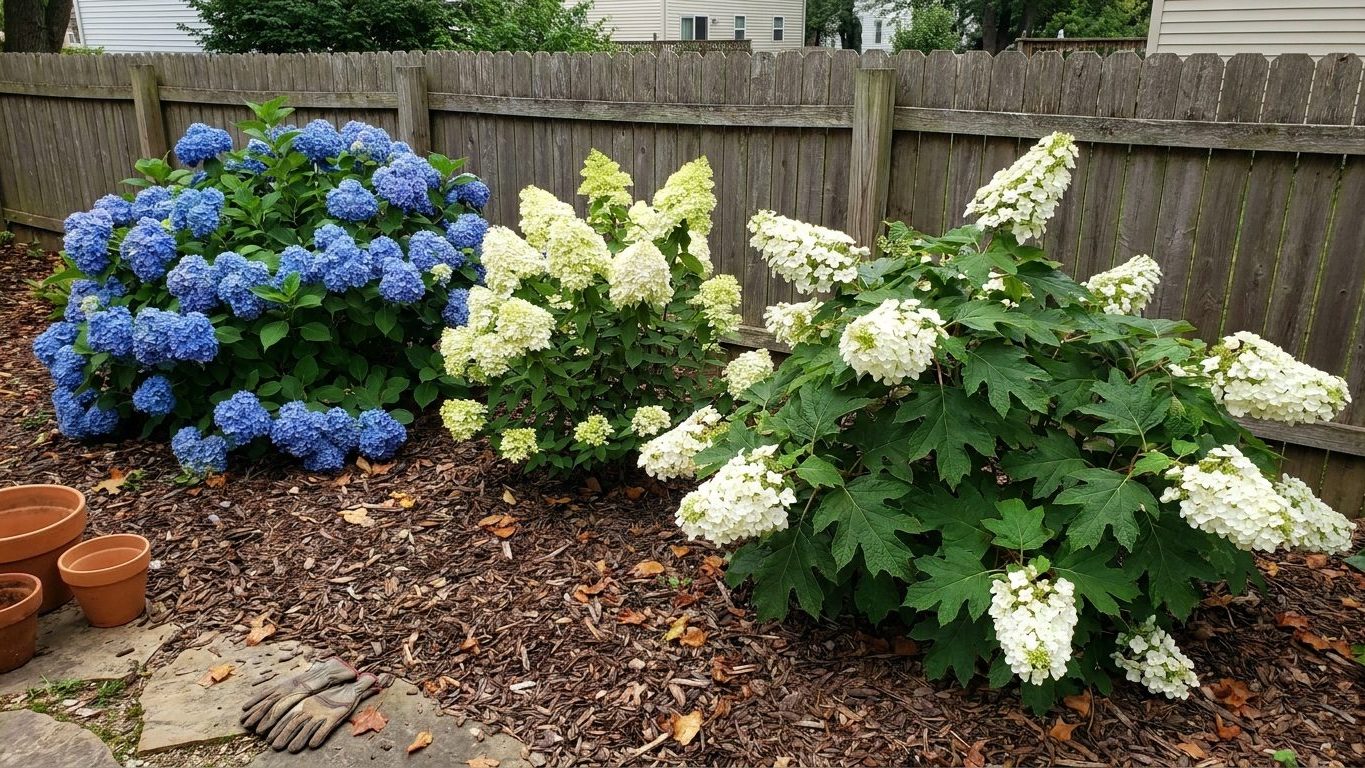
Smooth hydrangea and panicle hydrangea are the two types that actually bloom reliably in Anchorage yards, because both set their flower buds on new wood each spring rather than on stems that have to survive an Alaska winter. Bigleaf and oakleaf types, the ones filling mail-order catalogs, mostly fail here. The difference comes down to where the flower bud forms, not how pretty the tag photo looks.
Hydrangeas that grow well in Alaska: The Short Answer
Anchorage sits at the mild edge of Alaska’s growing conditions, but the USDA Plant Hardiness Zone Map 2023 still places the whole state, including its most populated city, within a 1a to 8a range that rules out most nursery hydrangeas.
Two genera handle that cold reliably in local yards: smooth hydrangea and panicle hydrangea, both of which set their flower buds on stems grown fresh each spring rather than on wood that must survive an Alaska winter intact.
Hydrangea arborescens ‘Annabelle’ (smooth hydrangea)

This is the safest bet in Anchorage yards. It blooms on new wood, so even a hard winter that kills the top growth back to the ground still leaves a shrub full of white mophead flowers by August. Full sun and steady moisture through the short summer matter more here than any winter wrapping.
Hydrangea arborescens ‘Invincibelle Spirit’ (pink smooth hydrangea)

A pink-flowered sibling of Annabelle with the same new-wood habit and the same forgiving nature after a hard freeze. It tolerates the dieback-and-regrow cycle without losing a season of bloom. Site it where afternoon shade softens the long daylight of an Anchorage July and August.
Hydrangea paniculata ‘Limelight’ (panicle hydrangea)

Panicle hydrangea is the other dependable choice for this climate. It flowers on new wood too, handles a cool, short summer better than bigleaf types ever will, and its cone-shaped blooms fade from green to soft pink as nights cool in late September. It wants full sun to bloom heavily.
Hydrangea paniculata ‘Little Lime’ (dwarf panicle hydrangea)

A compact version of Limelight that fits smaller Anchorage lots or large patio containers. Its size makes it easy to wheel a pot into an unheated garage for the coldest months, something some gardeners still do even though the straight species usually survives outdoors without help.
Hydrangea anomala subsp. petiolaris (climbing hydrangea)

This one is riskier here than the others. It can survive against a sheltered, south-facing wall where reflected heat stretches its short growing season, but an open bed rarely gives it enough warmth to set flower buds reliably year after year. Treat it as an experiment, not a foundation planting.
Hydrangea macrophylla (bigleaf or mophead hydrangea)

This is the one to skip. Alaska’s 1a to 8a range runs cold enough that Anchorage, even as one of the state’s milder pockets, falls short of the warmth this old-wood bloomer needs to keep its flower buds alive over winter. Expect a green shrub with no blooms most years.
Alaska — the year and the numbers
- State
- Alaska
- USDA zones
- 1a-8a
- Last spring frost
- May 3 to May 12
- First fall frost
- September 22 to October 1
- Annual rain
- 16 in
- Lawn zone
- cool-season
- Source
- NOAA NCEI 1991-2020 Climate Normals, 32F freeze probabilities · Anchorage
How to Work Out the Dates for Your Own Yard
Your own planting and pruning dates start from Anchorage’s frost window, not from a date printed on a seed packet.
- Mark your last spring frost window: NOAA NCEI 1991-2020 Climate Normals puts it at May 3 to May 12 for the Anchorage station, so treat the earlier date as your safety line if your yard sits in a low spot that holds cold air.
- Count forward to the site’s plant months: the calendar for this state lists May, June, July, and August as safe planting months, which lines up with soil that has finally warmed past that frost window.
- Give new smooth hydrangea growth until June: Annabelle-type plants that froze back to the ground over winter need until early summer to leaf out fully, so don’t judge a shrub dead before late June.
- Fertilize on the site’s two windows: May and July give roots and new stems a boost right when the plant is actively building the wood that will carry this year’s flowers.
- Prune bigleaf types only in June or July: the site’s calendar limits that cut to those two months, after the risk of a late freeze has passed and before next year’s buds start forming.
- Work back from the first fall frost: that window falls between September 22 and October 1, leaving roughly 143 frost-free days total, so stop heavy fertilizing by mid-August to let new growth harden off.
Annabelle survives this cycle every year, dying back hard some winters and still flowering by August. Bigleaf hydrangea doesn’t: its flower buds form on old wood the previous fall, and an Anchorage winter kills them long before summer, which is why the shrub might live but rarely blooms.
Alaska North to South: How the Dates Shift
Alaska’s frost dates and growing conditions shift dramatically depending on where you garden, even though this guide uses Anchorage as its reference point.
- Southeast panhandle (Juneau, Sitka, Ketchikan): coastal moisture and milder winters push the frost dates later into fall and earlier into spring than most of the state, giving smooth and panicle hydrangeas a longer season.
- Southcentral coast (Anchorage, Kenai, Homer): the reference conditions for this guide, with some of the mildest inhabited winters outside the panhandle and a frost-free season long enough for reliable panicle hydrangea bloom.
- Interior (Fairbanks, the Denali area): colder winter extremes and a shorter frost-free season push both hydrangea types toward containers or a sheltered south wall rather than an open bed.
- North Slope and far north (Utqiagvik and Arctic villages): the frost-free season shrinks to almost nothing, and outdoor hydrangeas of any kind aren’t a realistic yard plant there.
Check the state calendar page for the frost window that actually matches your part of Alaska before you commit to a planting date.
Mistakes Alaska Punishes
Buying a mophead for the flower color
Bigleaf hydrangeas fill garden center displays because they ship well in bloom, but their flower buds form on wood grown the previous year, and an Anchorage winter kills that wood before spring arrives. Choose Annabelle or a panicle type instead, since both flower on new wood and shrug off our winters.
Pruning outside the June to July window
Cutting back stems in fall or early spring removes wood that was about to push new growth, delaying bloom by weeks in a season that’s already short. The site’s calendar limits bigleaf pruning to June and July for exactly this reason, after frost risk drops and before next year’s buds begin forming.
Skipping fall mulch over the crown
Top growth is expected to die back most winters here, but an unmulched crown can freeze deep enough to kill the roots too, and a dead crown means no shrub at all next spring. Pile several inches of shredded bark or leaf mulch over the base before the ground freezes solid.
Alaska Extension Offices and County Contacts
USDA NIFA’s Land-Grant University Extension directory names the University of Alaska Fairbanks Cooperative Extension Service as the state’s contact point, and its county and district offices know local frost pockets a statewide range can’t capture.
- Your state calendar page: the exact frost dates and month-by-month pruning and fertilizing windows for Alaska.
- UAF Cooperative Extension Service: county offices that can confirm your local microclimate before you plant.
- What goes wrong here: the pests and problems specific to hydrangeas in Alaska yards.
Call the district office nearest you before you dig, since one conversation can tell you whether your yard runs colder or milder than the citywide average.
Common questions
Can I grow bigleaf hydrangea in Anchorage at all?
Only with heavy protection, and even then bloom is unreliable. Its flower buds form on old wood, and Anchorage winters routinely kill that wood before spring, which is why smooth and panicle types are the safer starting point for most yards.
When is the best month to plant a new hydrangea in Alaska?
The site’s calendar lists May through August as safe planting months here, once soil has warmed past the last spring frost window. Planting earlier in that range gives roots more time to establish before the first fall frost arrives.
Do hydrangeas need winter protection in Alaska?
Smooth and panicle types don’t need wrapping, since they’re expected to die back and regrow from the base each year. A layer of mulch over the crown before the ground freezes matters more than protecting the top growth.