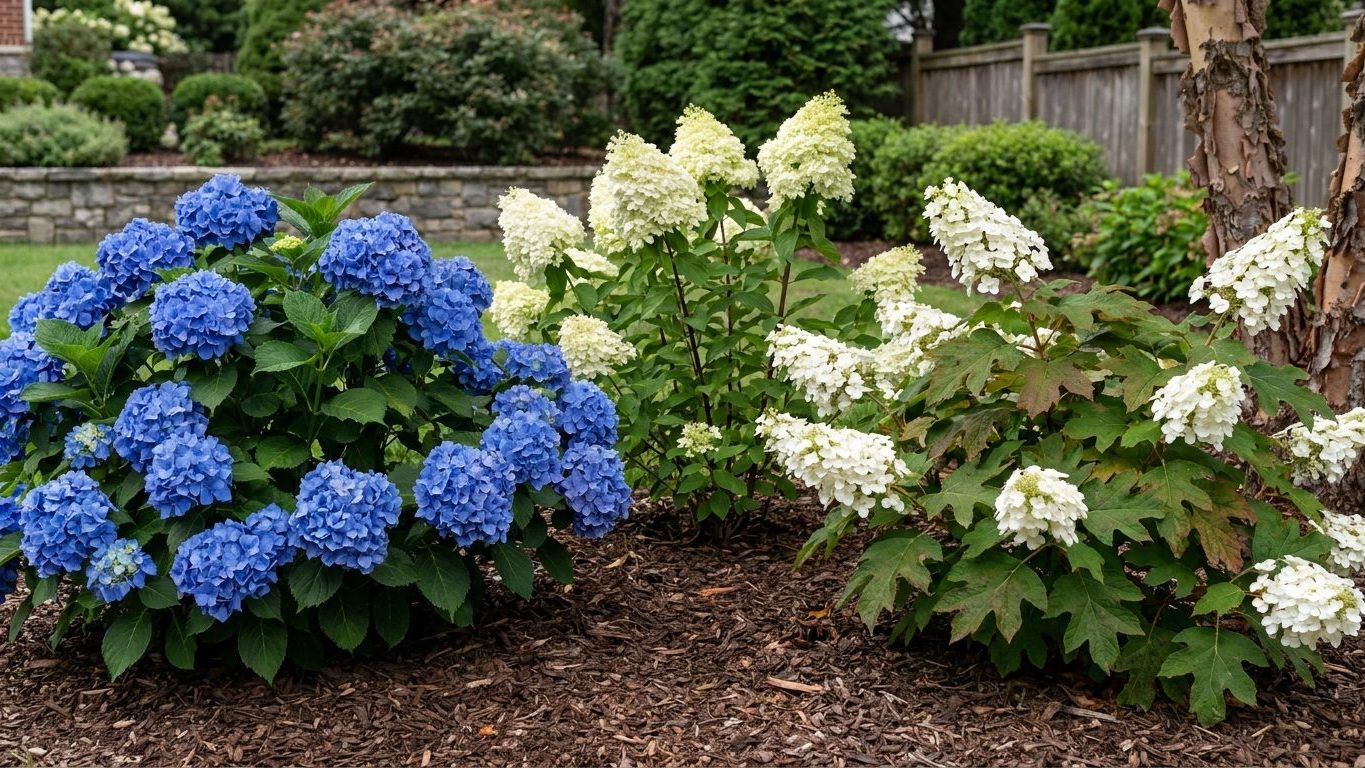
Bigleaf hydrangea is the shrub that made coastal gardens here famous, and around Vancouver it thrives without much fuss. Panicle and smooth hydrangeas back it up on colder ground, while oakleaf pushes the limit of what this coast can ripen most summers. The reference point for all of it sits at Canadian zone 9a, mild enough that old wood usually rides out winter intact.
The Short Answer
Some names on this list barely notice a British Columbia winter, others need a warm wall and a little luck. Here they are ordered from the safest bet to the riskiest.
Bigleaf hydrangea (Hydrangea macrophylla)

This is the shrub that lines older streets from Victoria to North Vancouver, and it’s the safest bet in the province. The Plant Hardiness Site from Natural Resources Canada puts Vancouver at 9a in the Canadian system, mild enough that this species keeps its old wood, and its flower buds, through most winters. The risk is narrow: a late cold snap after an early spring can still nip buds set the previous fall.
Panicle hydrangea (Hydrangea paniculata)

Panicle types bloom on new wood, so winter cold barely touches next year’s flowers. They tolerate more sun and heavier soil than bigleaf, which makes them the forgiving choice for a first-time BC gardener. Cultivars sold locally shrug off winters colder than anything the coast delivers.
Smooth hydrangea (Hydrangea arborescens)

Also a new-wood bloomer, smooth hydrangea sails through a hard frost that would ruin a bigleaf’s buds. It prefers steady moisture and part shade, which coastal BC supplies without irrigation most summers. Interior gardeners lean on it precisely because it doesn’t depend on a mild winter to flower.
Mountain hydrangea (Hydrangea serrata)

A smaller cousin of bigleaf, mountain hydrangea carries slightly hardier flower buds and a more compact habit. It suits the same coastal gardens as macrophylla but forgives a pruning mistake without losing an entire season’s bloom. It’s still an old-wood bloomer, so the same late-frost caution applies.
Climbing hydrangea (Hydrangea anomala subsp. petiolaris)

This one needs a wall or a mature tree and two or three years before it commits to flowering. Once established it’s nearly indestructible on the coast, but the slow start means a lot of gardeners give up before the first bloom. Patience matters more than climate here.
Oakleaf hydrangea (Hydrangea quercifolia)

Oakleaf wants a hotter, longer summer than most of coastal BC delivers, so both its fall color and bloom can fall short. In the Fraser Valley’s warmer pockets it does better than on the immediate coast or in the Interior’s short season. It’s the riskiest name on this list outside a warm microclimate.
British Columbia — the year and the numbers
- State
- British Columbia
- Hardiness zones
- 9a
- Last spring frost
- March 18
- First fall frost
- November 10
- Annual rain
- 47 in
- Lawn zone
- transition-season
- Source
- Environment and Climate Change Canada — Canadian Climate Normals 1981-2010, station VANCOUVER INT'L A · Vancouver
How to Work Out the Dates for Your Own Yard
Picking a variety isn’t a guess if you work through the numbers in order, starting from the average frost dates and moving to what the shrub itself tolerates.
- Start from the average last frost: Environment and Climate Change Canada’s Canadian Climate Normals put it at March 18 for Vancouver International Airport, but that’s a midpoint, not a guarantee, so treat late March and even early April as still in play.
- Check the average first fall frost: November 10 marks the other end of the growing season, which gives new-wood bloomers like panicle and smooth hydrangea a long stretch to set and open flowers.
- Confirm your zone: Vancouver sits at 9a in the Canadian system, mild enough for bigleaf and mountain hydrangea to carry old wood through winter most years.
- Match bloom type to that window: old-wood bloomers depend on the mild winter holding, new-wood bloomers don’t care what winter does at all.
- Test the riskiest name close to the house: a south or west wall adds shelter, which is where oakleaf or a marginal climbing hydrangea earns its keep.
- Give a new planting two winters before judging it: one mild year proves nothing, since frost lands later than that March average about half the time.
Bigleaf passes this test on the coast because the zone and the frost window both run in its favor. Oakleaf fails the same test in most of the Interior, where summer heat is fine but the winter side of the ledger runs short.
British Columbia North to South: How the Dates Shift
Coastal BC and the Interior are different growing worlds, and where you fall between them shifts which hydrangea makes sense before it shifts the calendar at all.
- South Coast and Vancouver Island (Victoria, the Sunshine Coast, the Fraser Valley): the mildest ground in the province, where bigleaf and mountain hydrangea hold old wood through winter with the least fuss.
- Interior valleys (the Okanagan, the Thompson): hotter, drier summers and colder winters favor panicle and smooth hydrangea over anything that depends on a gentle winter to flower.
- Northern BC and higher elevations (the Cariboo, the Peace region): a short season narrows the safe list to the toughest new-wood bloomers, and even those need a sheltered spot.
- Kootenay valleys (Nelson, Creston): warm pockets along the lakes can push bigleaf further than the surrounding mountains would suggest, but frost still settles in the low ground first.
The state page for British Columbia carries the province-wide frost window this list leans on, worth a look before planting anything old-wood dependent outside the coast.
Mistakes British Columbia Punishes
Fall pruning that cuts off next year’s blooms
Bigleaf and mountain hydrangea set flower buds on old wood by late summer, so a tidy fall cutback removes next year’s flowers entirely. Prune spent heads only right after bloom, never in fall or winter.
Clay soil that stays soggy all winter
Coastal BC’s wet season sits heavy in clay and rots roots before spring arrives. Dig the hole wider, not deeper, mix in coarse material, and raise the bed on the wettest lots.
Trusting the average frost date
Since March 18 is a mean and not a guarantee, tender new growth pushed early by a warm February gets caught by a later frost. Hold off removing frost cloth until closer to April.
British Columbia Extension Offices and County Contacts
British Columbia doesn’t run a county extension network the way many US states do, so the province-wide figures above are the starting point, and provincial staff fill in what’s local to your soil and elevation.
- British Columbia’s month-by-month page: the frost dates and pruning window laid out across the year in order.
- What goes wrong here: the pests and problems that actually show up on BC hydrangeas, in the order they appear.
- BC Ministry of Agriculture and Food: provincial staff who can confirm what holds up in your specific district.
Common questions
Do hydrangeas need full sun in British Columbia?
Most don’t want it here. Bigleaf and mountain hydrangea prefer morning sun and afternoon shade, since coastal humidity plus a hot west wall can scorch leaves even under cloud cover most days.
Can I grow hydrangeas in pots on the coast?
Yes, and it’s a common way to try oakleaf or a climbing type before committing garden space. Winter drainage matters most, since a pot that sits full of rainwater rots roots faster than open ground.
Why didn’t my hydrangea bloom this year?
The two usual causes are a fall or winter pruning that removed old wood, or a late frost that nipped buds already swelling after a mild stretch. Check the pruning timing before assuming the plant is unhealthy.