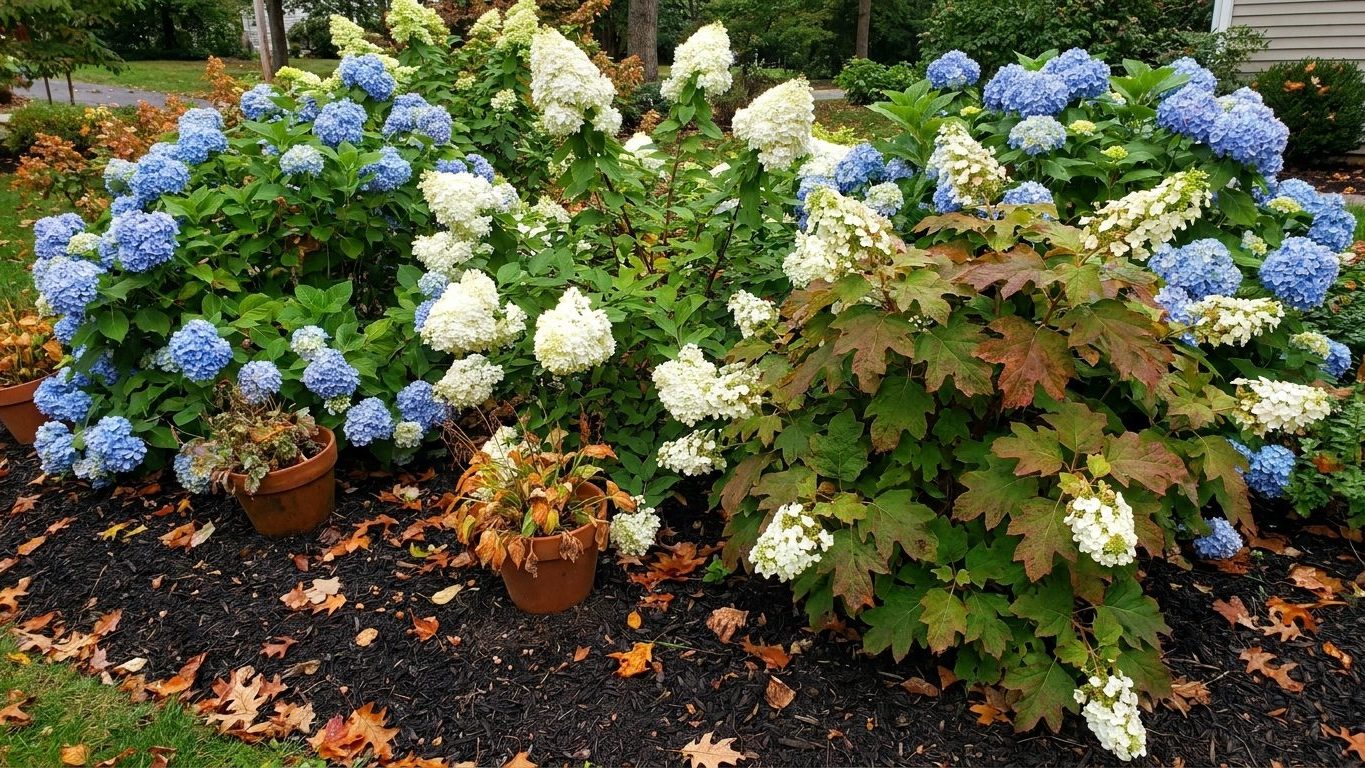
Only hydrangeas that flower on the current season’s growth are a fair bet in Whitehorse, where a winter can kill last year’s buds outright. Smooth and panicle types qualify. Bigleaf and oakleaf mostly do not.
Planting happens in a narrow slot too: June and July on the site’s calendar for Yukon. What follows sorts the names, shows the arithmetic behind the dates, and flags what this climate punishes.
Hydrangeas that grow well in Yukon: The Short Answer
Natural Resources Canada, Canada’s Plant Hardiness Site, puts Whitehorse at Canadian zone 1b, a separate system from USDA zones. There, smooth and panicle hydrangeas, which flower on new wood, do well, while bigleaf and oakleaf are gambles. The six below run from safest to riskiest.
Hydrangea arborescens ‘Annabelle’

The safest choice, because smooth hydrangeas flower on new wood. A hard winter that kills the stems back to the ground costs little, since the flowers form on shoots that grow in June. Cut dead stems back once growth starts and let it rebuild.
Hydrangea paniculata ‘Limelight’
Panicle hydrangeas also bloom on new wood and rank among the hardiest of the woody kinds. Its lime-green cones age to pink. Plant it out of the wind, since wood that survives winter gives a bigger, earlier show.
Hydrangea paniculata ‘Quick Fire’
Bred to flower earlier than most panicles, which counts when the growing season is short. Plant it in the June to July window so roots settle first. Of the panicles, it has the best odds of finishing its bloom before fall frost.
Hydrangea paniculata ‘Bobo’
A dwarf panicle, and small size helps here: low stems sit under snow cover, and a sheltered corner is easy to find. Give it the same June to July planting window as the larger panicles.
Hydrangea macrophylla ‘Endless Summer’
A bigleaf that reblooms, so it can flower on new wood when old buds freeze. Still a gamble at Canadian zone 1b: expect dieback and late flowers, if any. Choose a sheltered spot and hold pruning to the June to July window, once live buds show.
Hydrangea quercifolia ‘Snow Queen’
Oakleaf hydrangea sets buds on old wood and is native to the American Southeast, so Yukon sits far outside its comfort. Try it only in a large pot moved to shelter for winter. Blackened or scorched leaves: see Hydrangea Pests and Diseases in Yukon.
Yukon — the year and the numbers
- State
- Yukon
- Hardiness zones
- 1b
- Last spring frost
- June 5
- First fall frost
- August 25
- Annual rain
- 10 in
- Lawn zone
- cool-season
- Source
- Environment and Climate Change Canada — Canadian Climate Normals 1981-2010, station WHITEHORSE A · Whitehorse
How to Work Out the Dates for Your Own Yard
Environment and Climate Change Canada’s Canadian Climate Normals 1981-2010 give Whitehorse A an average last spring frost of June 5 and an average first fall frost of August 25, and both are midpoints, so each is the center of a window, not a safe date.
- Treat June 5 as the middle of a range: in one year out of two the last frost lands later, so the safe planting start sits past that date, not on it.
- Subtract weeks from August 25: a new shrub needs several weeks of root growth before fall frost, which puts the last planting stretch in July and explains why the planting window ends there.
- Plant in June, with July as the fallback: the calendar for Yukon lists June and July, and June gives roots the most weeks.
- Fertilize in May and July only: May feeds the first flush of growth, and July is the last feeding, so new shoots harden before frost.
- Prune bigleaf in June and July: wait for leaves so you cut back to live buds. The When to Plant and Prune Hydrangeas in Yukon page lays out the sequence.
Take two names through that test. Annabelle passes: if winter takes every stem down to the snow line, June growth still carries the flowers, so nothing is lost but height. Endless Summer’s old-wood buds sit above the snow and freeze, so its flowers wait on late new growth.
Yukon North to South: How the Dates Shift
Environment and Climate Change Canada’s Canadian Climate Normals 1981-2010 read June 5 for the last spring frost at the Whitehorse A station, and every other part of the territory moves from that anchor. Northern or upland districts run weeks behind it.
- Whitehorse and the Southern Lakes (Whitehorse, Carcross, Marsh Lake): the June to July calendar fits best here, and lake edges or south-facing slopes can ease late spring frost a little.
- Kluane and the high country (Haines Junction, Destruction Bay): higher ground and mountain air shorten the season at both ends, so stick to smooth and panicle types and plant late in the window.
- Dawson City and the Klondike (Dawson City, Mayo): winters run harder and the season starts later, so snow cover is what protects the roots.
- Watson Lake and the southeast (Watson Lake, the Liard country): cold air settles in low ground, so a gentle slope beats a hollow.
For the territory-wide picture, the Hydrangeas in Yukon guide is the place to start.
Mistakes Yukon Punishes
Planting on the average frost date
Environment and Climate Change Canada’s normals put the average last spring frost at Whitehorse A on June 5, and in one year out of two it falls later. Plant after that range passes, inside the June to July window. Details: When to Plant and Prune Hydrangeas in Yukon.
Building the border on bigleaf
Bigleaf buds ride through winter on old wood, and a Yukon winter often kills them. Anchor the border with smooth or panicle types instead, and give any bigleaf a sheltered corner. Prune it only in the June to July window, once live wood shows.
Feeding late in the season
Fertilizer after the July feeding pushes soft growth that fall frost, averaging August 25 at Whitehorse A, can blacken. Stop feeding after July. If leaves darken anyway, compare them with Hydrangea Pests and Diseases in Yukon.
Yukon Extension Offices and County Contacts
Yukon has no US-style county offices, so the Whitehorse numbers here are a starting point, not a ruling for your valley. A nursery near you and the federal agriculture department at agriculture.canada.ca/en hold the rest. Start with these pages:
- Hydrangeas in Yukon: the territory-wide picture and the frost ranges where you live.
- When to Plant and Prune Hydrangeas in Yukon: month-by-month gestures for planting, feeding and pruning.
- Hydrangea Pests and Diseases in Yukon: what to check on a shrub that looks off, before you carry a photo of it to a grower.
Common questions
Is Canadian zone 1b the same as a USDA zone?
No. Natural Resources Canada, Canada’s Plant Hardiness Site, rates Whitehorse at Canadian zone 1b, and its system uses seven climate variables where USDA uses one. NRCan notes Canadian zone 4a overlaps nine USDA zones, from 3a to 7a, so never read 1b as a USDA number.
Can bigleaf hydrangeas grow in Yukon?
As a gamble only. Buds on old wood often freeze at zone 1b, so flowers are unreliable. A reblooming bigleaf in a sheltered spot can flower on new growth, but build the border on smooth and panicle types, and prune bigleaf in June or July.
When do I plant and feed?
Plant in June or July, once the spring frost range has passed. Fertilize in May and July. Late plantings need several weeks of root growth before fall frost, so June is the safer half of the planting window.