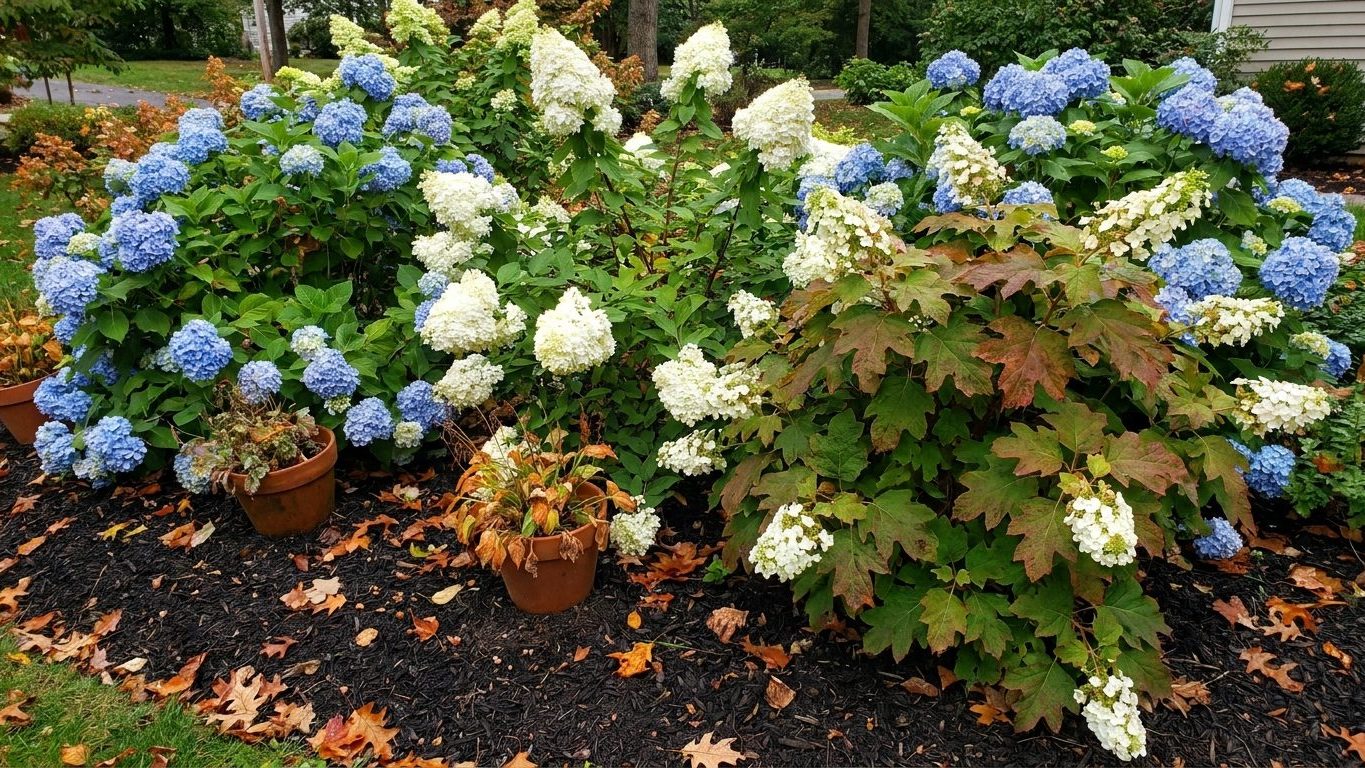
Panicle and smooth hydrangeas are the dependable choices in Vermont, because they flower on the current season’s growth and shrug off a hard winter. Oakleaf and climbing types come next, and bigleaf is the gamble, especially in the Green Mountains and the Northeast Kingdom. Here are six worth planting, ranked from safest to riskiest, and how to fit them to your own yard.
Hydrangeas that grow well in Vermont: The Short Answer
In Burlington, where NOAA NCEI Climate Normals put the last spring freeze at April 30 to May 10, the winner is any hydrangea whose buds form on new wood. They cannot be frozen off in winter because they do not exist yet. Old-wood bloomers carry theirs through January.
Burlington sits on Lake Champlain, the mildest corner of the state. The Green Mountains and the Northeast Kingdom run substantially shorter, so read this ranking, safest first, as a best case.
Limelight

A panicle hydrangea, and the most dependable choice for a Vermont front yard. It flowers on new wood, so a hard winter that kills back tips costs nothing come August. Give it full sun to part shade and cut it back in late winter before growth starts. Cold is rarely the problem, heavy blooms flopping in wind can be.
Annabelle
The classic smooth hydrangea, and it thrives on neglect. Even if winter kills every stem to the ground, it regrows and blooms on that season’s growth. The flaw is soft stems: big white heads flop after rain. Plant it in sun to part shade with some support nearby and cut it low in late winter.
Incrediball
A smooth hydrangea bred for stiffer stems, so the heads stay upright where Annabelle bows. It shares the same new-wood habit, which is why Vermont winters barely slow it down. Choose it for a spot along a walkway or near the house where a sagging bloom would show. Same late-winter cut, same sun to part shade.
Climbing hydrangea
Slow to start, then long-lived. It clings to a stone wall or a mature tree and blooms on old wood, so a sheltered wall beats an exposed one. Expect a few years of leaves before flowers. Near Lake Champlain it does better than on a windy hilltop.
Oakleaf hydrangea
Oakleaf hydrangea, with lobed leaves and bold fall color, is native to the Southeast and blooms on old wood. A cold Vermont winter can kill the buds even when the stems live. Plant it against a south or east wall, mulch the roots, and treat any bloom as a bonus.
Endless Summer
The bigleaf gamble. Bigleaf hydrangeas set buds on old wood, and Vermont cold often kills them, so a shrub can look healthy and never flower. Reblooming types like Endless Summer also bloom on new growth, which helps. Even so, keep them on a sheltered site, and prune only after bloom, not in spring.
Vermont — the year and the numbers
- State
- Vermont
- USDA zones
- 3b-5b
- Last spring frost
- April 30 to May 10
- First fall frost
- October 3 to October 13
- Annual rain
- 38 in
- Lawn zone
- cool-season
- Source
- NOAA NCEI 1991-2020 Climate Normals, 32F freeze probabilities · Burlington
How to Work Out the Dates for Your Own Yard
Work backward from the frost window, then adjust for your own hill or valley.
- Find the first fall freeze: NOAA NCEI Climate Normals put Burlington at October 3 to October 13.
- Subtract about six weeks: that rule of thumb for root settling turns the window into August 22 to September 1, inside the August and September planting months.
- Anchor the spring side: the last freeze runs April 30 to May 10, so May planting follows it, while April suits only dormant, hardy stock.
- Match the wood to the winter: the USDA system runs 3b to 5b across Vermont, and Burlington sits at the mild end. Annabelle blooms on new wood, so it passes the winter even when stems die to the ground. A classic bigleaf sets buds on old wood the summer before, so the same winter can leave leaves and no flowers.
- Fix the maintenance dates: feed in March, May and July, and prune bigleaf in June and July, right after bloom.
Your yard will not match Burlington. A hollow where cold air pools or an exposed ridge can move every date, so log your own first killing frost each fall and shift the range to match.
Vermont North to South: How the Dates Shift
Elevation and water move these dates more than latitude does, and every shift below is measured against Burlington.
- Champlain Valley (Burlington, Shelburne, Charlotte): the lake holds warmth into autumn, so frost arrives later and the whole ranking is in play, including a trial bigleaf.
- Green Mountains (Stowe, Killington, the Mad River Valley): each step up in elevation shortens the season, so frost comes earlier in fall and lingers in spring. Stay with panicle and smooth types.
- Northeast Kingdom (Newport, St. Johnsbury, Island Pond): the coldest winters and the shortest season. Plant early in the window and skip oakleaf and bigleaf.
- Connecticut River Valley (Brattleboro, Windsor, Bellows Falls): low, sheltered ground runs milder than the hills above it, and south-facing slopes add a little more.
- Southern hills (Bennington, Manchester, Wilmington): valley floors are forgiving, ridges are not, and cold air pools in hollows.
For the full state picture on frost and pruning, start with Hydrangeas in Vermont.
Mistakes Vermont Punishes
Pruning bigleaf in early spring
Bigleaf carries next summer’s flower buds on last year’s stems, so a spring haircut removes the show. Prune bigleaf in June and July, right after it blooms, and trim only dead tips before then. The timing table sits in When to Plant and Prune Hydrangeas in Vermont.
Planting too close to freeze
Late roots get no time to anchor before the ground locks up. NOAA NCEI Climate Normals put Burlington’s first fall freeze at October 3 to October 13, so finish fall planting in August or September, well ahead of that window, and water the new shrub through dry weeks.
Blaming pests for dead stems
Black, brittle stems in spring usually mean winter dieback, not disease. Wait for leaf-out, then cut back to living wood. If leaves later show spots, holes or a coating, check Hydrangea Pests and Diseases in Vermont before you spray anything.
Vermont Extension Offices and County Contacts
The USDA NIFA Land-Grant University Extension directory lists the University of Vermont’s Extension service at uvm.edu/extension. The statewide numbers here are a starting point, and county staff know your soil and your frost pockets.
- Your state page: the frost dates and the pruning window where you live.
- The calendar page: month-by-month planting, feeding and pruning.
- The problems page: what to check when leaves spot or stems die. Bring a photo of the stems when you call your county office.
Common questions
Can bigleaf hydrangeas grow in Vermont?
Yes, on sheltered sites, with mixed results. A classic bigleaf can survive and never flower after a hard winter. Odds are better near Lake Champlain than in the Green Mountains or the Northeast Kingdom. Reblooming types hedge the bet. Prune in June or July, after bloom.
What is the best month to plant hydrangeas in Vermont?
The calendar lists April, May, August and September. Fall planting gives roots warm soil and time before Burlington’s first freeze. Spring planting works best once the last freeze has passed, which is why May beats April for most shrubs.
When should I fertilize hydrangeas in Vermont?
The calendar lists March, May and July. Stop after July, since a late push of soft growth can be caught by the first freeze. Follow the label rate, and skip a feeding if the shrub already grows well.