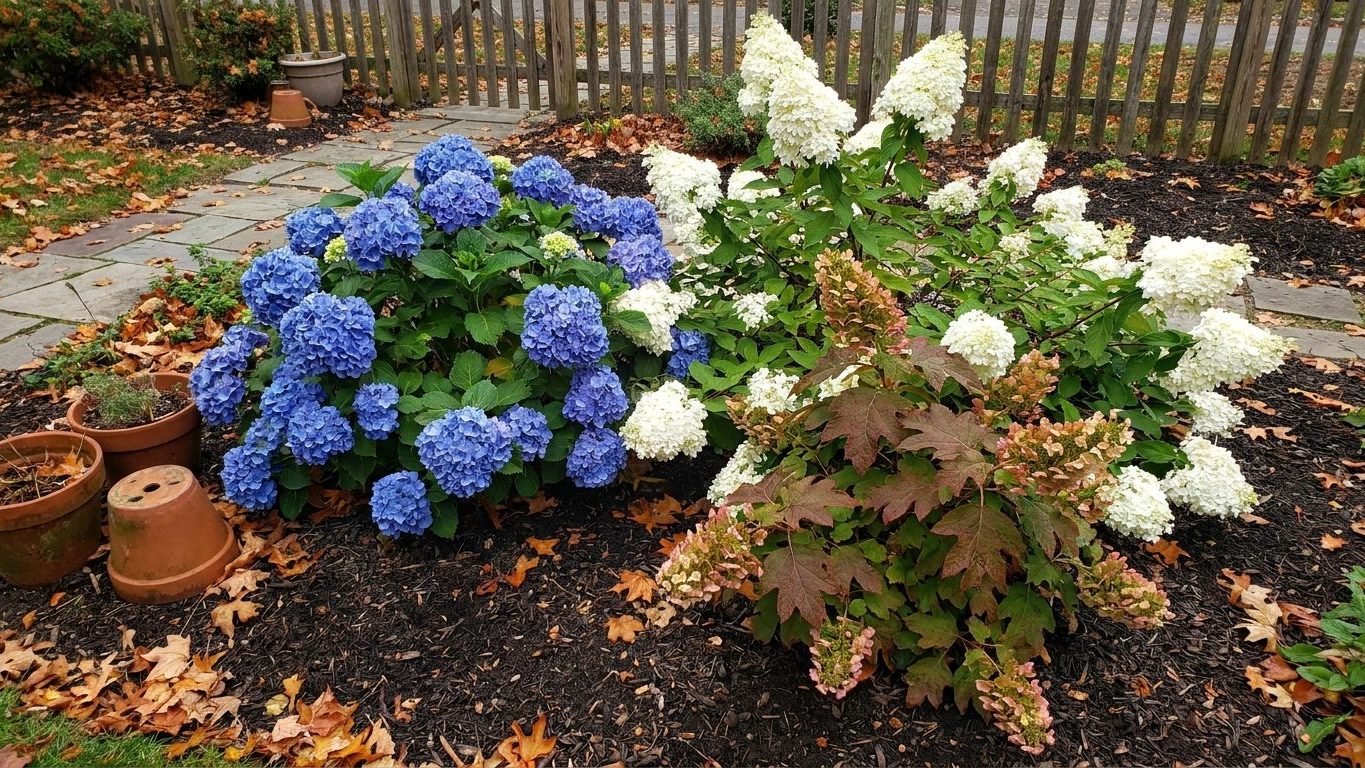
Panicle and smooth hydrangeas thrive across nearly all of New York, from the Adirondacks to New York City, because both set their flower buds fresh each spring instead of trying to carry them through winter. Bigleaf hydrangea is the riskiest pick outside the mildest coastal pockets. New York’s USDA hardiness range runs from zone 3b to 7b, with New York City sitting at the milder end of that spread.
Hydrangeas that grow well in New York: The Short Answer
Panicle Hydrangea (Hydrangea paniculata)

The USDA Plant Hardiness Zone Map puts New York’s range at zone 3b to 7b, and panicle hydrangea covers nearly all of it without any winter protection. It flowers on new wood each summer, so a hard Adirondack winter never touches next year’s blooms. This is the shrub most New York yards should start with.
Smooth Hydrangea (Hydrangea arborescens)

Smooth hydrangea, the parent of varieties like ‘Annabelle’, is native to parts of the eastern United States and shrugs off the coldest corners of the state the same way panicle does. It also blooms on new wood, so winter dieback just means a shorter shrub, not a missed season.
Climbing Hydrangea (Hydrangea petiolaris)

This woody vine handles New York winters from Long Island to the Great Lakes shore, clinging to brick or a sturdy trellis with aerial roots. It is slow to establish, often taking a few seasons before it flowers, which is the real risk here, not the cold.
Mountain Hydrangea (Hydrangea serrata)

Mountain hydrangea is a close, more cold-tolerant relative of bigleaf, and some named forms hold their flower buds through a milder New York winter better than true bigleaf does. It still sets buds on old wood, so an exposed site or a late hard freeze can erase the flower show even while the plant survives.
Oakleaf Hydrangea (Hydrangea quercifolia)

Oakleaf does best toward the milder end of the state’s range, closer to New York City and Long Island, where its fall foliage color and peeling bark are worth the extra siting care. Upstate, winter can kill the buds back hard enough that flowering becomes unreliable.
Bigleaf Hydrangea (Hydrangea macrophylla)

Bigleaf is the variety most New York gardeners picture and the one this climate treats hardest, since it sets its flower buds the previous fall and needs them to survive winter intact. Outside a sheltered coastal pocket, expect a plant that lives but rarely blooms.
New York — the year and the numbers
- State
- New York
- USDA zones
- 3b-7b
- Last spring frost
- March 23 to April 3
- First fall frost
- November 14 to November 27
- Annual rain
- 50 in
- Lawn zone
- cool-season
- Source
- NOAA NCEI U.S. Climate Normals 1991-2020, 32F freeze probabilities · New York City
How to Work Out the Dates for Your Own Yard
Subtracting the calendar from your last frost window is how the state’s plant, fertilize and prune dates turn into a schedule for one particular yard.
- Mark the last spring frost window: NOAA NCEI U.S. Climate Normals 1991-2020 places New York City’s 32°F freeze odds at March 23 to April 3, the point below which new growth still risks damage.
- Wait for the plant window to open: the state’s plant window runs March and April, so anything set out in early March should still have frost cover ready.
- Feed on the March, May and July cycle: fertilizing on that schedule keeps buds forming without pushing soft new growth toward an early fall freeze.
- Prune bigleaf only in June or July: cutting outside that window removes buds that already survived winter, since bigleaf sets next year’s flowers on this year’s wood.
- Use the September and October plant window for anything else: roots get settled before the first fall frost window opens November 14 to November 27.
Panicle hydrangea barely needs this calendar, since its buds form fresh each spring and never have to outlast a New York winter. Bigleaf does not get that grace: its buds form the previous fall, and a freeze inside that November window can erase a full season of blooms before they open.
New York North to South: How the Dates Shift
Elevation, lake effect and distance from the coast move these dates around more than latitude alone does inside one state.
- Long Island and New York City (Nassau, Suffolk, the five boroughs): the mildest ground in the state, with the ocean and the harbor holding off both the first and last frost longer than anywhere else.
- The Hudson Valley and Capital Region (Poughkeepsie, Albany, Saratoga): colder nights than the city, with frost settling into low ground first even when the calendar says otherwise.
- The Great Lakes Shore (Buffalo, Rochester, Niagara): lake effect snow piles up, but the lake itself also delays both frosts along the immediate shoreline.
- The North Country and the Adirondacks (Lake Placid, Plattsburgh, Tug Hill): the coldest, shortest season in the state, and the hardest ground for anything that sets buds on old wood.
Whichever band a yard sits in decides how much of the state’s hardiness range actually applies there, and the New York state guide breaks the frost windows down further.
Mistakes New York Punishes
Pruning bigleaf too late in the season
Bigleaf sets its flower buds on the current season’s wood by late summer, so any cut made after July removes next year’s flowers along with this year’s spent ones. Stick to the June and July prune window and hold off again until after bloom the following year.
Leaving bigleaf exposed to open wind
An exposed bigleaf loses buds to desiccation long before the thermometer hits its limit, especially away from the coast. Plant it against a wall, a fence or a stand of evergreens, or choose panicle or smooth hydrangea instead for an open site.
Skipping mulch before the ground freezes
NOAA NCEI U.S. Climate Normals puts New York City’s first fall frost at November 14 to November 27, and upstate ground can lock up weeks before that. Mulch in October, ahead of either window, so root growth doesn’t stall before winter settles in.
New York Extension Offices and County Contacts
The state’s hardiness range and New York City’s frost dates are a starting point, not a final answer, since county-level advice fills in what the map can’t.
- Your state page: the frost dates and the pruning window for New York, laid out month by month.
- What goes wrong here: the pests and problems this state’s climate causes for hydrangeas, and how to catch each one early.
- Cornell Cooperative Extension: county offices for soil tests, pest identification and planting advice specific to one yard.
Call the county office before planting near the shoreline or well above the valley floor, since neither shows up on a statewide hardiness map.
Common questions
Can bigleaf hydrangea bloom reliably anywhere in New York?
Only in the mildest coastal pockets, mainly Long Island and parts of New York City, where winter rarely damages the buds set the previous fall. Anywhere colder, expect healthy foliage most years and flowers only in the years winter goes easy on the shrub.
What is the easiest hydrangea to start with in New York?
Panicle hydrangea, since it flowers on new wood every summer regardless of how hard the previous winter was. Smooth hydrangea is a close second for the same reason.
When should I fertilize hydrangeas in New York?
The state’s fertilize window falls in March, May and July, spacing feedings across the season without pushing soft growth toward an early fall freeze.